
Baillieul goes on to sack Chrysopolis, near …
Years: 1074 - 1074
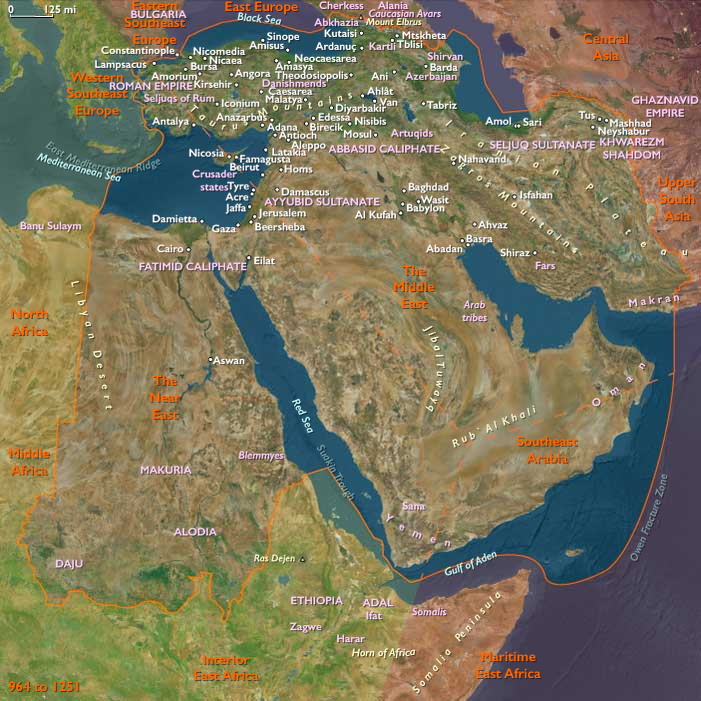
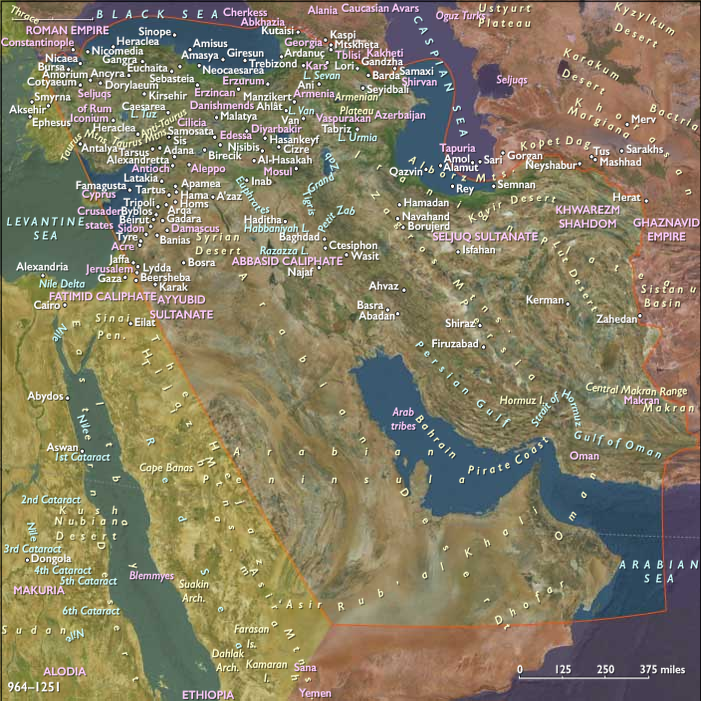
Baillieul goes on to sack Chrysopolis, near Constantinople, and even supports a usurper candidate,proclaiming his prisoner John Doukas Emperor, but by formally ceding lands that the Seljuq Turks had actually conquered, the emperor Michael VII persuades the Seljuq warlord Tutush I to remove Roussel.
However, …
Locations
People
- Alexios I Komnenos
- Goffredo Malaterra
- John Doukas
- Michael VII Doukas
- Roger I of Sicily
- Roussel de Bailleul
- Tutush I
Groups
- Greeks, Medieval (Byzantines)
- Cibyrrhaeots, Theme of the
- Normans
- Turkmen people
- Seljuq Empire (Isfahan)
- Roman Empire, Eastern: Doukid dynasty
Topics
Commodoties
Subjects
Regions
Subregions
Related Events
Filter results
Showing 10 events out of 50707 total
Mahmud al-Kashgari, having studied the Turkic languages of his time, in 1072-74 writes the first comprehensive dictionary of Turkic languages, the Dīwānu l-Luġat al-Turk (Arabic: "Compendium of the languages of the Turks").
It is intended for use by the Caliphs of Baghdad, the new, Arabic allies of the Turks.
Mahmud Kashgari's comprehensive dictionary, later edited by the Turkish historian, Ali Amiri, contains specimens of old Turkic poetry in the typical form of quatrains, representing all the principal genres: epic, pastoral, didactic, lyric, and elegiac.
His book also includes the first known map of the areas inhabited by Turkic-speaking peoples.
This map is housed at the National Library in Istanbul.
He advocates monolingualism and the linguistic purism of the Turkic languages, and holds a belief in the superiority of nomadic people.
Most of his Turkic-speaking contemporaries, however, are bilingual in Tajik, which is the prestige language of Central Asia, as well as its indigenous language before forced Turkification.
One of al-Kashgari's most famous poems relates to the Turko-Islamic conquest of the Buddhist, Tocharian Kingdom of Khotan, which existed for over a thousand years in the region of present Xinjiang, China, until it was conquered by Muslim invaders in 1006: We came down on them like a flood! We went out among their cities! We tore down the idol-temples, We shat on the Buddha's head! (Elverskog, Johan (2010). Buddhism and Islam on the Silk Road. University of Pennsylvania Press. p. 95.)
Gregory VII summons the bishops Jaromir of Prague and John of Olomouc to Rome.
At an Easter synod in 1074, Jaromír confesses his ill-treatment of Bishop John, but refuses to yield Podvin.
Gregory orders that Vratislaus should remove his brother by force if necessary.
Andonikos Doukas is recorded in an act of 1073, with his titles as protoproedros, protovestiarios and megas domestikos, which Michael Attaleiates clarifies as being the post of domestikos ton scholon of the East, which he had been given when sent against Diogenes.
Together with his father, Andronikos commands the imperial army in 1074 against the rebel mercenaries led by Roussel de Bailleul.
Both are captured by the rebels, who release the badly wounded Andronikos to allow him to seek proper medical treatment in Constantinople.
Here he recovers for a few years, but will die of an edema in October 1077.
…the Norman evades imperial would-be captors and finds refuge in Amasya, where the population so love him that he makes himself undisputed governor.
He is given up in 1074 by the people through a ploy of Alexios Komnenus, at this time a general; he will later be emperor.
With the departure of Bailleul, Malik-Shah annexes Ankara, an important location for military transportation and natural resources, to his territory.
Malik-Shah, along with Nizam al-Mulk, had taken part Alp Arslan’s campaign in the Caucasus in 1064.
The same year, Malik-Shah had been married to Turkan Khatun, the daughter of the Kara-Khanid khan, Ibrahim Tamghach-Khan.
Following his father's assassination, Malik is challenged in battle by his uncle, Qawurd-Beg.
In January 1074, their armies meet near Hamadan, Qawurd-Beg's troops consist of the traditional Turkmen elements from Alp Arslan's army, while Malik's consists of ghulams and contingents of Kurdish and Arab troops.
Due to Turkmen defections to Malik's army, Qawurd is defeated and, despite Malik's consideration for mercy, is later poisoned, presumably on the orders of vizier Nizam al-Mulk.
The victorious Turks dominate Cairo, hold the successive vizirs in subjection, treat al-Mustansir with contempt, and use their power to deplete the treasury by enhancing their pay to nearly twenty times its former figure.
Nasir ad-Dawla becomes so overbearing and tyrannical in his conduct that he provokes even his own followers, and is at length assassinated in 1074.
Unfortunately, this leaves the city in a worse condition than ever, for it is now at the mercy of the various Turkish factions, who behave no better than brigands.
Conditions in Egypt continue to deteriorate, and unabated violence rages in the streets and countryside alike.
Peter Kresimir IV, ruler of Croatia, had in 1069 persuaded the emperor in Constantinople to recognize him as supreme ruler of the parts of Dalmatia that the empire had controlled since the Croatian dynastic struggle of 997.
At the time, the empire was at war both with the Seljuq Turks in Asia and the Normans in southern Italy, so Kresimir had taken the opportunity and, avoiding an imperial nomination as proconsul or eparch, had consolidated his holdings as the regnum Dalmatiae et Chroatia.
This is not a formal title, but it designates a unified political-administrative territory, which had been the chief desire of the Croatian kings.
William I’s Year in Normandy and the Submission of Edgar the Ætheling (1073–1074)
After successfully reclaiming Maine in 1073, William I returned briefly to England to release his army from service before quickly returning to Normandy, where he spent the entire year of 1074. This period demonstrated that William felt secure enough in his rule over England to leave the kingdom under the governance of his trusted supporters. Meanwhile, the French king attempted to use Edgar the Ætheling as a figurehead against William, though Edgar was ultimately forced to submit to William’s authority.
Governance of England in William’s Absence (1074)
- William left England in the hands of trusted allies, including:
- Richard fitzGilbert, a Norman lord with significant English holdings.
- William de Warenne, a leading supporter who had fought at Hastings and held lands in Sussex and Yorkshire.
- Lanfranc, Archbishop of Canterbury, William’s most important clerical advisor, responsible for overseeing ecclesiastical governance.
- The fact that William could remain in Normandy for an entire year reflected his confidence in his control over England, as no major insurrections arose in his absence.
Edgar the Ætheling’s Return and French Support
- Edgar the Ætheling, the last surviving male heir of the Anglo-Saxon royal family, had been in exile in Flanders.
- In 1074, he returned to Scotland, where he had previously taken refuge under King Malcolm III.
- Seeing an opportunity to challenge William, King Philip I of France proposed that Edgar be given the castle of Montreuil-sur-Mer, a strategic port on the English Channel.
- If successful, this move would have given Edgar a military base from which to launch future attacks on William’s rule in England.
Edgar’s Submission to William
- However, Edgar was unable to gain enough military support to make use of the opportunity.
- He was ultimately forced to submit to William, returning to William’s court and abandoning his claim to the English throne—at least for now.
- This event marked another failure in Edgar’s repeated attempts to challenge William’s rule, reinforcing Norman dominance over England.
Significance and Consequences
- William’s year in Normandy (1074) demonstrated his firm control over England, allowing him to focus on continental affairs without fear of rebellion.
- The failure of Philip I’s attempt to install Edgar in Montreuil-sur-Mer showed that even with foreign backing, Edgar lacked the military strength to seriously threaten William.
- With Edgar now back under William’s control, one of the last remaining Anglo-Saxon threats to the Norman regime was effectively neutralized.
Although the French king had sought to challenge William’s authority, the submission of Edgar the Ætheling in 1074 reinforced Norman dominance in England and weakened anti-Norman resistance on the continent.
Waltheof is the second son of Siward, Earl of Northumbria.
His mother was Aelfflaed, daughter of Ealdred, Earl of Bernicia, son of Uhtred, Earl of Northumbria.
Waltheof’s brother, Osbearn, who was much older than he, had been killed in battle in 1054, making Waltheof his father’s heir.
Siward himself had died in 1055, and Waltheof being far too young to succeed as Earl of Northumbria, King Edward had appointed Tostig Godwinson to the earldom.
He is said to be devout and charitable and was probably educated for a monastic life.
Instead, around 1065 he had become an earl, governing Northamptonshire and Huntingdonshire.
Following the Battle of Hastings he had submitted to William and had been allowed to keep his pre-Conquest title and possessions, remaining until 1068 at William’s court.
When Sweyn II invaded northern England in 1069, Waltheof and Edgar Ætheling had joined the Danes and had taken part in the attack on York.
He had again made a fresh submission to William after the departure of the invaders in 1070.
Restored to his earldom, and went on to marry William's niece, Judith of Lens, daughter of Lambert II, Count of Lens and Adelaide of Normandy, Countess of Aumale.
He had in 1072 been appointed Earl of Northampton.
William in 1072, had expelled Gospatric from the earldom of Northumbria.
Gospatric is Waltheof’s cousin and had taken part in the attack on York with him, but like Waltheof, had been pardoned by William.
Gospatrichad fled into exile and William had appointed Waltheof as the new earl.
Waltheof has many enemies in the north, among them members of a family who had killed Waltheof’s maternal great-grandfather, Uchtred the Bold, and his grandfather Ealdred.
This is part of a long-running blood feud.
Waltheof in 1074 moves against the family by sending his retainers to ambush them, succeeding in killing the two eldest of four brothers.
Years: 1074 - 1074
Locations
People
- Alexios I Komnenos
- Goffredo Malaterra
- John Doukas
- Michael VII Doukas
- Roger I of Sicily
- Roussel de Bailleul
- Tutush I
Groups
- Greeks, Medieval (Byzantines)
- Cibyrrhaeots, Theme of the
- Normans
- Turkmen people
- Seljuq Empire (Isfahan)
- Roman Empire, Eastern: Doukid dynasty
