
Baibars next occupies 'Atlit and …
Years: 1265 - 1265
Baibars next occupies 'Atlit and …
Locations
People
Groups
- Christians, Eastern (Diophysite, or “Nestorian”) (Church of the East)
- Christians, Roman Catholic
- Jerusalem, Latin Kingdom of
- Tripoli, County of
- Hospitallers of St. John of Jerusalem
- Jaffa and Ascalon, County of
- Cyprus, Kingdom of
- Egypt and Syria, Mamluk Bahri Sultanate of
- Palestine, Mamluk
Topics
Commodoties
Subjects
Regions
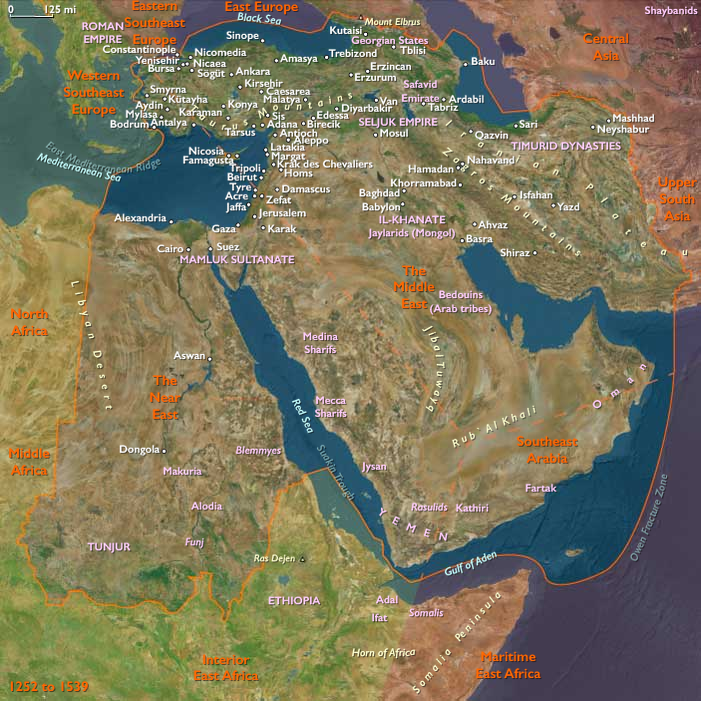
Subregions
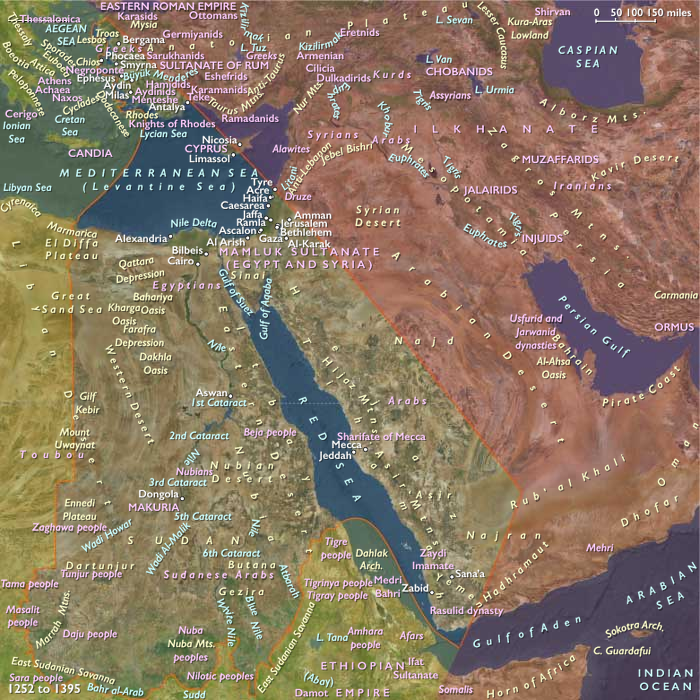
Related Events
Filter results
Showing 10 events out of 45858 total
Stephen V, the junior king of Hungary, had assumed control over the government of Transylvania again shortly after the Peace of Pressburg.
Stephen and his father, Bela IV, had conducted a joint military campaign against Bulgaria in 1261, but their relationship had become increasingly tense, because the senior king has been favoring his younger son, Duke Béla of Slavonia and his daughter, Anna, the mother-in-law of the King of Bohemia.
Finally, with the mediation of Archbishops Fülöp of Esztergom and Smaragd of Kalocsa, Stephen and his father had signed an agreement in the summer of 1262 in Pozsony.
Based on their agreement, Stephen took over the government of the parts of the kingdom East of the Danube.
However, the two kings' reconciliation was only temporary, because their partisans were continuously inciting them against each other.
In 1264, Stephen had seized his mother's and sister's estates in his domains, but his father sent troops against him.
Stephen's wife and son were captured by his father's partisans, and he had to retreat to the castle of Feketehalom.
However, he managed to repel the siege and to commence a counterattack.
He gains a strategic victory over his father's army in the Battle of Isaszeg in March 1265.
After his victory, he concludes a peace with Béla IV.
Based on the provisions of the peace, he receives back the government of the Eastern parts of the kingdom.
Michael signs a treaty with the Venetians on June 18, 1265, but it is not ratified by the Doge.
His treatment of the Laskarid heir of Nicaea, for which the patriarch Arsenius—who in 1259 had crowned John and Michael as co-emperors—had excommunicated him in 1261, had appalled many of Michael’s own subjects and provokes what is known as the Arsenite schism in the Greek Church.
Arsenius, deposed by the Emperor in 1265, is exiled to Proconnesus, where he writes a testament that will serve as an important source of contemporary history.
After Arsenius' deposition, the empire is split into two factions known as the Arsenites (followers of Arsenius) and the Josephists (followers of Joseph, Arsenius' second successor).
The Greeks push the Bulgarian boundary beyond Mount Haemus (the Balkan Mountains) in 1265.
The emperor, returning from battle, is ambushed and captured by the Bulgarians, who release him after forcing him to promise the return of the two seaports taken in 1261.
Abaqa, son of Il-khanate founder Hulagu Khan, was born in February 1234.
His stepmother was Hulagu's Kerait princess bride, Doquz Khatun.
Doquz, a devout Nestorian Christian, is regarded as a spiritual leader of the Mongols, who are generally tolerant of many religions.
Abaqa himself is marginally Buddhist, though he is also very sympathetic to Christianity due to his mother's influence.
A favored son of Hulagu, he had been made governor of Turkestan.
Hulagu has been negotiating with the Eastern Emperor Michael VIII Palaiologos of Constantinople to add a daughter of the Greek imperial family to Hulagu's number of wives.
Michael VIII had selected his illegitimate daughter Maria Palaiologina, who was dispatched in at the beginning of 1265, accompanied by the Eastern Orthodox Patriarch Euthymius.
Since Hulagu died from illness on February 8, 1265, before she arrived, she is instead married to Hulagu's son, Abaqa.
He receives her hand in marriage when he is installed as Ilkhan.
When Hulagu's wife Doquz Khatun dies in 1265 as well, the role of spiritual leader transfers to Maria, who is called "Despina Khatun" by the Mongols.
It is Abaqa who decides on the permanent location for the Ilkhanate capital, Tabriz, which is in the northwestern grasslands that the Mongols prefer.
Abaqa takes power four months after the death of his father, and then spends the next several months redistributing fiefs and governorships.
Some of the coins from Abaqa's era display the Christian cross, and bear in Arabic the Christian inscription "In the name of the Father, the Son and the Holy Spirit, only one God".
Baibars—ruthless and devoid of the generous chivalry that the earlier crusaders had admired in Saladin—conducts almost annual raids against them from 1265 to 1271.
Most of his conquests are followed by massacre of the inhabitants, often including the native Christians, especially when they have been in league with the Mongols.
In 1265, he takes Caesarea Maritima, which, after its destruction by the Mamluks, is abandoned.
…Haifa.
Arsuf had been captured by the Muslims in 1187 but on September 7, 1191, had fallen again to the Crusaders after a battle between Richard I of England and Saladin.
John of Ibelin, Lord of Beirut (1177—1236) had in 1207 become Lord of Arsuf when he married Melisende of Arsuf (born around 1170).
Their son John of Arsuf (who lived from around 1211 to 1258) had inherited the title.
The title then passed to John of Arsuf's eldest son Balian of Arsuf (1239—1277) who had built new walls, a large fortress, and in 1241 a new harbor.
The city has been ruled from 1261 by the Knights Hospitaller.
Baibars captures Arsur in 1265 after forty days of siege.
The Mamluks raze the city walls and the fortress to their foundations, fearing a return of the crusaders.
The destruction is so complete that the site is abandoned.
Michael VIII Palaeologus, after restoring the empire in Constantinople in 1261, had frequently harassed the Depotate of Epirus, and in 1265 forces Michael II's son Nikephoros to marry his niece Anna Palaiologina Kantakouzene.
Michael considers Epirus a vassal state, although Michael II and Nikephoros continue to ally with the Latin Princes of Achaea and the Dukes of Athens.
Alfonso X of Castile and León is the first to use Castilian as a cultural language.
Alfonso himself writes important historical and scientific treatises.
As a writer and intellectual, he gains considerable scientific fame based on his encouragement of astronomy and the Ptolemaic cosmology as known to him through the Arabs.
Alfonso also produces an evocative personal work of Marian poetry, the celebrated “Las cantigas de Santa Maria” (“Songs to Saint Mary”), one of the largest collections of monophonic songs to survive from Medieval times.
Gui Foucois was born in Saint-Gilles-du-Gard in the Languedoc region of France.
After reaching adulthood, he was an unlikely candidate for holy orders: widowed and the father of two young women before taking orders, he had been successively a soldier and a lawyer, and in the latter capacity had acted as secretary to King Louis IX, to whose influence he was chiefly indebted for his elevation to the cardinalate.
Upon the death of his wife, he had followed his father's example and abandoned up secular life for the Church.
His rise has been rapid: in 1257, he had been appointed Bishop of Le Puy; in 1259, he had been appointed Archbishop of Narbonne; and in December 1261, he had become the first cardinal created by Pope Urban IV, for the See of Sabina.
The papal legate in England between 1262 and 1264, he had been named grand penitentiary in 1263.
The Holy See is engaged in a conflict with Manfred of Sicily, the illegitimate son and designated heir of Holy Roman Emperor Frederick II of Hohenstaufen, but whom papal loyalists, the Guelphs, call "the usurper of Naples".
Clement IV, who is in France at the time of his election on February 5, 1265, is compelled to enter Italy in disguise.
He immediately takes steps to ally himself with Charles of Anjou, his erstwhile patron's brother, the impecunious French claimant to the Neapolitan throne.
Charles is willing to recognize the Pope as his feudal overlord (a bone of contention with the Hohenstaufens) and is crowned by cardinals in Rome, where Clement IV, permanently established at Viterbo, dares not venture, since the anti-papal Ghibelline party is so firmly in control there.
Then, fortified with papal money and supplies, Charles marches into Naples.
Years: 1265 - 1265
Locations
People
Groups
- Christians, Eastern (Diophysite, or “Nestorian”) (Church of the East)
- Christians, Roman Catholic
- Jerusalem, Latin Kingdom of
- Tripoli, County of
- Hospitallers of St. John of Jerusalem
- Jaffa and Ascalon, County of
- Cyprus, Kingdom of
- Egypt and Syria, Mamluk Bahri Sultanate of
- Palestine, Mamluk
