
Taj-ud-Din Firuz, ruler of Bahmani, launches an …
Years: 1408 - 1408
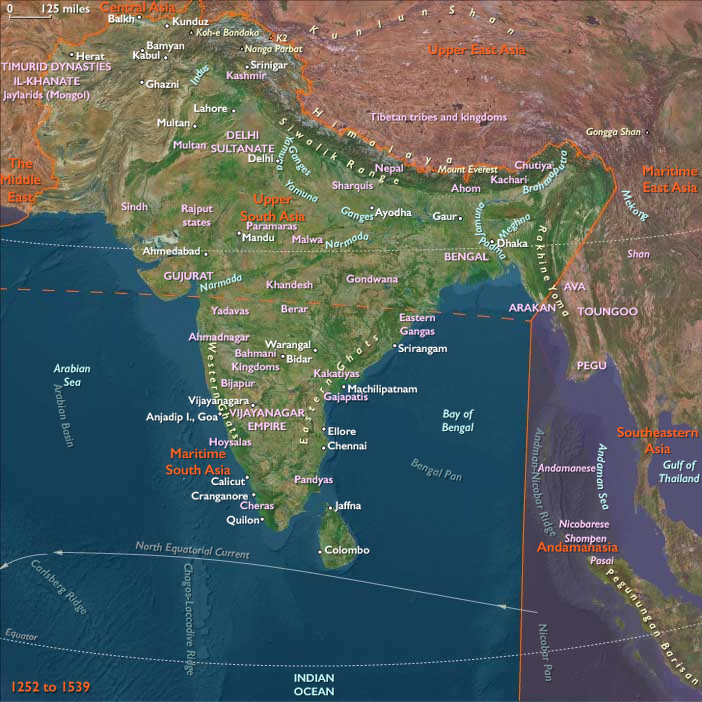
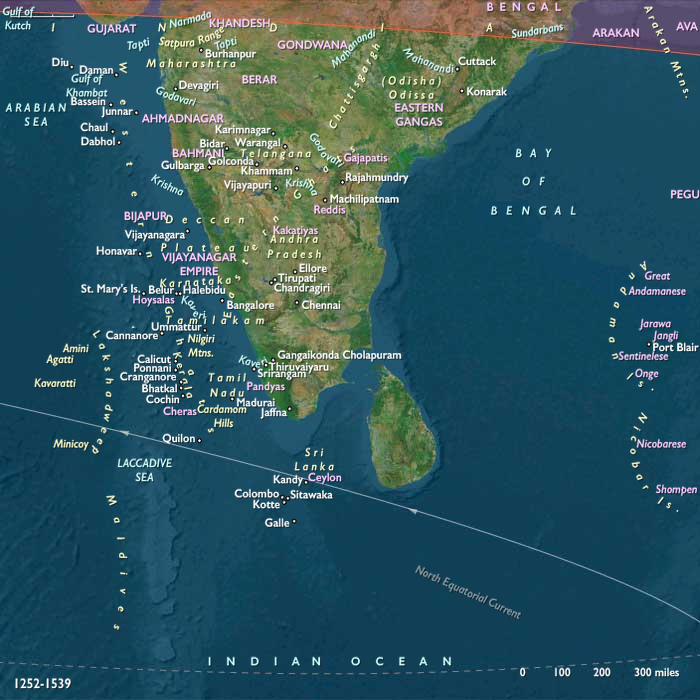
Taj-ud-Din Firuz, ruler of Bahmani, launches an invasion of Vijayanagar, attacking its capital.
Locations
People
Groups
Topics
Commodoties
Subjects
Regions
Subregions
Related Events
Filter results
Showing 10 events out of 42493 total
Eastern Southeast Europe (1408–1419 CE): Ottoman Interregnum and Regional Reassertion
Settlement and Migration Patterns
Ottoman Interregnum and Political Fragmentation
Following the defeat of Ottoman Sultan Bayezid I by Timur (Tamerlane) at the Battle of Ankara (1402), the Ottoman Empire entered a prolonged interregnum (1402–1413), known as the Ottoman Civil War. The resulting fragmentation temporarily weakened Ottoman control in Eastern Southeast Europe, as various Ottoman princes vied for power, causing instability and population displacement throughout Thrace and Macedonia.
Regional Powers Reassert Authority
The Ottoman interregnum enabled regional powers—including Serbia, Wallachia, and Hungarian-influenced Bulgaria—to regain a degree of autonomy. Serbian despot Stefan Lazarević notably expanded and solidified control over central and northern Serbia, revitalizing Belgrade as a prominent cultural and economic center. Wallachia under Mircea the Elder strengthened its autonomy, carefully balancing diplomatic relationships between Hungary and the fractured Ottoman domains.
Economic and Technological Developments
Renewed Economic Activity and Trade Revival
The temporary weakening of Ottoman dominance allowed regional trade and commerce, particularly along the Danube and through the Black Sea ports, to briefly flourish independent of centralized Ottoman control. Cities such as Belgrade, Smederevo, and Vidin experienced revived economic activities, becoming critical commercial hubs for regional trade between Central Europe and the Black Sea basin.
Fortification Efforts and Military Readiness
In response to the uncertain political landscape, regional leaders, particularly the Serbian despotate under Stefan Lazarević and Wallachian authorities, significantly enhanced military defenses. Belgrade, heavily fortified during this period, emerged as a key military stronghold and an influential economic center along the Hungarian frontier.
Cultural and Artistic Developments
Serbian Cultural Renaissance
Under Stefan Lazarević, the Serbian despotate experienced a remarkable cultural renaissance. Belgrade became a vibrant cultural and intellectual center, attracting scholars, artists, and architects from Byzantium and Western Europe. Lavish manuscripts, frescoes, and new church architecture demonstrated a sophisticated blending of Byzantine traditions with local Serbian innovations.
Preservation and Revival of Orthodox Traditions
Throughout the region, particularly in Serbia, Wallachia, and Bulgarian territories, Orthodox Christian traditions enjoyed a period of renewed vigor. Monastic centers and churches underwent renovation and expansion, producing illuminated manuscripts and religious artworks that helped reinforce regional identity amidst the shifting political dynamics.
Social and Religious Developments
Temporary Restoration of Local Autonomies
The Ottoman civil war significantly altered local governance structures, enabling the restoration and enhancement of local autonomies. Serbian, Wallachian, and Bulgarian rulers used this opportunity to assert authority, strengthening regional political cohesion and fostering greater cultural and religious autonomy under Orthodox Christian frameworks.
Increased Influence of Orthodox Christianity
Orthodox Christianity's social and cultural prominence grew significantly during this era, especially under Serbian despot Stefan Lazarević. Ecclesiastical centers flourished as religious institutions played pivotal roles in community life, governance, and education, solidifying the social cohesion of Orthodox populations.
Political Dynamics and Regional Rivalries
Reemergence of Hungarian Influence
Hungary, under King Sigismund of Luxembourg, capitalized on Ottoman fragmentation, strengthening political influence across Wallachia, Moldavia, and the northern Serbian territories. Hungarian diplomatic and military initiatives sought to counterbalance the Ottomans, actively promoting regional alliances aimed at containing future Ottoman resurgence.
Ottoman Reconsolidation under Mehmed I (1413–1421)
By the end of this era, Mehmed I successfully emerged as Ottoman Sultan, ending the Ottoman civil war by reuniting disparate Ottoman territories. His consolidation efforts began the reassertion of Ottoman authority in Eastern Southeast Europe, setting the stage for renewed Ottoman expansion in subsequent decades.
Long-Term Consequences and Historical Significance
The era from 1408 to 1419 CE represented a pivotal interlude during which regional powers temporarily regained autonomy amid Ottoman fragmentation. The period witnessed notable cultural flourishing, especially in Serbia, alongside revived regional trade networks and reinforced military fortifications. Ultimately, this period of relative independence and cultural revival laid important foundations for subsequent historical developments, significantly influencing Eastern Southeast Europe's socio-political and cultural resilience in the face of renewed Ottoman expansion.
East Europe (1408–1419 CE): Muscovite Strengthening and Regional Challenges
Political and Military Developments
Continued Muscovite Expansion
Between 1408 and 1419 CE, Muscovy further consolidated territorial gains, strengthening administrative structures and expanding its influence across East Europe. Moscow's political and military presence became increasingly dominant throughout the region.
Regional Rivalries and Diplomatic Maneuvers
The period saw continued tensions between Moscow and rival principalities such as Tver and Novgorod. Diplomatic negotiations, strategic marriages, and occasional military conflicts characterized regional dynamics.
Integration of Diverse Ethnic Communities
Ethnic groups, including the Mari, Mordvins, Udmurts, Komi, and Vepsians, deepened their integration into Muscovite administrative and social systems, reinforcing internal stability and cultural diversity.
Economic and Technological Developments
Enhanced Regional Trade Networks
Muscovy sustained economic growth through flourishing internal trade and active participation in international commerce. Key cities, particularly Moscow, Novgorod, and Tver, benefited substantially from strengthened economic exchanges.
Advancement in Military Technology and Infrastructure
Muscovite forces continued to advance in military technology, refining siege tactics, cavalry strategies, and fortifications. These developments enhanced the security and territorial integrity of Muscovite territories.
Cultural and Artistic Developments
Continued Cultural Synthesis
The fusion of Rus', Mongol, and diverse ethnic traditions persisted, resulting in distinctive artistic and architectural developments. Religious art and iconography flourished, reflecting rich cultural diversity.
Ongoing Intellectual and Literary Endeavors
Literary and scholarly activities thrived, with chroniclers continuing to document historical, religious, and cultural events. This intellectual continuity was crucial in reinforcing cultural heritage and regional identity.
Settlement Patterns and Urban Development
Urban Growth and Infrastructure Improvement
Cities, particularly Moscow, continued their steady growth, supported by strategic infrastructure investments and effective urban planning. This period saw significant advancements in urban organization and governance.
Fortification and Defense Strengthening
Enhanced urban defense systems and strategic fortifications provided security against potential regional threats, stabilizing urban centers and their surrounding areas.
Social and Religious Developments
Social Complexity and Ethnic Cohesion
Social hierarchies continued to evolve, reflecting the integration of diverse ethnic groups into Muscovite society. The inclusive approach fostered stability and cohesion within the expanding state.
Central Role of Orthodox Christianity
The Orthodox Church's influential position persisted, significantly shaping education, moral guidance, and community cohesion. Its cultural and social contributions remained vital for societal stability.
Long-Term Consequences and Historical Significance
The era from 1408 to 1419 CE was marked by significant Muscovite consolidation, regional rivalries, and ethnic integration. These developments laid crucial foundations for further centralization and shaped East Europe's historical trajectory toward greater unity and cultural richness.
The Polish–Lithuanian–Teutonic War or Great War occurs between 1409 and 1411, pitting the allied Kingdom of Poland and Grand Duchy of Lithuania against the Teutonic Knights.
Inspired by the local Samogitian uprising, the war begins by Teutonic invasion of Poland in August 1409.
As neither side is ready for a full-scale war, Wenceslaus, King of the Romans, brokers a nine-month truce.
After the truce expires in June 1410, the military-religious monks are decisively defeated in the Battle of Grunwald (Tannenberg), one of the largest battles in medieval Europe.
Most of the Teutonic leadership is killed or taken prisoner.
While defeated, the Teutonic Knights withstand the siege on their capital in Marienburg (Malbork) and suffer only minimal territorial losses in the Peace of Thorn, concluded in 1411.
Territorial disputes will last until the Peace of Melno of 1422.
However, the Knights will never recover their former power and the financial burden of war reparations causes internal conflicts and economic decline in their lands.
The war shifts the balance of power in Eastern Europe and marks the rise of the Polish–Lithuanian union as the dominant power in the region.
The Hunger War or Famine War is a brief conflict between the allied Kingdom of Poland, and Grand Duchy of Lithuania, against the Teutonic Knights in summer 1414 in an attempt to resolve territorial disputes.
The war earns its name from destructive scorched earth tactics followed by both sides.
While the conflict ends without any major political results, famine and plague sweep through Prussia.
According to Johann von Posilge, eighty-six knights of the Teutonic Order die from plague following the war.
In comparison, about four hundred knights had perished in the Battle of Grunwald.
Northeast Europe (1408–1419 CE): Decisive Conflicts, Kalmar Unity, and the Lithuanian-Polish Triumph
Introduction
Between 1408 and 1419 CE, Northeast Europe entered a period of intense geopolitical and military confrontation, prominently featuring the culmination of conflicts between the Teutonic Knights and the Polish-Lithuanian Union. Simultaneously, the Kalmar Union solidified internal cohesion under Eric of Pomerania, stabilizing the Scandinavian political landscape. These years saw decisive battles, diplomatic realignments, and significant shifts in regional power dynamics.
The Polish–Lithuanian–Teutonic War (1409–1411)
The Polish–Lithuanian–Teutonic War, also known as the Great War, erupted between 1409 and 1411, sparked by a local Samogitian uprising and subsequent Teutonic invasion of Poland in August 1409. Neither side was fully prepared for prolonged conflict, prompting Wenceslaus, King of the Romans, to broker a nine-month truce. After the truce expired in June 1410, the conflict culminated in the decisive Battle of Grunwald (Tannenberg), one of medieval Europe's largest engagements. Most of the Teutonic leadership, including Grand Master Ulrich von Jungingen, were either killed or captured.
Despite this crushing defeat, the Teutonic Knights successfully resisted a siege on their capital, Marienburg (Malbork), ultimately sustaining only minor territorial concessions in the Peace of Thorn (1411). Nevertheless, the war left the Order significantly weakened, financially burdened by war reparations, and plagued by internal conflict and economic decline. Territorial disputes persisted until the Peace of Melno (1422), but the Order never fully recovered its previous power, allowing the Polish–Lithuanian Union to emerge as the dominant regional power.
The Hunger War of 1414
In 1414, tensions resurfaced with the outbreak of the Hunger War (Famine War), a brief conflict driven by unresolved territorial disputes. Characterized by destructive scorched-earth tactics, the war concluded without major political outcomes but severely impacted the population. Famine and plague ravaged Prussia, further crippling the Teutonic Order. Chronicler Johann von Posilge reported that eighty-six knights of the Teutonic Order perished from plague in the war’s aftermath, a heavy toll compared to the approximately four hundred knights who had fallen at Grunwald.
Stability and Prosperity within the Kalmar Union
The Kalmar Union, under King Eric of Pomerania, strengthened its political and administrative structures during this period. Stability and centralized authority improved governance across the member kingdoms of Denmark, Norway, and Sweden, enhancing economic coordination, maritime trade, and internal peace.
Danish-controlled Estonia, administered from Reval (Tallinn) and centered around the fortress of Castrum Danorum atop Toompea Hill, remained relatively stable and economically prosperous, benefiting from improved maritime trade routes and strengthened fortifications.
Livonian Confederation's Adjustments
The Livonian Confederation, with its administrative center in Riga, adjusted strategically to the changing regional power dynamics. The Confederation strengthened diplomatic ties, improved its defensive capabilities, and maintained robust commercial networks, thereby ensuring internal stability and continued regional significance despite upheavals experienced by its Prussian counterparts.
Swedish Control and Finnish Integration
Within the framework of the broader Kalmar Union, Sweden further integrated Finland politically, culturally, and economically. Southern Finnish territories saw the reinforcement of defensive fortifications, expanded ecclesiastical influence, and strengthened administrative structures, solidifying their distinct alignment with Swedish governance.
Economic and Urban Growth
Economic prosperity advanced substantially during this era. Major cities, notably Reval (Tallinn), Riga, Königsberg, and Visby on the island of Gotland, thrived as commercial and cultural hubs. Maritime commerce flourished, linking Northeast Europe with broader European markets, and enhancing economic stability throughout the region.
Ecclesiastical Influence and Cultural Integration
Ecclesiastical institutions, particularly the influential Teutonic Order and local bishoprics, remained significant agents of social stability, education, and cultural integration. Monastic establishments played critical roles in fostering Latin Christian identity, shaping educational structures, and promoting regional cohesion amidst geopolitical upheavals.
Heightened Regional Geopolitical Complexity
The dramatic reshuffling of power post-Grunwald significantly reshaped regional alliances and diplomatic strategies. Continued tensions between the Lithuanian-Polish Union and the weakened Teutonic Order, coupled with the Kalmar Union's consolidation, resulted in an era of strategic complexity characterized by shifting alliances and careful diplomatic maneuvering.
Legacy of the Era
The period from 1408 to 1419 CE marked a turning point in Northeast European history, underscored by the Lithuanian-Polish victory at Grunwald, the decline of Teutonic authority, and reinforced stability under the Kalmar Union. These critical events and transformations profoundly influenced regional politics, territorial boundaries, and cultural identities, shaping Northeast Europe's historical trajectory for centuries to follow.
East Central Europe (1396–1407 CE): Luxemburg Dynastic Challenges, Teutonic Tensions, and Consolidation of the Polish-Lithuanian Union
Between 1396 and 1407 CE, East Central Europe—covering modern-day Poland, Czechia, Slovakia, Hungary, and the eastern portions of Germany and Austria east of 10°E—continued to experience significant political realignments, intensified military conflicts, and ongoing economic and cultural prosperity. The period was marked by rising tensions between the Teutonic Order and the strengthening Polish-Lithuanian Union, internal instability within Luxemburg-ruled Bohemia and Hungary, continued prominence of regional duchies and principalities, and sustained economic activity driven by flourishing Hanseatic trade.
Political and Military Developments
Rising Polish-Lithuanian Power and Conflict with the Teutonic Order
-
Under King Władysław II Jagiełło (Jogaila, r. 1386–1434), the Polish-Lithuanian Union continued consolidating power, strengthening its military and political structures.
-
Increased hostilities emerged with the Teutonic Order, particularly over disputed territories in Prussia and Samogitia. These tensions set the stage for heightened military conflict, eventually leading to the decisive Battle of Grunwald (1410) in subsequent years.
Luxemburg Dynastic Challenges: Hungary and Bohemia under Sigismund and Wenceslaus IV
-
In Hungary, King Sigismund of Luxemburg (r. 1387–1437) continued fortifying defenses against the Ottomans, though his significant defeat at the Battle of Nicopolis (1396) against the Ottoman Sultan Bayezid I strained Hungarian resources, temporarily undermining his political authority.
-
In Bohemia, King Wenceslaus IV struggled with internal political discord among nobility and urban factions, resulting in diminished royal authority and increasing regional fragmentation and unrest.
Continued Significance of the Electorate of Saxony and Saxe-Lauenburg
-
The Electorate of Saxony, created by Emperor Charles IV’s Golden Bull of 1356, maintained prominence, wielding considerable influence in imperial elections and central European politics, impacting East Central Europe through its alliances and regional strategies.
-
The neighboring Duchy of Saxe-Lauenburg continued consolidating local authority, navigating regional rivalries and cooperating intermittently with the Electorate of Saxony and Hanseatic cities.
Brunswick–Lüneburg’s Regional Economic and Political Influence
-
The Duchy of Brunswick–Lüneburg, especially the Principality of Lüneburg (Celle), retained substantial economic influence due to its dominance in the salt trade. This economic prosperity reinforced its political leverage within regional and imperial contexts.
Mecklenburg-Stargard’s Continued Independence
-
The Duchy of Mecklenburg-Stargard remained independent, maintaining local stability and influencing broader Mecklenburg politics, reinforcing its regional presence in northern East Central Europe.
Economic and Technological Developments
Continued Hanseatic Economic Expansion
-
Hanseatic League cities (Gdańsk, Lübeck, Rostock, Toruń, Elbląg, Stettin) continued robust trade activities, securing regional economic prosperity through extensive trade networks dealing in grain, timber, salt, amber, and textiles.
-
Ongoing urban and economic growth was bolstered by improving infrastructure, including fortifications, warehouses, and marketplaces, significantly enhancing the economic vitality of these cities.
Impact of Brunswick–Lüneburg’s Salt Trade
-
The Principality of Lüneburg continued benefiting from its thriving salt industry, a key commodity in Hanseatic commerce, ensuring its economic prominence and further enriching the Duchy of Brunswick–Lüneburg.
Cultural and Artistic Developments
Luxemburg-Bohemian Cultural Patronage
-
Despite political instability under Wenceslaus IV, Prague maintained cultural prominence through ongoing artistic, architectural, and intellectual pursuits, notably in architecture and manuscript illumination.
Polish-Lithuanian Cultural Integration and Patronage
-
Kraków emerged further as a center of culture, scholarship, and religious activity under Jagiełło’s patronage, facilitating cultural integration between Poland and Lithuania, including significant Christian missionary activities in Lithuanian territories.
Hanseatic Urban Cultural Dynamism
-
Hanseatic cities continued to flourish culturally, driven by urban wealth, merchant patronage, and vibrant civic institutions, resulting in distinctive architectural styles, urban planning, and artistic patronage throughout their territories.
Settlement and Urban Development
Ongoing Urban Expansion and Development
-
Urban growth persisted strongly in key regional cities—Prague, Kraków, Gdańsk, Toruń, Lüneburg, Lübeck, Rostock, and Stettin—fueled by sustained commercial prosperity, increased population density, and improved civic infrastructure.
Fortification and Regional Stability
-
New fortifications, castles, and urban defenses arose throughout East Central Europe, particularly in border regions facing military threats from the Ottomans in Hungary and from the Teutonic Order in Poland-Lithuania.
Social and Religious Developments
Strengthened Aristocratic and Noble Privileges
-
In Poland-Lithuania and Bohemia, aristocratic privileges and influence strengthened significantly, often at the expense of royal centralization, shaping internal governance and political structures profoundly.
Ecclesiastical Institutions and Christianization
-
Continued Christian missionary activities significantly advanced the integration of Lithuania into Latin Christendom, supported by ecclesiastical authorities and monastic orders across East Central Europe.
Social Structures and Labor Conditions
-
Post-plague demographic recovery improved labor conditions, empowering urban artisans, merchants, and rural peasants, reshaping social dynamics and stimulating regional economies.
Long-Term Consequences and Historical Significance
The era 1396–1407 CE represented a crucial period in the evolution of East Central Europe. Dynastic unions and political alliances, particularly the strengthened Polish-Lithuanian relationship, deeply reshaped regional politics, while rising tensions with the Teutonic Order anticipated major military conflicts. Luxemburg authority in Bohemia and Hungary faced growing internal and external pressures, signaling future upheaval. The continued economic strength of Hanseatic trade, driven by urban prosperity and Brunswick–Lüneburg’s salt industry, significantly enriched regional economic and cultural life. Collectively, these developments established lasting political, economic, and cultural foundations, setting the stage for East Central Europe's trajectory into the 15th century and beyond.
East Central Europe (1408–1419 CE): Battle of Grunwald, Hussite Revolution, and Regional Realignments
Between 1408 and 1419 CE, East Central Europe witnessed pivotal events that fundamentally reshaped the political, religious, and cultural landscape. The monumental Battle of Grunwald (Tannenberg) in 1410 decisively altered power relations, elevating the Polish-Lithuanian Union to regional prominence and weakening the Teutonic Order. Concurrently, Bohemia descended into profound religious and social upheaval following the execution of reformer Jan Hus (1415), igniting the Hussite Revolution, and significantly challenging ecclesiastical and imperial authority. Meanwhile, the Hungarian realm continued to face internal political struggles under King Sigismund of Luxemburg, grappling with aristocratic unrest and increasing Ottoman threats.
Political and Military Developments
Battle of Grunwald and the Decline of the Teutonic Order (1410)
-
In July 1410, Polish-Lithuanian forces under King Władysław II Jagiełło and Lithuanian Grand Duke Vytautas decisively defeated the Teutonic Knights at the Battle of Grunwald, weakening Teutonic political and military power significantly.
-
The victory bolstered Polish-Lithuanian territorial influence in Prussia and the Baltic region, profoundly shifting regional geopolitics and solidifying Jagiełło’s reign.
Council of Constance and Execution of Jan Hus (1415)
-
The Council of Constance executed Bohemian religious reformer Jan Hus, sparking widespread outrage and rebellion throughout Bohemia.
-
Hus’s death galvanized popular opposition to imperial and ecclesiastical authority, igniting a sustained period of religious and political upheaval known as the Hussite Wars.
Outbreak of the Hussite Wars (1419)
-
In 1419, Bohemia plunged into open rebellion after the First Defenestration of Prague, marking the start of prolonged conflict between Hussite factions and imperial Catholic forces.
-
Hussite forces soon dominated Bohemian politics, challenging the Luxemburg dynasty and dramatically altering regional stability.
Continued Hungarian Instability under Sigismund
-
King Sigismund of Luxemburg (1387–1437) faced ongoing challenges from powerful Hungarian aristocrats, weakening central royal authority and complicating defense against Ottoman incursions.
Economic and Technological Developments
Impact of Grunwald on Baltic Trade
-
Following Grunwald, Polish-Lithuanian control over vital trade routes and cities such as Gdańsk (Danzig), Toruń (Thorn), and Elbląg significantly enhanced their commercial prosperity.
-
The Teutonic Knights’ defeat weakened their monopolies, shifting regional economic power toward Polish and Lithuanian cities.
Bohemian Economic Disruption
-
The early stages of the Hussite wars disrupted Bohemian economic life, affecting trade, agriculture, and urban commerce, notably in Prague and major towns like Kutná Hora.
Cultural and Artistic Developments
Cultural Renaissance in Poland and Lithuania
-
Following Grunwald, Polish and Lithuanian courtly culture flourished, supported by enhanced royal and aristocratic patronage, expanding artistic and intellectual networks linked to Western and Southern Europe.
Hussite Movement and Cultural Radicalism
-
The Hussite movement radically influenced Bohemian cultural and intellectual life, promoting vernacular literacy, religious reforms, and challenging traditional ecclesiastical practices.
-
Jan Hus’s legacy became central to Bohemian cultural identity, significantly impacting regional intellectual traditions.
Settlement and Urban Development
Urban Growth in Polish-Lithuanian Territories
-
Polish and Lithuanian cities, notably Kraków, Vilnius, and Lublin, thrived economically and expanded significantly in the aftermath of Grunwald, reflecting increased political stability and commercial prosperity.
Fortification and Defensive Infrastructure
-
Following regional conflicts, urban fortifications across Bohemia, Hungary, and northern Polish territories saw significant improvements, responding to heightened military threats and local unrest.
Social and Religious Developments
Hussite Revolution and Social Unrest
-
Hussite religious reform rapidly evolved into broader social revolution, challenging noble privileges, ecclesiastical wealth, and imperial authority, dramatically altering Bohemian society.
Increased Aristocratic Autonomy
-
Throughout Hungary and Bohemia, powerful aristocratic families exploited weakening royal authority, enhancing their own local governance, autonomy, and privileges, deeply influencing regional politics and stability.
Advancement of Christianization in Lithuania
-
Christianization in Lithuania continued steadily, supported by Polish ecclesiastical structures, deeply integrating Lithuanian society into Western Christendom.
Long-Term Consequences and Historical Significance
The era 1408–1419 CE profoundly shaped East Central Europe’s subsequent historical trajectory. The Battle of Grunwald significantly elevated Polish-Lithuanian power while initiating the decline of Teutonic dominance. Simultaneously, the execution of Jan Hus and the ensuing Hussite Wars triggered lasting religious, social, and political upheaval in Bohemia, prefiguring broader European Reformation trends. Continued Hungarian instability under Sigismund foreshadowed future vulnerabilities to Ottoman expansion, setting the stage for profound geopolitical transformations.
Eastern Southeast Europe (1408–1419 CE): Ottoman Interregnum and Regional Reassertion
Settlement and Migration Patterns
Ottoman Interregnum and Political Fragmentation
Following the defeat of Ottoman Sultan Bayezid I by Timur (Tamerlane) at the Battle of Ankara (1402), the Ottoman Empire entered a prolonged interregnum (1402–1413), known as the Ottoman Civil War. The resulting fragmentation temporarily weakened Ottoman control in Eastern Southeast Europe, as various Ottoman princes vied for power, causing instability and population displacement throughout Thrace and Macedonia.
Regional Powers Reassert Authority
The Ottoman interregnum enabled regional powers—including Serbia, Wallachia, and Hungarian-influenced Bulgaria—to regain a degree of autonomy. Serbian despot Stefan Lazarević notably expanded and solidified control over central and northern Serbia, revitalizing Belgrade as a prominent cultural and economic center. Wallachia under Mircea the Elder strengthened its autonomy, carefully balancing diplomatic relationships between Hungary and the fractured Ottoman domains.
Economic and Technological Developments
Renewed Economic Activity and Trade Revival
The temporary weakening of Ottoman dominance allowed regional trade and commerce, particularly along the Danube and through the Black Sea ports, to briefly flourish independent of centralized Ottoman control. Cities such as Belgrade, Smederevo, and Vidin experienced revived economic activities, becoming critical commercial hubs for regional trade between Central Europe and the Black Sea basin.
Fortification Efforts and Military Readiness
In response to the uncertain political landscape, regional leaders, particularly the Serbian despotate under Stefan Lazarević and Wallachian authorities, significantly enhanced military defenses. Belgrade, heavily fortified during this period, emerged as a key military stronghold and an influential economic center along the Hungarian frontier.
Cultural and Artistic Developments
Serbian Cultural Renaissance
Under Stefan Lazarević, the Serbian despotate experienced a remarkable cultural renaissance. Belgrade became a vibrant cultural and intellectual center, attracting scholars, artists, and architects from Byzantium and Western Europe. Lavish manuscripts, frescoes, and new church architecture demonstrated a sophisticated blending of Byzantine traditions with local Serbian innovations.
Preservation and Revival of Orthodox Traditions
Throughout the region, particularly in Serbia, Wallachia, and Bulgarian territories, Orthodox Christian traditions enjoyed a period of renewed vigor. Monastic centers and churches underwent renovation and expansion, producing illuminated manuscripts and religious artworks that helped reinforce regional identity amidst the shifting political dynamics.
Social and Religious Developments
Temporary Restoration of Local Autonomies
The Ottoman civil war significantly altered local governance structures, enabling the restoration and enhancement of local autonomies. Serbian, Wallachian, and Bulgarian rulers used this opportunity to assert authority, strengthening regional political cohesion and fostering greater cultural and religious autonomy under Orthodox Christian frameworks.
Increased Influence of Orthodox Christianity
Orthodox Christianity's social and cultural prominence grew significantly during this era, especially under Serbian despot Stefan Lazarević. Ecclesiastical centers flourished as religious institutions played pivotal roles in community life, governance, and education, solidifying the social cohesion of Orthodox populations.
Political Dynamics and Regional Rivalries
Reemergence of Hungarian Influence
Hungary, under King Sigismund of Luxembourg, capitalized on Ottoman fragmentation, strengthening political influence across Wallachia, Moldavia, and the northern Serbian territories. Hungarian diplomatic and military initiatives sought to counterbalance the Ottomans, actively promoting regional alliances aimed at containing future Ottoman resurgence.
Ottoman Reconsolidation under Mehmed I (1413–1421)
By the end of this era, Mehmed I successfully emerged as Ottoman Sultan, ending the Ottoman civil war by reuniting disparate Ottoman territories. His consolidation efforts began the reassertion of Ottoman authority in Eastern Southeast Europe, setting the stage for renewed Ottoman expansion in subsequent decades.
Long-Term Consequences and Historical Significance
The era from 1408 to 1419 CE represented a pivotal interlude during which regional powers temporarily regained autonomy amid Ottoman fragmentation. The period witnessed notable cultural flourishing, especially in Serbia, alongside revived regional trade networks and reinforced military fortifications. Ultimately, this period of relative independence and cultural revival laid important foundations for subsequent historical developments, significantly influencing Eastern Southeast Europe's socio-political and cultural resilience in the face of renewed Ottoman expansion.
The Ottoman Turks expand their empire from Anatolia to the Balkans in the fourteenth century.
They had crossed the Bosporus in 1352 and crushed the Serbs at Kosovo Polje, in the south of modern-day Kosovo, in 1389.
Tradition holds that Walachia' s Prince Mircea the Old (1386-1418) sent his forces to Kosovo to fight beside the Serbs; soon after the battle Sultan Bayezid marched on Walachia and imprisoned Mircea until he pledged to pay tribute.
After a failed attempt to break the sultan's grip, Mircea had fled to Transylvania and enlisted his forces in a crusade called by Hungary's King Sigismund.
The campaign ends miserably: the Turks rout Sigismund's forces in 1396 at Nicopolis in present-day Bulgaria, and Mircea and his men are lucky to escape across the Danube.
In 1402 Walachia gains a respite from Ottoman pressure as the Mongol leader Tamerlane attacks the Ottomans from the east, kills the sultan, and sparks a civil war.
When peace returns, the Ottomans renew their assault on the Balkans.
In 1417 Mircea capitulates to Sultan Mehmed I and agrees to pay an annual tribute and surrender territory; in return the sultan allows Walachia to remain a principality and to retain the Eastern Orthodox faith.
The Middle East: 1408–1419 CE
Kara Koyunlu Dominance and Regional Realignment
The death of the conqueror Timur (Tamerlane) in 1405 leaves a significant power vacuum across the Middle East and Central Asia. His expansive empire, previously unified by force, quickly begins to fragment, unleashing new conflicts for dominance among his successors and regional powers.
In western Persia and Mesopotamia, the Turkmen tribal confederation known as the Kara Koyunlu (Black Sheep Turks), led by the ambitious and capable Qara Yusuf, emerges as a formidable regional force. In 1408, Qara Yusuf decisively defeats Shah Rukh, Timur’s prominent successor who rules over Persia and Mawerannahr (Transoxiana). This critical victory allows Qara Yusuf to capture Baghdad, solidifying Kara Koyunlu control over western Persia and marking the effective end of Timurid authority in the area.
Taking advantage of this newfound strength and the temporary weakness of the Kingdom of Georgia, already severely depleted by Timur’s previous invasions, the Kara Koyunlu extend their military campaigns into the Caucasus. Georgia, struggling to recover its former power and cohesion, endures further incursions and territorial losses, deepening its period of decline and internal instability.
By the close of this era, the Kara Koyunlu have become the dominant political power in Mesopotamia and western Persia, dramatically reshaping the regional order. Georgia, weakened and fragmented, continues its decline as local powers and rival empires capitalize on its diminished strength, setting the stage for further regional shifts in the decades to come.
The Kingdom of Georgia had soon faced a new threat after the devastating invasions by Timur and subsequent enfeeblement of the kingdom.
Timur's death in 1405 had marked the beginning of the end of his empire, unified only by fear and blood of the subjected peoples.
Turkmens, particularly the Kara Koyunlu clan, are among the first to rebel against Shah Rukh, who rules most of Persia and Mawerannahr (Transoxiana).
Qara Yusuf, ruler of the Kara Koyunlu, defeats Shah Rukh, captures Baghdad, and repels the Timurids from western Persia.
After they establish themselves as the new leading power in the Near East, they take advantage of the temporary weakness of Georgia and launch attacks against the kingdom.
Years: 1408 - 1408
Locations
People
Groups
Topics
Commodoties
Subjects
Regions
Subregions