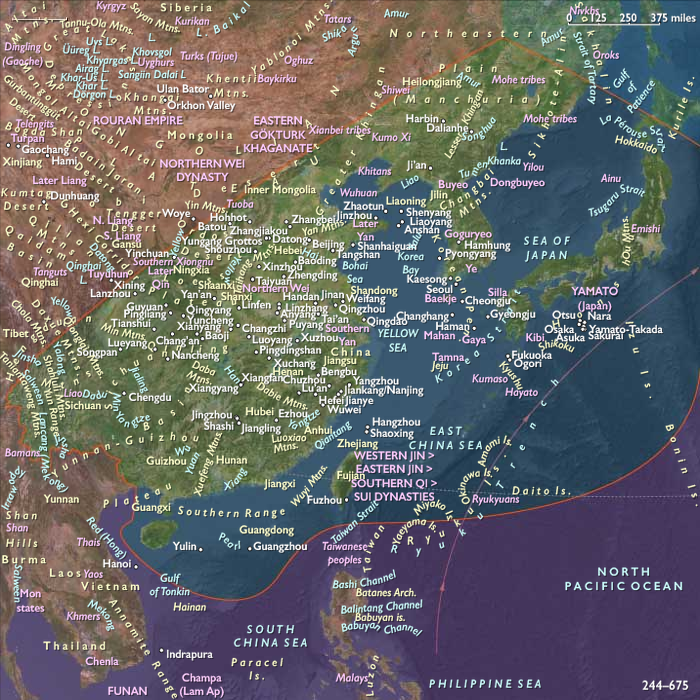
Baekje, Silla, and Daegaya form an alliance …
Years: 481 - 481
Baekje, Silla, and Daegaya form an alliance against Goguryeo.
Locations
Groups
- Korean people
- Silla, Kingdom of
- Baekje (or Paekche), Kingdom of
- Goguryeo (Koguryo), Kingdom of
- Gaya confederacy
Topics
Commodoties
Subjects
Regions
Subregions
Related Events
Filter results
Showing 10 events out of 58482 total
No sooner had Persia recovered from the famine, than war broke out with the Hephthalites, who, having displaced the Scythians and conquered Sogdiana and Khorasan before 425, had later crossed the Syr Darya (Jaxartes) River and invaded Persian lands.
In Persia, they were initially held off by Bahram Gur.
Peroz, provoked by an insult by Khush-Newaz, leads an invasion of the Hephthalite country forcing them to retreat, but when Peroz pursues the Hephthalites to the hills, he suffers a crushing defeat, is captured and forced to surrender his son Kavadh I to Khush-Newaz as a hostage until the ransom is paid.
The Armenians revolt against Persian rule in an uprising that continue until 484.
Led by Vahan Mamikonian, nephew of the late Vartan, they obtain religious and political freedom in return for military aid.
Vahan is installed as governor (marzban).
The Ostrogoth Theodoric Strabo besieges Dyrrhachium in 481.
Theodoric Strabo defeats the Bulgars in Thrace and moves with an army (thirteen thousand men) towards Constantinople.
After logistical problems, he is forced to return to Greece.
In an encampment at Stabulum Diomedis, near Philippi, he falls from an unruly horse onto a spear and dies.
King Huneric organizes a conference between Catholic and Arian bishops at Carthage on February 1, 481.
At the request of Emperor Zeno, he allows the election of a Catholic bishop, named Eugenius.
The Patriarchate of Alexandria had passed on December 9 to Peter III, who has proved to be a supporter of the christological opinion commonly called monophysitism or more accurately miaphysitism, despite the condemnation of this opinion at the Council of Chalcedon.
The Patriarch of Constantinople, Acacius, devises an irenic formula of unity called the Henotikon, which Zeno promulgates without the approval of the Bishop of Rome or of a Synod of bishops.
By this act, Zeno hopes to placate the increasingly miaphysite provinces of Egypt, Palestine and Syria, which are under increasing attacks by the Persian Sassanid dynasty.
The Henotikon endorses the condemnations of Eutyches and Nestorius made at Chalcedon and explicitly approves the twelve anathemas of Cyril of Alexandria, but avoids any definitive statement on whether Christ had one or two natures, attempting to appease both sides of the dispute.
This act fails to satisfy either side.
All sides take offense at the Emperor openly dictating church doctrine, although the Patriarchs of Antioch and Alexandria are pressured into subscribing to the Henotikon.
Those monophysites who had formerly followed Peter of Alexandria now abandon him and cling to their doctrines.
They will henceforth be called Akephaloi (headless ones), since they have lost their leader.

Iberia breaks into revolt around 482 and declares its independence.
Peroz sends Adar-Vishnasp, the Persian Governor of Armenia, to Iberia to quell the rebellion, but no sooner has he left the province than had Armenia risen in rebellion and chosen an Armenian Christian as its king.
After restoring Persian rule in Iberia, Adar-Vishnasp rushes to Armenia to quell the rebellion but is soundly defeated.
Peroz responds by sending two large armies to the region, one under Adar-Narseh into Armenia and the other against Iberia.
Sahag, the Armenian king, is killed and Mihran is wreaking havoc in Persia, but just when success is within grasp, Peroz blunders by recalling Mihran and entrusting the command to one Hazaravough.
Hazaravough does not remain long in Armenia and is recalled in a few months.
This frequent rotation of military commanders ensure the loss of Armenia for the time being.
The Rise of Clovis and the Frankish Conquest of Gaul (481 CE Onward)
In 481 CE, Clovis, son of Childeric I and Basina of Thuringia, ascends as ruler of the Salian Franks based in Tournai, in the former Roman province of Gallia Belgica. Though initially controlling only a small Frankish realm, Clovis embarks on a relentless campaign of expansion, laying the foundations for what will become the Frankish Kingdom and, ultimately, medieval France.
Clovis’ Early Rule and the Consolidation of the Franks
- Clovis inherits a fragmented collection of Frankish tribes, including the Salians and parts of the Ripuarian Franks, who live along the Rhine River.
- Unlike previous Frankish reguli, who ruled as local chieftains, Clovis moves toward centralized kingship, asserting dominance over rival Frankish warlords.
- His capital at Tournai serves as the starting point for the Frankish conquest of Gaul.
The Frankish Conquest of Central and Southern Gaul
Under Clovis, the Franks push southward, expanding into Roman-held and Visigothic-controlled territories:
1. Defeat of Syagrius and the End of Roman Gaul (486 CE)
- Clovis first targets the last Roman stronghold in northern Gaul—the Domain of Soissons, ruled by Syagrius, the last Roman dux.
- At the Battle of Soissons (486 CE), Clovis defeats Syagrius, marking the final collapse of Roman rule in Gaul.
- With Syagrius eliminated, Clovis absorbs the former Roman territories in northern Gaul, strengthening his control.
2. Expansion Against the Alemanni (496 CE)
- Clovis then turns eastward to face the Alemanni, who threaten Frankish lands.
- At the Battle of Tolbiac (496 CE), Clovis achieves a decisive victory, securing eastern Gaul and gaining control over parts of the Rhine Valley.
- This battle is also a turning point for Clovis’ religious identity—according to tradition, he converts to Christianity (Catholic Nicene, not Arian) after his victory, an event that will transform the Franks into champions of Catholicism in the West.
3. Conquest of the Burgundians and Visigoths
- By the early sixth century, Clovis moves against the Burgundians, gradually bringing them under Frankish influence.
- In 507 CE, he wages war against the Visigothic Kingdom of Toulouse, defeating King Alaric II at the Battle of Vouillé.
- With this victory, Clovis annexes Aquitaine, securing central and southern Gaul for the Franks.
The Emergence of the Frankish Kingdom
By the time of Clovis’ death in 511 CE, the Franks have transformed from a loose tribal confederation into the most powerful kingdom in Western Europe:
- Clovis unites northern, central, and much of southern Gaul, creating a new Frankish political and military order.
- His conversion to Catholic Christianity, rather than Arianism (which was practiced by most Germanic rulers), wins him the support of the Roman Catholic Church and the Gallo-Roman aristocracy.
- The Frankish Kingdom emerges as the dominant successor to the Western Roman Empire, replacing Visigothic and Burgundian power in Gaul.
This marks the beginning of the Merovingian dynasty, which will shape the early medieval history of Francia and Western Europe.
Illus and Verina attempt to overthrow emperor Zeno and place another general named Leontius on the throne.
Pope Simplicius dies in 483; Felix III, a widower with two children, succeeds him.
Years: 481 - 481
Locations
Groups
- Korean people
- Silla, Kingdom of
- Baekje (or Paekche), Kingdom of
- Goguryeo (Koguryo), Kingdom of
- Gaya confederacy