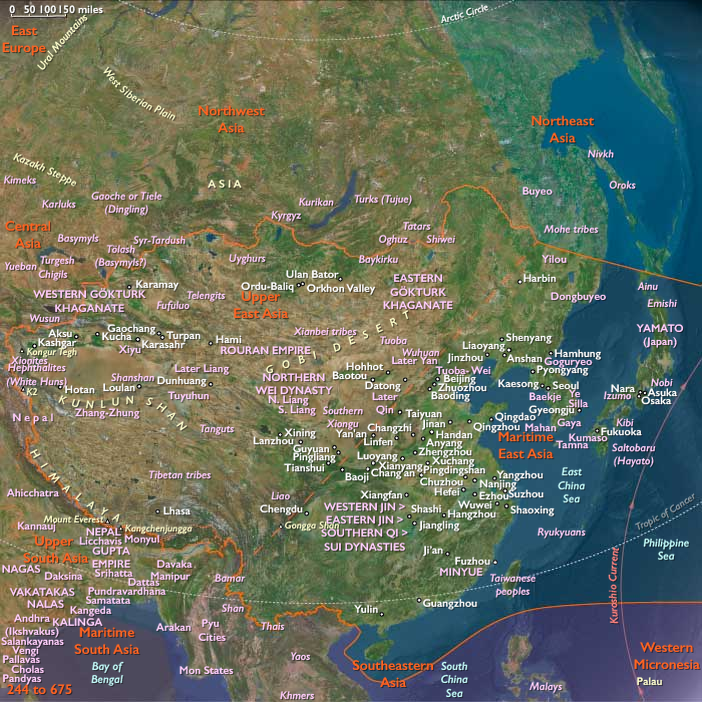
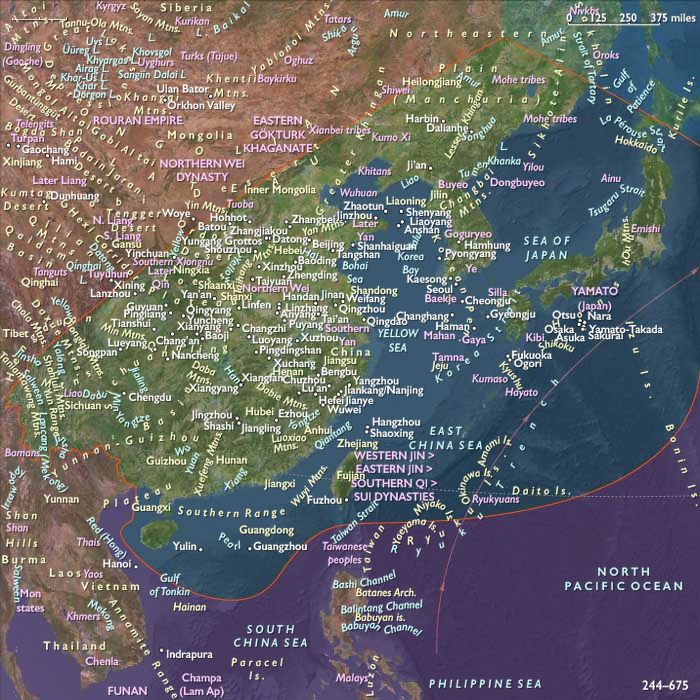
Baekje and the Gaya Confederacy wage war …
Years: 554 - 554
August
Baekje and the Gaya Confederacy wage war upon Silla, one of the Three Kingdoms of Korea, but are defeated.
Locations
Groups
Topics
Commodoties
Subjects
Regions
Subregions
Related Events
Filter results
Showing 10 events out of 57582 total
Cynric (who is either the son or grandson of Saxon prince Cerdic of Wessex) succeeds to the Wessex kingship in 554.
Cerdic is today regarded as the ancestor of all subsequent Kings of Wessex.
Cynric is said to have captured the fort at Old Sarum in this year after repulsing an attack by the Britons across the Fosse Way, a Roman road that links Exeter (Isca Dumnoniorum) in southwest England to Lincoln (Lindum Colonia) in Lincolnshire, via Ilchester (Lindinis), Bath (Aquae Sulis), Cirencester (Corinium) and Leicester (Ratae Corieltauvorum).
Buccelin marches north in the spring of 554, by which time the Frankish army, infected by dysentery, has been reduced to about thirty thousand men.
The imperial army, with eighteen thousand men (including a contingent of Goths under Aligern), marches south to meet them at Casilinum on the banks of the River Volturno.
Narses sends a cavalry force under Chanaranges to destroy the supply wagons of the Franks.
Outmaneuvering Buccelin, he chooses a disposition similar to that at Taginae.
After a frontal assault on the Imperial center, the Franks and the Alamanni are annihilated.
Butelinus and most of his men perish, while Roman casualties are small.
Agathias gives the impossibly low number of eighty dead Romans, while claiming that only five barbarians survived.
Whatever the true numbers, it is a magnificent victory for Narses, and signals the final triumph of the Empire in Italy.
Meanwhile, in the north, Lothair and his army are struck by an epidemic.
The Western Wei official Yuwen Renshu (probably Yuwen Tai's relative but the relationship is unclear), while on a diplomatic mission to Liang (now with Xiao Yi as its undisputed emperor—as Emperor Yuan) in spring 554, is slighted by Emperor Yuan, who treats Northern Qi's ambassador with far greater respect.
Emperor Yuan then further aggravated the situation by sending an impolite letter to Yuwen Tai demanding that the borders be redrawn in accordance with old borders.
Yuwen made the comment, "Xiao Yi is the type of person that, as said in proverbs, 'One who has been abandoned by heaven cannot be revived by anyone else.'"
Yuwen Tai therefore began to prepare attacking Emperor Yuan at his headquarters of Jiangling (in modern Jingzhou, Hubei), as Emperor Yuan had made Jiangling his capital and declined to move back to the old capital Jiankang.
The Western Wei general Ma Bofu, formerly a Liang general, secretly reveals the attack plans to Emperor Yuan, but Emperor Yuan does not believe Ma and takes minimal precautions.
In winter 554, under Yuwen Tai's orders, Western Wei forces, commanded by Yu Jin, who is assisted by Yuwen Tai's nephew Yuwen Hu and Yang Zhong, launches a major attack on Liang.
Emperor Yuan initially does not take reports of the Western Wei attack seriously, and while he summons his major generals Wang Sengbian and Wang Lin from afar, he himself takes little defensive or evasive actions.
Yu quickly descends on Jiangling and puts it under siege.
Soon, Emperor Yuan surrenders, and Western Wei forces give him to Xiao Cha to be executed.
Western Wei creates Xiao Cha the Emperor of Liang (as Emperor Xuan) and gives him the Jiangling area in exchange for his old domain of Xiangyang area, over which Western Wei takes control directly.
(However, the rest of Liang does not recognize Emperor Xuan, and soon recognizes a rival candidate for the throne supported by Northern Qi, Emperor Yuan's cousin Xiao Yuanming.)
Most of the hundred thousand residents of Jiangling are seized as slaves and distributed to generals and officials., although eventually most of them are released by Yuwen after he is persuaded to do so by one of the captives, the Liang official Yu Jicai.

Gong Di succeeds his brother Fei Di as emperor of Western Wei.
He is deposed by general Yuwen Tai, who will later put him to death.
Al-Mundhir III ibn al-Nu'man, king of the Lakhmids, is killed in battle with the Ghassanids in 554.
His eldest son, 'Amr III ibn al-Mundhir, succeeds him.
He is also often called 'Amr ibn Hind after his mother, Hind bint al-Harith b. Amr b. Hujr Akil al-Murar al-Kindi.
He had been appointed a governor of Anah by his father, who also sent him to the Yemeni borders where, in 552, he had clashed with the forces of Abraha with little success.
The Goths, deprived of their leader and riven by internal feuds, capitulate to Narses’s forces in Rome and elsewhere, enabling Justinian to regain control of the Italian peninsula and its island dependencies by 554 and administer peninsular Italy, from its capital of Ravenna, as a division of the empire.
Narses garrisons in Italy an army of sixteen thousand men.
The recovery of the Italian Peninsula has cost the empire about three hundred thousand pounds of gold.
Justinian hopes to restore the social and economic well being of Italy by a series of measures, the Pragmatic Sanction of 554, but the country is so ravaged by war that any return to normal life will prove impossible during Justinian's lifetime.
The emperor Justinian rewards Liberius for his long and distinguished service in the Pragmatic Sanction, granting him extensive estates in Italy.
Jing, age twelve, succeeds his father Yuan and is declared emperor by general Chen Baxian.
The Göktürks behead three thousand Rouran in 555.
Some scholars claim that the Rouran then fled west across the steppes and became the Avars, though many other scholars contest this claim.
The remainder of the Rouran flee into China, are absorbed into the border guards, and disappear forever as an entity.
The last Rouran khagan flees to the court of Western Wei, but at the demand of the Gökturks, Western Wei executes him and the nobles that had accompanied him.
The Gökturk expansion also pushes against the Avars, who are driven toward the East Roman Empire and the Sassanid Empire and eventually toward the Danube.
Other tribes of Central Asia, such as the eastern Bulgars, are also displaced.
The Bavarians had emerged in a region north of the Alps originally inhabited by the Celts, which had been part of the Roman provinces of Raetia and Noricum.
The Bavarians speak Old High German but, unlike other Germanic groups, probably did not migrate from elsewhere.
Rather, they seem to have coalesced out of other groups left behind by Roman withdrawal late in the fifth century.
These peoples may have included the Celtic Boii, some remaining Romans, Marcomanni, Allemanni, Quadi, Thuringians, Goths, Scirians, Rugians, Heruli.
The name "Bavarian" ("Baiuvarii") means "Men of Baia" which may indicate Bohemia, the homeland of the Celtic Boii and later of the Marcomanni.
They first appear in written sources around 520.
By the sixth century, there is evidence of the foundation of a Bavarian stem duchy whose leadership is related to the ruling Frankish (and possibly Alemannic/Swabian) houses.
The dukes of Bavaria choose the site of a first century CE Roman camp (later called Regensburg) as their seat; it will remain the capital of Bavaria from about 530 to the first half of the thirteenth century.
From about 554, the house of Agilolfing rules the Duchy of Bavaria, subordinate to the Franks.
Three early dukes are named in Frankish sources: Garibald I may have been appointed to the office by the Merovingian kings and married the Lombard princess Walderada when the church forbade her to King Chlothar I in 555.
Justinian in the mid 550s pays the westward-migrating Avars, a tribe of northeast Asian origin—and reputedly an amalgamation of Huns and Mongols—to subjugate those Huns and Slavs who continue to raid the Balkan provinces.
Procopius of Caesarea probably retires to Constantinople in 548 after Belisarius’ disgrace.
In the “Wars,” he narrates Justinian's achievements to 553.
In “The Buildings” completed in 555, Procopius writes a further paean to Justinian for his public works.
In the posthumously published and highly scurrilous “Secret History,” Procopius claims to reveal information about the emperor's personality and policy that he could not present in the earlier books because he feared the emperor’s wrath.
He alleges that the emperor’s late wife, Theodora, was formerly and actress and a prostitute.