
Babylonian king Shamash-shum-ukin rises in rebellion against …
Years: 657BCE - 646BCE
Babylonian king Shamash-shum-ukin rises in rebellion against his brother in May 652.
The reasons for this are completely unknown, as no Babylonian sources have been preserved.
He forms a powerful coalition including Nabu-bel-shumate, king of the Mesopotamian Sealands, the Elamites, the Chaldean tribes of the south under Merodach Baladan, the kings of Guti, Amurru and Meluhha and the Arabs from Arabia.
According to a later Aramaic tale on Papyrus 63, Shamash-shum-ukin formally declared war on Ashurbanipal in a letter where he claims that his brother is only the governor of Nineveh and his subject.
Again the Assyrians delayed an answer, this time due to unfavorable omens.
It's not certain how the rebellion affected the Assyrian heartlands but some unrest in the cities indicates that there were problems.
When Babylon finally is attacked, the Assyrians prove to be more powerful.
Civil war prevents further military aid, and in 648 BCE, Borsippa and Babylon are besieged.
Without aid, the situation is hopeless.
The sources describe cases of cannibalism.
After two years Shamash-shum-ukin meets his end in his burning palace just before the city surrenders in June 648, to be remembered by the Greeks in the story of Sardanapal (Ashurbanipal).
This time Babylon is not destroyed, as under Sennacherib, but a terrible massacre of the rebels takes place, according to the king's inscriptions.
Ashurbanipal allows Babylon to keep its semiautonomous position, but it becomes even more formalized than before.
The next king Kandalanu leaves no official inscription, probably as his function is only ritual.
During the four-year civil conflict between Assyria and Babylonia, Egypt has become independent, the alliance with Lydia has ended, and Elam and Media cease to be tributary to Assyria.
Locations
People
Groups
- Mesopotamia
- Medes
- Lydia, Kingdom of
- Arab people
- Babylon, Kingdom of
- Elam, (New) Kingdom of
- Assyrian people
- Assyria, (New) Kingdom of (Neo-Assyrian Empire)
- Egypt (Ancient), Late Period of
Topics
- Younger Subboreal Period
- Iron Age, Near and Middle East
- Iron Age Cold Epoch
- Classical antiquity
- Assyrian Wars of c. 745-609 BCE
Commodoties
Subjects
Regions
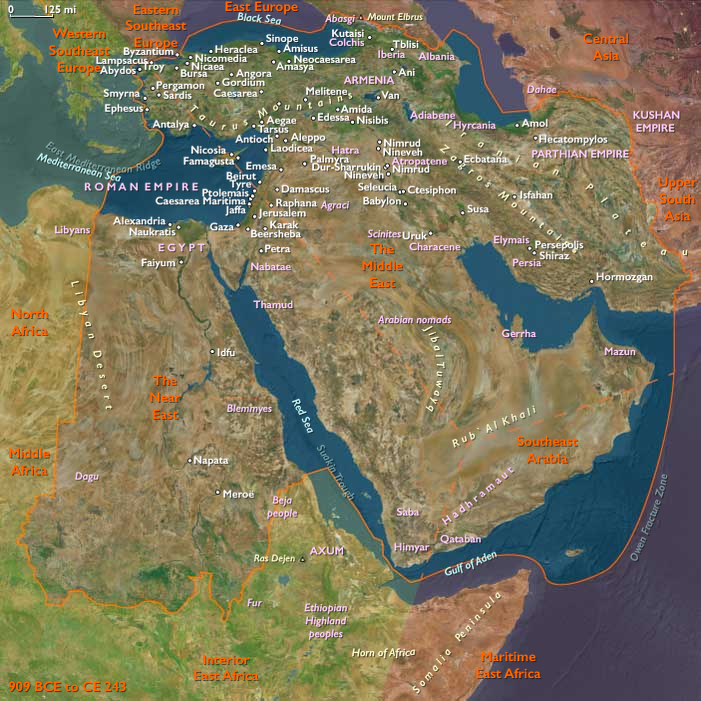
Subregions
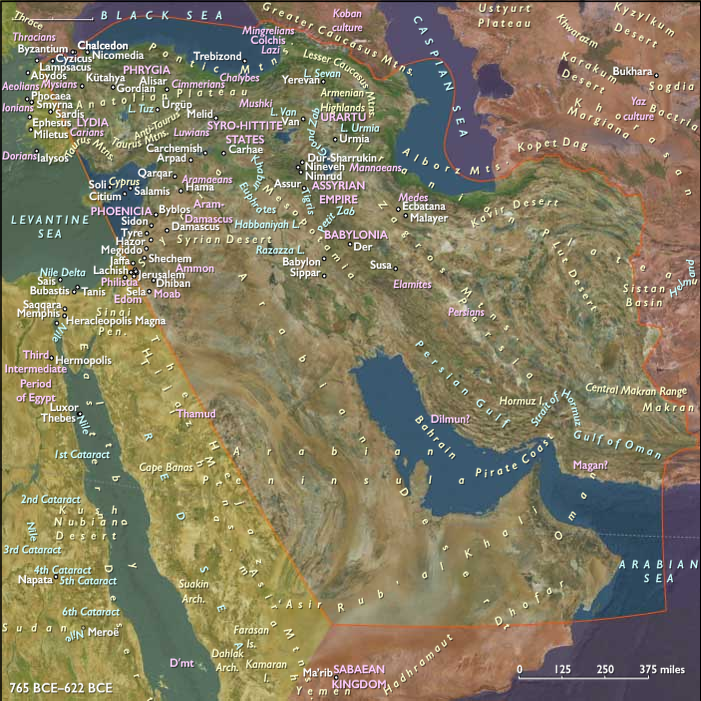
Related Events
Showing 10 events out of 66210 total
Years: 657BCE - 646BCE
Locations
People
Groups
- Mesopotamia
- Medes
- Lydia, Kingdom of
- Arab people
- Babylon, Kingdom of
- Elam, (New) Kingdom of
- Assyrian people
- Assyria, (New) Kingdom of (Neo-Assyrian Empire)
- Egypt (Ancient), Late Period of
Topics
- Younger Subboreal Period
- Iron Age, Near and Middle East
- Iron Age Cold Epoch
- Classical antiquity
- Assyrian Wars of c. 745-609 BCE
Commodoties
Subjects
Regions
Subregions