Babylonian astronomers fully develop a calendar based …
Years: 405BCE - 394BCE
Babylonian astronomers fully develop a calendar based on the motion of the Sun and the phases of the Moon from about 400 BCE, then turn their attentions to the prediction of the exact time of the new crescent Moon first becomes visible; they define the beginning of the month according to this event.
Locations
Groups
Topics
Subjects
Regions
Subregions
Related Events
Filter results
Showing 10 events out of 65030 total
Athenian influence has been strong among the Bosporus cities after the second half of the fifth century; Athens controls local trade until 404 BCE and will remain the chief customer of the Bosporus' food and other exports throughout the fourth century.
Satyrus I (r. 433 BC - 389 BCE) and the other Spartocid rulers of the Bosporus kingdom had been honored by awards of Athenian citizenship because they had promised to provide Athens with wheat, as their predecessor Leucon had done before them in the mid-fifth century.
These rulers (as inscriptions show) call themselves archon when dealing with their Greek subjects but king when describing their authority over the native population.
Scandinavia’s Late Bronze Age civilizations had soon succumbed to tribal warriors newly equipped with long iron swords.
Some Scandinavian peoples around 400 learn the technique of working iron, facilitating a rapid growth of population and clearing of land with iron tools.
Celts settle Styria, a mountainous, mostly forested province in southeastern Austria, bordering on Slovenia in the south, around 400; they are probably drawn by the area’s rich deposits of iron ore.
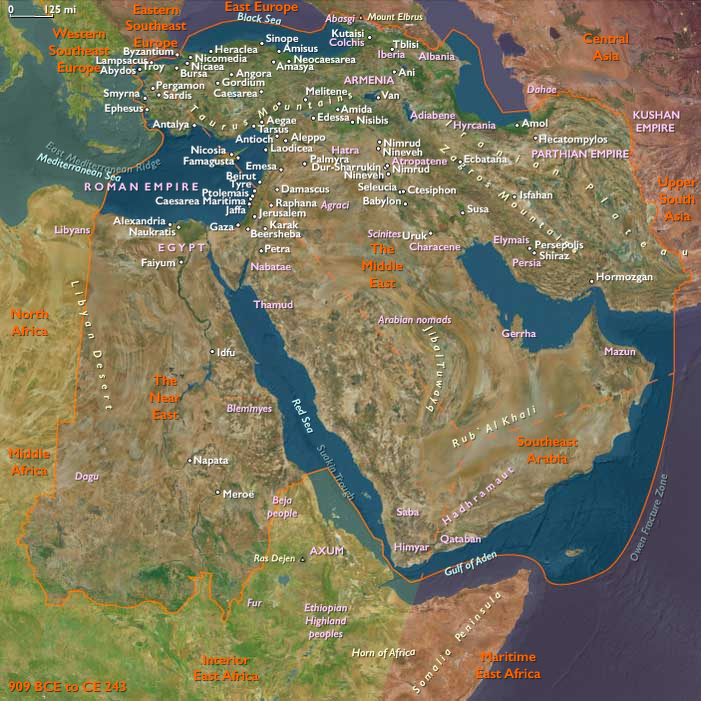
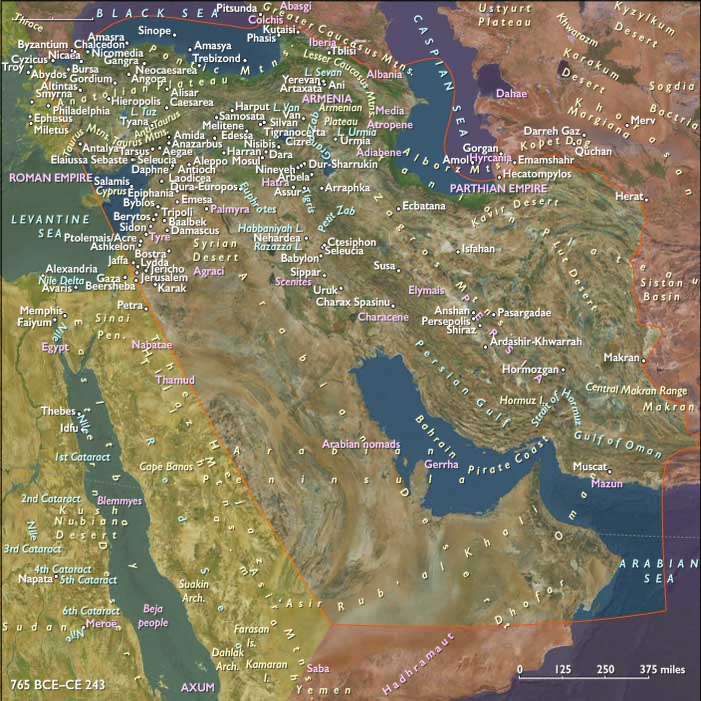
The Middle East: 405–394 BCE
The Expedition of Cyrus the Younger and Cultural Shifts in the Near East
During this era, Cyrus the Younger, brother of the Persian king Artaxerxes II, attempts to seize the Persian throne. In 401 BCE, Cyrus assembles a substantial mercenary force, prominently featuring Greek soldiers known as the Ten Thousand, and marches into the heart of Mesopotamia. At the Battle of Cunaxa, Cyrus is killed, leaving his Greek mercenaries stranded deep within hostile territory. Their arduous return journey to Greece, vividly documented by the Athenian general and writer Xenophon in his seminal work, the Anabasis, highlights the growing complexities of Greek-Persian interactions and the inherent vulnerabilities of Persian imperial governance.
Culturally, this period marks the end of certain longstanding traditions. Around 400 BCE, the East Semitic Akkadian language, a cornerstone of Mesopotamian civilization for approximately twenty-six centuries, gradually falls into disuse, mirroring the concurrent decline of Biblical Hebrew as a vernacular language. Reflecting continued Babylonian scholarly achievements, astronomers refine their calendrical computations, meticulously synchronizing lunar and solar cycles, and precisely determining the visibility of the new crescent moon—a standard now defining the start of their months.
In Cyprus, Evagoras, ruler of Salamis, continues to promote Hellenic culture vigorously. Recognized by Athens as a champion of Greek values, Evagoras receives Athenian citizenship and maintains constructive diplomatic ties with Persia. His influential role further demonstrates the fluid nature of alliances and cultural exchanges between Greek city-states and the Persian empire, underscoring the shifting political landscape of the period.
Simultaneously, within the Judahite community, a significant intellectual and spiritual movement emerges. Jewish scholars intensify their study of the biblical Torah around 400 BCE, seeking to adapt its principles to contemporary circumstances and integrating oral traditions into a coherent body of teachings, known as the Oral Torah. The influential figure Ezra the Scribe compiles the written Torah in Babylon, subsequently leading a substantial caravan to Jerusalem in 397 BCE under official Persian authorization. Ezra, appointed by the Persian court to regulate religious and social matters among the Judahites west of the Euphrates, reinforces stricter observance of the Law, dissolves intermarriages with non-Jews, and initiates reforms aiming at religious purity and communal identity.
In this period, the Hebrew canon continues to evolve, with texts such as the Book of Ezra taking shape, articulating clear religious and moral directives that become foundational for later Judaism. Similarly, the enigmatic Book of Joel, possibly composed between 400 and 350 BCE, emerges with powerful poetic descriptions of divine judgment and redemption, contributing further to the rich prophetic tradition characterizing this formative era of Jewish history.
This era thus witnesses critical military, linguistic, scholarly, and religious transitions, profoundly reshaping the cultural and geopolitical contours of the Middle East.

Cyrus the Younger, in an attempt to wrest the throne of the Persian Empire from his brother, Artaxerxes II, musters a group of mercenary units, mainly Greek, known as The Ten Thousand.
Their march to the Battle of Cunaxa and back to Greece (401 BCE-399 BCE) is recorded by Xenophon (one of its leaders) in his work, The Anabasis.
The East Semitic Akkadian language, after a twenty-six-hundred-year run in Mesopotamia, falls into disuse in about 400 BCE, as does the Biblical Hebrew language.
Evagoras, a member of the traditional ruling family of the Greek city of Salamis in Cyprus, had gained the throne in 411-410 after a period of Phoenician domination.
(Most of what is known of him is found in the panegyric “Evagoras” by Isocrates, where he is described, with extravagant praise, as a model ruler whose aim was to promote the welfare of his state by cultivation of Greek refinement and civilization.)
Pursuing a policy of friendship with Athens and the promotion of Hellenism in Cyprus, Athens recognizes his services by the gift of Athenian citizenship.
He also maintains friendly relations with Achaemenian Persia, securing Persian support for Athens in the early years of the Corinthian War (395-387) against Sparta.
Jewish scholars begin an intensive study of the biblical laws from about 400, applying them to new situations and supplementing them with traditions of popular observance and with precedents established by prominent leaders.
This material, long transmitted by word of mouth and known as the Oral Torah, defines the meaning of biblical laws.
Ezra, a priest and “a scribe skilled in the law” has in Babylon compiled the Torah (Law, or the regulations of the first five books of the Old Testament).
He represents the position of stricter Babylonian Jews who have been upset by reports of laxity in Judah and desire to see matters corrected.
Ezra sets out in the spring of 397 BCE, the seventh year of the reign of Artaxerxes II, at the head of a sizable caravan, apparently with official status as a commissioner of the Persian government.
His title, “scribe of the law of the God of heaven,” is best understood as “royal secretary for Jewish religious affairs,” or the like.
The Persians are tolerant of native cults but, in order to avert internal strife and to prevent religion from becoming a mask for rebellion, insist that these be regulated under responsible authority.
The delegated authority over the Jews of the satrapy (administrative area) “beyond the river” (Avar-nahara) or west of the Euphrates River, is entrusted to Ezra; for a Jew to disobey the Law he brings is to disobey “the law of the king.” According to one view of the Biblical Book of Ezra, the purposes of scribe Ezra's mission to Jerusalem from the Persian court are apparently to introduce stricter observance of the Law and to dissolve marriages with foreigners.
Other scholars date Ezra’s arrival at 428 or 397 BCE.
Ezra, with the Book of Nehemiah, were originally one work in the Hebrew canon, and scholars disagree on whether the two books were written by the same hand.
Ezra is written to fit a schematic pattern in which the God of Israel inspires a king of Persia to commission a leader from the Jewish community to carry out a mission; three successive leaders carry out three such missions, the first rebuilding the Temple, the second purifying the Jewish community, and the third sealing of the holy city itself behind a wall. (This last mission, that of Nehemiah, is not part of the Book of Ezra.)
The theological program of the book explains the many problems its chronological structure presents.
It probably appeared in its earliest version around 400 BCE, and continued to be revised and edited for several centuries after before being accepted as scriptural around the time of Christ.
Scholars have assigned a wide range of dates to the Hebrew Bible’s Book of Joel, which derives its name from the prophet Joel, as the book contains no explicit references to datable persons or events.
It is probably composed between 400 and 350 (although some scholars place it much earlier, in the ninth to seventh centuries).
The book’s first section (1:1-2:17) recounts a plague of locusts and a drought that ravaged Judah as a symbol of divine judgment.
The second (2:18-3:21) promises the outpouring of the spirit of the Lord for Judah’s entire population and declares final judgment on all nations, with protection and fertility for Judah and Jerusalem.
India, which has produced fabrics of tussah silk as early as 1400, obtains knowledge of the Chinese process by 400 (although the cultivated B. mori fails to flourish in India).
Beginning around this time, wood-carved blocks may be used to print textiles in India.