
Ayutthaya’s King Narai, a son of King …
Years: 1687 - 1687
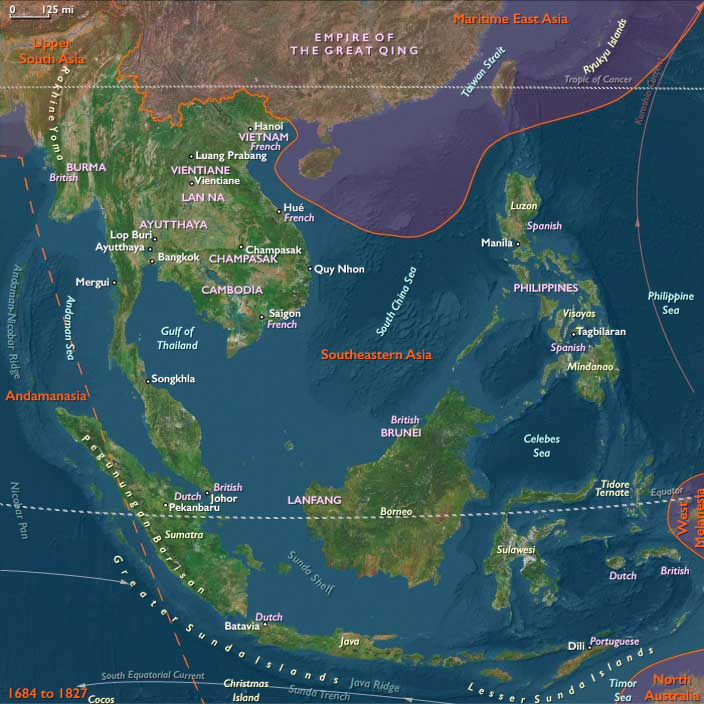
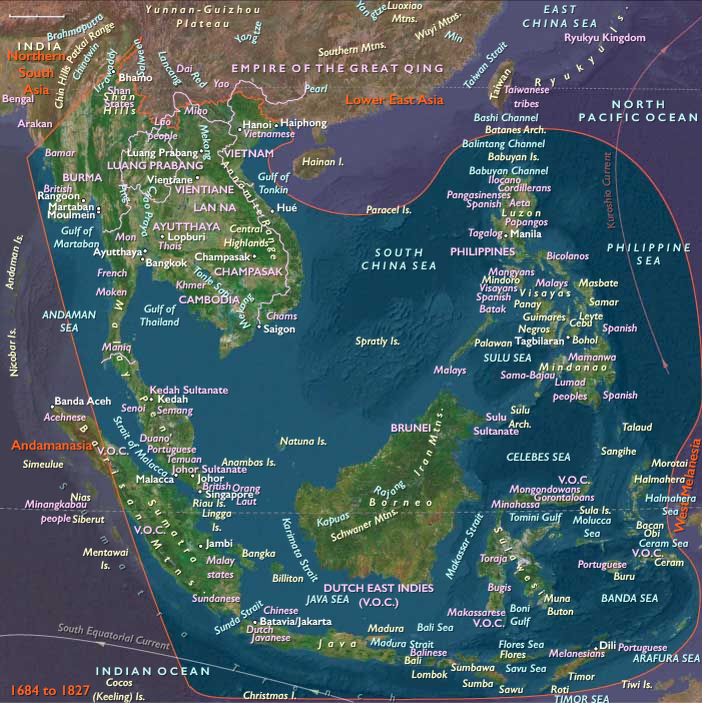
Ayutthaya’s King Narai, a son of King Prasat Thong by a queen who was a daughter of King Song Tham, had come to the throne after violent palace upheavals had cut short the reigns of his elder brother and his uncle.
An effective ruler who has dealt successfully with Siam's traditional Southeast Asian rivals, Narai has ambitions to thrust his kingdom onto the stage of world politics.
Anxious to break the domination of the Dutch East India Company over Siam's external trade, his officers—including Chinese, Persians, and Englishmen—have developed trade with Japan and India, and Narai has sought to develop contacts with the British East India Company and the French.
The East India Company had in 1678 dispatched a Greek agent, Constantine Phaulkon, to the Ayutthayan court.
Born on Cefalonia of Greek Cypriot and Venetian (Italian) parentage, Phaulkon had come to Siam (today's Thailand) as a merchant in 1675 after working for England's East India Company.
A talented linguist with a flair for international trade, already fluent in English, French, Portuguese, and Malay, he has become fluent in Thai in just a few years and has begun to work at the court of King Narai as a translator.
Due to his experience with the East India Company, he had soon been able to become a counselor of the king, serving as both the king's interpreter in diplomatic negotiations and as the chief official in charge of Siam's foreign trade.
Phaulkon had abandoned Anglicanism for Catholicism in 1682, and soon after married a Catholic woman of mixed Japanese-Portuguese-Bengali descent named Maria Guyomar de Pinha.
They live a life of affluence as Phaulkon rises through the office of the state treasury to become highly influential at Narai’s court.
He earns the Thai noble title Chao Phraya Wichayen, the favor of the king, and the enmity of the nationalist, anti-French faction led by Phra Phetracha, Commander of the Royal Regiment of Elephants.
When his English coworkers accused him of corruption, Phaulkon had quit the English East India Company and offered his services to England's archenemy, France, whose previous attempts to gain colonies in the Far East had failed.
Narai, his flirtations with France encouraged by Phaulkon, believes French influence would be an effective counterweight to growing English and Dutch power in the region, and has sent diplomatic missions to King Louis XIV of France in 1680, 1684, and 1686.
The French, encouraged by Phaulkon to hope for territorial concessions, have sent increasingly large delegations to Siam in 1682, 1685, and 1687—the last including six hundred soldiers in six warships.
A large number of missionaries had come in 1684 with the French ambassador to Siam, and when Narai allowed them to preach without restrictions the French thought (wrongly) that the king was about to convert to Catholicism.
Locations
People
Groups
- Christians, Roman Catholic
- Ayutthaya (Siam), Thai state of
- Anglicans (Episcopal Church of England)
- France, (Bourbon) Kingdom of
- East India Company, British (The Company of Merchants of London Trading into the East Indies)
- Dutch East India Company (Vereenigde Oostindische Compagnie or VOC in Dutch, literally "United East Indies Company")
- England, (Stewart, Restored) Kingdom of
- French East India Company
Topics
Commodoties
Subjects
Regions
Subregions
Years: 1687 - 1687
Locations
People
Groups
- Christians, Roman Catholic
- Ayutthaya (Siam), Thai state of
- Anglicans (Episcopal Church of England)
- France, (Bourbon) Kingdom of
- East India Company, British (The Company of Merchants of London Trading into the East Indies)
- Dutch East India Company (Vereenigde Oostindische Compagnie or VOC in Dutch, literally "United East Indies Company")
- England, (Stewart, Restored) Kingdom of
- French East India Company
Topics
Commodoties
Subjects
Regions
Subregions