Ayutthayan invaders occupy the Khmer empire’s capital, …
Years: 1389 - 1389
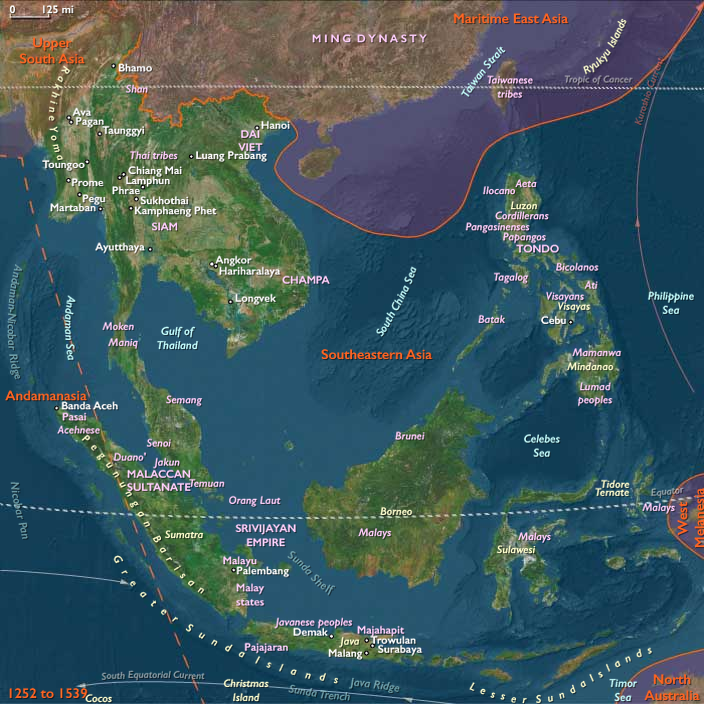
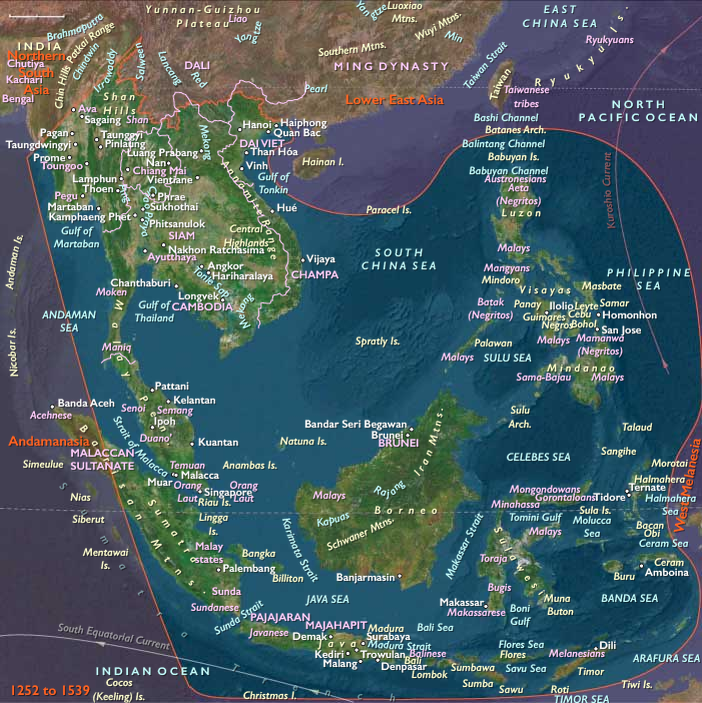
Ayutthayan invaders occupy the Khmer empire’s capital, Angkor, in 1389.
Locations
People
Groups
Topics
Commodoties
Subjects
Regions
Subregions
Related Events
Filter results
Showing 10 events out of 43506 total
Majapahit spirals rapidly into obscurity after the death of Emperor Hayam Wuruk in 1389.
Internal revolt and the spread of Islam to Java prove fatal to the Hindu empire.
General Yi drives his army from the Yalu River straight into the capital, defeats forces loyal to the king (led by General Choe, whom he proceeds to eliminate) and forcibly dethrones King U in a de facto coup d'état but does not ascend to the throne right away.
Instead, he places on the throne King U's son, King Chang, and following a failed restoration of the former monarch, has both of them put to death.
Now the undisputed power behind the throne, General Yi soon forcibly has a Goryeo royal named Yo, now King Gongyang, crowned as king.
After indirectly enforcing his grasp on the royal court through the puppet king, Yi then proceeded to ally himself with Sinjin aristocrats such as Jeong Do-jeon and Jo Jun.
Moscow’s grand duke Dimitry Donskoy, after winning the first Russian victory over the Mongols in 1380, has substantially enlarged the territory of Moscow and helped prevent an invasion by Lithuania.
The University of Erfurt is founded in 1389 as the third university in the territory which is now Germany; for some time, it will be the largest university in the country.
Together with the University of Cologne, it is one of the first city-owned universities in Germany, while they are usually owned by the Landesherren.
Tradition holds that Wallachia's Prince Mircea had sent his forces to Kosovo to fight beside the Serbs; soon after the battle, Bayezid marches on Wallachia, a Hungarian vassal state, and imprisons Mircea until he pledges to pay tribute.
Wallachia thus becomes an Ottoman vassal for the first time.
Fourteenth century-Italian portolan charts show Varna as arguably the most important seaport between Constantinople and the Danube delta; they usually label the region Zagora.
The city had been unsuccessfully besieged by Amadeus VI of Savoy, who had captured all Bulgarian fortresses to the south of it, including Galata, in 1366.
In 1386, Varna had briefly became the capital of the spinoff Principality of Karvuna, and is taken over by the Ottomans in 1389.
A combined army of Serbs, Albanians, and Hungarians, led by the Serb knez, or prince, Lazar Hrebeljanovic, and including a large Bosnian contingent sent by Tvrtko, meets Murad's forces in battle on St. Vitus' Day (Vidovdan), June 28 (June 15, Old Style), 1389, on the Kosovo Polje ("Field of Blackbirds") near Pristina.
Victory appears at first to be on the side of the Serbs when Murad is killed by a Serbian noble, Miloš Obilić (or Kobilic), who had made his way into the Turkish camp on the pretext of being a deserter and forced his way into Murad's tent and stabbed him with a poisoned dagger.
Murad's twenty-nine-year-old son Bayezid quickly quells the confusion, and succeeds in surrounding the Serbs and inflicting a crushing defeat on their army.
Lazar is taken prisoner and executed; the Serbs are forced to pay tribute to the Turks and promise to do military service in the Ottoman army.
The defeat of the Serbs at the Battle of Kosovo seals the fate of the entire Balkan Peninsula, but will become hallowed in several great heroic ballads.
The vision of Lazar on the eve of the battle, the alleged betrayal by the Bosnian Vuk Brankovic, the killing of Murad by Serbian knight Miloš Obilić, the succor brought to the wounded on the battlefield by the Maid of Kosovo—these and other stories will be immortalized in Serbian folk literature.
The territory of Zeta, one of the Serbian medieval polities that has existed from 1360 and 1421, encompasses parts of present-day Montenegro and northern Albania.
The state is administrated by the local noble family Balšić.
Zeta had been first noted, with its name, as an administrative unit of the Principality and Kingdom of Serbia (Rascia), ruled by heirs to the Serbian throne from the Nemanjić dynasty.
When the principal heir becomes Grand Župan of Rascia or King of Serbs, the appanage is granted to the second in line.
During Emperor Stefan Dušan Uroš IV Nemanjić (r. 1331–1355) Upper and Lower Zeta had been governed by dukes, who in turn were subordinate to the wife of Dušan.
After Dušan, his son, Uroš the Weak, ruled Serbia during the fall of the Serbian Empire; the gradual disintegration of the Empire has been a result of decentralization in which provincial lords gain semiautonomy and eventually independence.
The Balšići had wrested control of the region in 1360-1362, when they defeated the two lords of Upper and Lower Zeta.
Over the past few decades, they have become an important player in Balkan politics.
The disintegrating Holy Roman Empire’s landholding nobles have established themselves as individual entities with private armies and the system of secret courts known as the Holy Vehm, or Veme.
The nobles, their strengths deriving from ancient feudal privileges, war frequently between and among themselves, as do Imperial (free) towns, cities and even units of the church.
Nobles and church units fight to stop annexations by the oligarchical towns, whose increasing wealth draws many rural workers; the towns fight to halt excessive and illegal tolls on their trade in raw materials and manufactured commodities.
The ineffective Emperor Wenceslas, king of Germany and Bohemia, a weak and lazy ruler made weaker by alcoholism, attempts to reign from Bohemia, but finds it nearly impossible to control the private powers.
One of these, the exceptionally oppressive Duke Leopold of Austria, had provoked the large Swabian League of Cities, whose forces, allied with those of the Swiss Confederation, had fought and defeated Leopold’s forces at Sempach in 1386.
A general war between towns and had nobles ensued.
By 1389, the towns, especially in southern Germany, have had the worst of it, being isolated pockets of autonomy surrounded by feudal territory.
Wenceslas, who sides with the nobles, arranges an unsatisfactory peace, which tones down the so-called German Town War but does not completely end it.

The murderous Pope Urban VI dies at about seventy-one.
Piero (also Perino, Pietro) Tomacelli comes from an ancient but impoverished baronial family of Casarano in the Kingdom of Naples.
An unsympathetic German contemporary source, Dietrich of Nieheim, asserted that he was illiterate (nesciens scribere etiam male cantabat).
Neither a trained theologian nor skilled in the business of the Curia, he is tactful and prudent in a difficult era, but Ludwig Pastor, who passes swiftly over his pontificate, says, "The numerous endeavors for unity made during this period form one of the saddest chapters in the history of the Church.
Neither Pope had the magnanimity to put an end to the terrible state of affairs" by resigning.
After his election at the papal conclave of 1389, Germany, England, Hungary, Poland, and the greater part of Italy accepts him as Pope Boniface IX in the Roman papal line.
The remainder of Europe recognizes the Avignon Pope Clement VII.
He and Boniface mutually excommunicate each other.