
Ayutthaya exchanges embassies with the Tokugawa Shogunate. …
Years: 1627 - 1627
Ayutthaya exchanges embassies with the Tokugawa Shogunate.
Japanese national Yamada Nagamasa lives in the Japanese quarters of Ayutthaya, home to another fifteen hundred Japanese inhabitants (some estimates run as high as seven thousand).
The community, called "Ban Yipun" in Thai, and headed by a Japanese chief nominated by Thai authorities, is apparently a combination of traders, Christian converts who had fled their home country following the persecutions of Toyotomi Hideyoshi and Tokugawa Ieyasu, and unemployed former samurai who had been on the losing side at the battle of Sekigahara.
The Christian community seems to have been in the hundreds, as described by Padre Antonio Francisco Cardim, who will recount having administered sacrament to around four hundred Japanese Christians in 1627 in the Thai capital.
The colony is active in trade, particularly in the export of deer hide to Japan in exchange for Japanese silver and Japanese handicrafts (swords, lacquered boxes, high-quality papers).
They are noted by the Dutch for challenging the trade monopoly of the Dutch East India Company (VOC).
The colony also has an important military role in Ayutthaya, organized under a "Department of Japanese Volunteers" (Krom Asa Yipun) by the Thai king.
Yamada Nagamasa is alleged to have carried on the business of a corsair or pirate from the period of 1620, attacking and plundering Dutch ships in and around Batavia (present day Jakarta).
In the space of fifteen years, Yamada Nagamasa has risen from the low Thai nobility rank of Khun to the senior of Ok-ya, his title becoming Ok-ya Senaphimuk.
He has become the head of the Japanese colony, and in this position supports the military campaigns of the Thai king Songtham, at the head of a Japanese army flying the Japanese flag.
After more than twelve years in Siam, Yamada Nagamasa had gone to Japan in 1624 aboard one of his ships, where he had sold a cargo of Siamese deer hide in Nagasaki.
He had stayed in Japan for three years, trying to obtain a Red Seal permit, but finally left in 1627, with the simple status of a foreign ship.
Nagamasa had in 1626 offered a painting of one of his fighting ships to a temple of his hometown in Shizuoka.
That painting will be lost in a fire, but a copy of it remains to this day, portraying a ship with Western-style rigging, eighteen cannons, and sailors in samurai gear.
He returns to Siam in 1627.
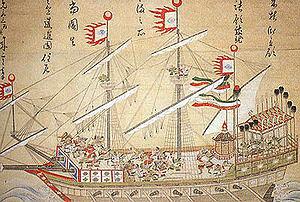
Yamada Nagasama's fighting ship, 17th century painting.
Locations
People
Groups
- Christians, Roman Catholic
- Ayutthaya (Siam), Thai state of
- Japan, Tokugawa, or Edo, Period
- Dutch East India Company (Vereenigde Oostindische Compagnie or VOC in Dutch, literally "United East Indies Company")
Commodoties
Subjects
Regions
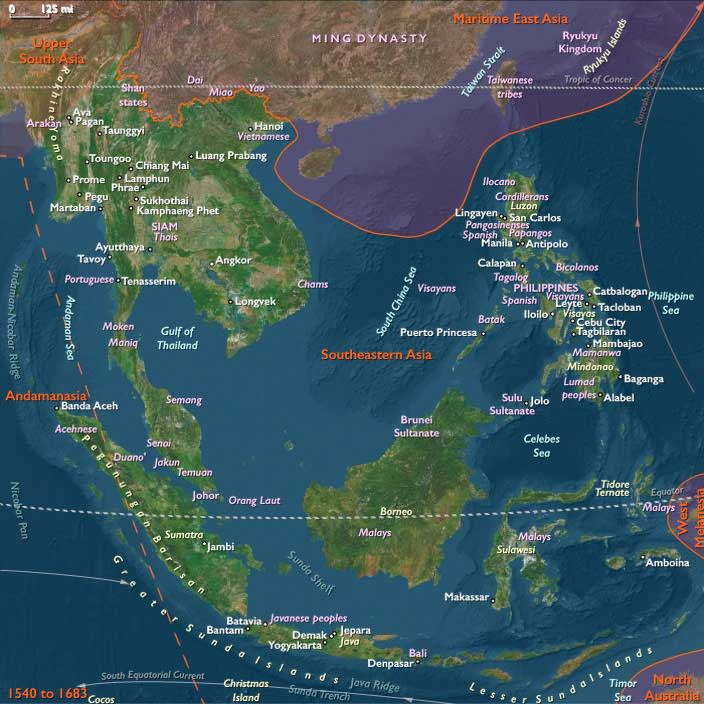
Subregions
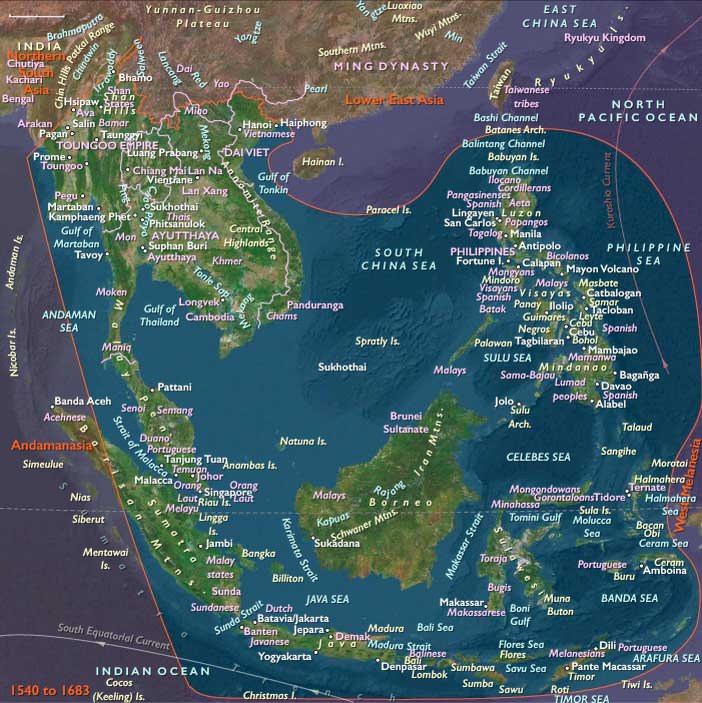
Years: 1627 - 1627
Yamada Nagasama's fighting ship, 17th century painting.
Locations
People
Groups
- Christians, Roman Catholic
- Ayutthaya (Siam), Thai state of
- Japan, Tokugawa, or Edo, Period
- Dutch East India Company (Vereenigde Oostindische Compagnie or VOC in Dutch, literally "United East Indies Company")
Commodoties
Subjects
Regions
Subregions