
The year 1796 is most productive for …
Years: 1796 - 1796
The year 1796 is most productive for both Johann Carl Friedrich Gauss and number theory.
He discovers a construction of the heptadecagon on March 30.
He further advances modular arithmetic, greatly simplifying manipulations in number theory.
On April 8 he becomes the first to prove the quadratic reciprocity law.
This remarkably general law allows mathematicians to determine the solvability of any quadratic equation in modular arithmetic.
The prime number theorem, conjectured on 31 May, gives a good understanding of how the prime numbers are distributed among the integers.
Gauss also discovers on July 10 that every positive integer is representable as a sum of at most three triangular numbers; he then then jots down in his diary the note: "ΕΥΡΗΚΑ! num = Δ + Δ' + Δ".
On October 1 he publishes a result on the number of solutions of polynomials with coefficients in finite fields, which one hundred and fifty years later will lead to the Weil conjectures.
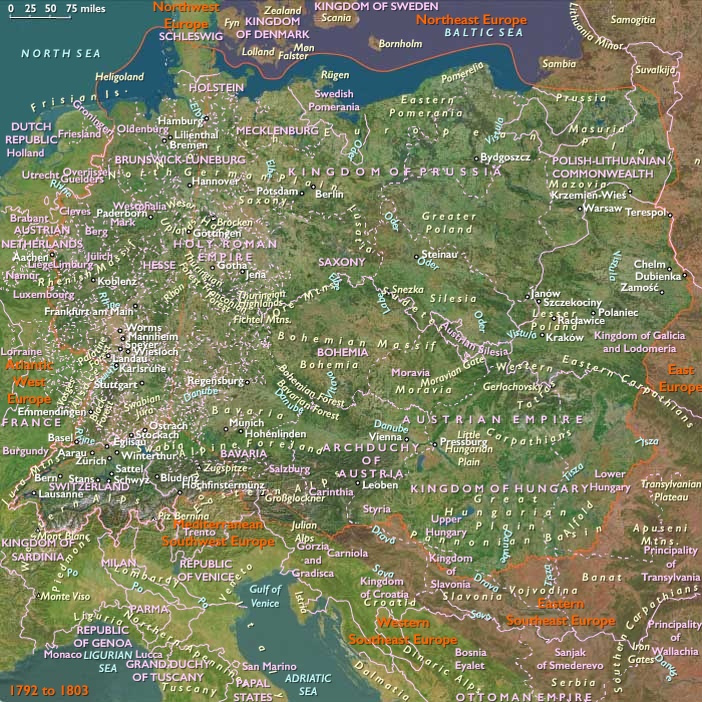
Gauss was born on April 30, 1777 in Brunswick (Braunschweig), in the Duchy of Brunswick-Wolfenbüttel (now part of Lower Saxony, Germany), to poor, working-class parents.
His mother was illiterate and never recorded the date of his birth, remembering only that he had been born on a Wednesday, eight days before the Feast of the Ascension (which occurs thirty-nine days after Easter).
Gauss later solved this puzzle about his birthdate in the context of finding the date of Easter, deriving methods to compute the date in both past and future years.
He had been christened and confirmed in a church near the school he attended as a child.
Gauss was a child prodigy.
A contested story relates that, when he was eight, he figured out how to add up all the numbers from 1 to 100.
There are many other anecdotes about his precocity while a toddler, and he made his first ground-breaking mathematical discoveries while still a teenager.
He completed his magnum opus, Disquisitiones Arithmeticae, in 1798, at the age of twenty-one—though it will not be published until 1801.
This work is fundamental in consolidating number theory as a discipline and will shape the field to the present day.
Gauss's intellectual abilities had attracted the attention of the Duke of Brunswick, who sent him to the Collegium Carolinum (now Braunschweig University of Technology), which he had attended from 1792 to 1795, and to the University of Göttingen from 1795 to 1798.
While at university, Gauss independently rediscovers several important theorems.
His breakthrough occurs in 1796 when he shows that a regular polygon can be constructed by compass and straightedge if the number of its sides is the product of distinct Fermat primes and a power of 2.
This is a major discovery in an important field of mathematics; construction problems have occupied mathematicians since the days of the Ancient Greeks, and the discovery ultimately leads Gauss to choose mathematics instead of philology as a career.
Gauss is so pleased with this result that he requests that a regular heptadecagon be inscribed on his tombstone.
The stonemason declines, stating that the difficult construction would essentially look like a circle.
Locations
People
Groups
Subjects
Regions
Subregions

Years: 1796 - 1796
Locations
People
Groups
Subjects
Regions
Subregions