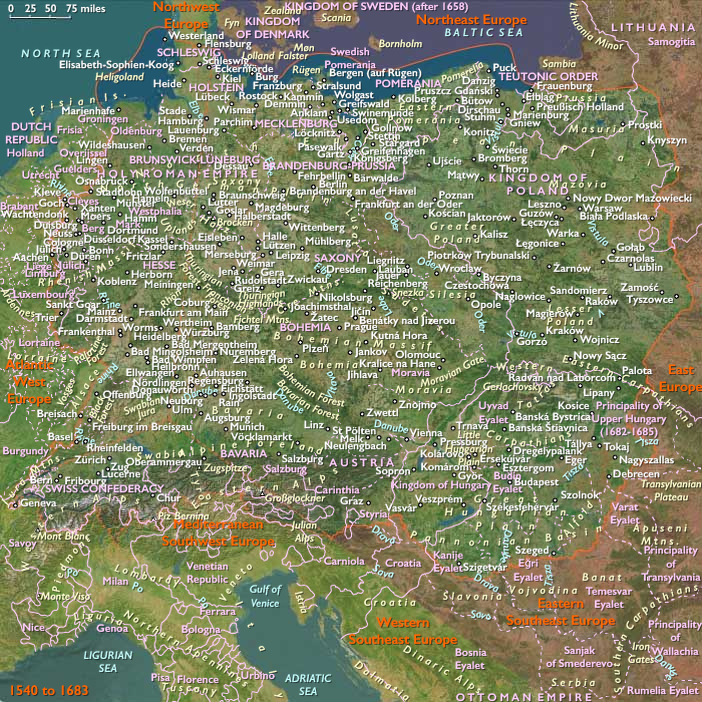
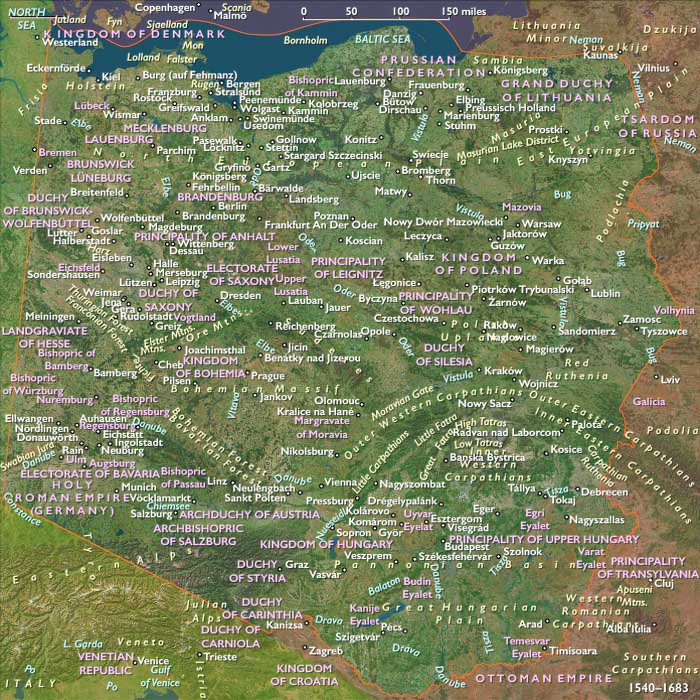
Austria manages to recover Raab (Gyõr), but …
Years: 1598 - 1598
Austria manages to recover Raab (Gyõr), but ...
Locations
People
Groups
- Austria, Archduchy of
- Wallachia, Principality of
- Ottoman Empire
- Hungary, Royal
- Moldavia (Ottoman vassal), Principality of
- Transylvania (Ottoman vassal), Principality of
Topics
Subjects
Regions
Subregions
Related Events
Filter results
Showing 10 events out of 34140 total
Spain’s Don Tello de Aguirre opens diplomatic relations with Ayutthaya in 1598.
The treaty of friendship and commerce is similar to that signed by the Portuguese in 1516.
Matteo Ricci, born in 1552 in Macerata, today a city in the Italian region of Marche and then part of the Papal States, had studied theology and law in a Roman Jesuits' school, entered the religious order in 1571, and in 1577 had applied to be a member of a missionary expedition to India.
Departing from Lisbon in March 1578, he had arrived in Goa, a Portuguese Colony, in September 1578, and four years later had been dispatched to China, arriving at Macau, a Portuguese trading post on the South China Sea coast, in August 1582.
Christian missionary activity in China was at the time almost exclusively limited to Macau, where a certain number of the local Chinese people, who converted to Christianity, were expected to live in Portuguese ways, and, until 1579, no one among the Christian missionaries there would even seriously learn the Chinese language.
It was only in July 1579 (just three years before Ricci's arrival) that Michele Ruggieri, invited by Alessandro Valignano, had arrived from Portuguese India to apply himself to the study of Chinese, and to prepare for spreading the Jesuits' missionary work from Macau into Mainland China.
Once in Macau in 1582, Ricci had started learning the Chinese language and Chinese customs.
This was the beginning of a long project that would eventually make him one of the first Western scholars to master Chinese script and Classical Chinese.
Together with Ruggieri, Ricci had traveled a number of times to Guandong's major cities, Canton and Zhaoqing (then, residence of the Viceroy of Guangdong and Guangxi), in order to find a way to establish a permanent Jesuit mission house outside Macau.
Ricci and Ruggieri had in 1583 obtained permission to settle in Zhaoqing from that city’s governor, Wang Pan, who had heard of Ricci's skill as a mathematician/cartographer.
Ricci stayed in Zhaoqing from 1583 to 1589 before having to leave after a new viceroy decided to expel him.
It was in Zhaoqing, in 1584, that Ricci had composed the first European-style map of the world in Chinese, now called the "Impossible Black Tulip" on account of its rarity.
No versions of the 1584 map survive, though surviving It is thought that during this time, Ricci, together with Ruggieri, compiled their Portuguese-Chinese dictionary - the first ever European-Chinese dictionary, for which they developed a consistent system for transcribing Chinese words in the Latin alphabet.
Unfortunately, the manuscript was misplaced in the Jesuit Archives in Rome, and not re-discovered until 1934.
This dictionary was finally published in 2001.
Ricci had managed to obtain permission to relocate to Shaoguan (Shaozhou, in Ricci's account) in the north of the province, and reestablish his mission there.
Further travels in China had seen Ricci reach Nanjing and Nanchang in 1595.
Alessandro Valignano, his superior, had in August 1597 appointed him as Major Superior of the mission in China, with the rank and powers of a Provincial, a charge that he is to fulfill until his death.
He had moved to Tongzhou (a port for Beijing) in 1598 and then first reached Beijing on September 7, 1598.
Because of the ongoing Japanese invasion of Korea, however, Ricci could not reach the Imperial Palace.
After waiting for two months, he left Beijing first for Nanjing and also stopped at Suzhou in Jiangsu Province.
With the help of his Jesuit colleague Lazzaro Cattaneo during the winter of 1598-99, Ricci compiles another Chinese-Portuguese dictionary, in which tones of the romanized Chinese syllables are indicated with diacritical marks.
This work has been lost, and, unlike Ricci's and Ruggieri's earlier Portuguese-Chinese dictionary, has never been found.

The Russians have slowly conquered the Uzbek Khanate of Sibir over the past fourteen years.
Khan Kuchum, defeated on the banks of the Ob in 1598, is forced to flee to the territories of the Nogai, bringing an end to his rule.
He escapes to Bukhara, but his sons and grandsons are taken by the Tsar to Moscow, where they will eventually assume the surname of Sibirsky.
Self-preservation as much as ambition lead Boris to seize the throne at the death of the childless Feodor on January 7, 1598.
Had he not done so, the mildest treatment he could hope for would have been lifelong seclusion in a monastery.
His election is proposed by Patriarch Job of Moscow, who believes that Boris was the one man capable of coping with the difficulties of the situation.
Boris, however, will only accept the throne from the Zemsky Sobor, or national assembly, which meets on February 17 and unanimously elects him on February 21.
He is solemnly crowned Tsar of all the Russias on September 1.
Tycho accepts a proposal in 1598 from the Bohemian king and Holy Roman emperor Rudolph II that he come to Prague, where he becomes the official imperial astronomer.
He builds the new observatory in a castle in Benátky nad Jizerou, fifty kilometers from Prague, and works there for one year.
...fails in 1598 at Buda, ...
Michael pledges fealty to Habsburg emperor Rudolf II in 1598 and concludes a peace with the Turks, although his ultimate goal is complete independence for Wallachia.
...as do the Turks at Verazdin the same year.
Caravaggio paints a Saint Catherine, a Martha and Mary Magdalene, and a Sacrifice of Isaac around 1598.
Alfonso II, Margrave of Este, had first married Lucrezia, daughter of grand-duke Cosimo I of Tuscany, then after becoming a widower, Barbara, the sister of Maximilian II, Holy Roman Emperor, and finally a third wife, Margherita Gonzaga, daughter of the duke of Mantua.
Though he has raised the glory of Ferrara to its highest point, and has been the patron of Torquato Tasso and Giovanni Battista Guarini, favoring the arts and sciences, as the princes of his house have always done, the legitimate line ends in 1597 with him.
Emperor Rudolph II recognizes as heir his first cousin Cesare d'Este, member of a cadet branch born out of wedlock, who continue to rule in the imperial duchies and carried on the family name.
Ferrara, on the other hand, is annexed by force of arms in 1598 by Pope Clement VIII, on grounds of the heir's illegitimacy, and incorporated into the Papal States.
The Jewish community of Ferrara had played an important role when Ferrara enjoyed its greatest splendor in the fifteenth and sixteenth century, with the duke Ercole I d'Este.
It is the only Jewish community in Emilia Romagna with a continuous presence from the Middle Ages to the present day.
The princes of the house of Este had always accorded favor and protection to the Jews, and are much beloved by them.
Eleonora, a princess of this house, had inspired two Jewish poets; and when she was ill public prayers had been said in the synagogues for her restoration to health.
But misfortune overtakes the Jews of Ferrara as well; for once the principality of Ferrara is incorporated in the dominions of the Church, Clement decrees the banishment of the Jews.
An Aldobrandini relative of the pope takes possession of Ferrara in the pontiff's name.
Seeing that all the commerce is in the hands of the Jews, he complies with their request for an exemption of five years from the decree, although this is much against the pope's wish.
Years: 1598 - 1598
Locations
People
Groups
- Austria, Archduchy of
- Wallachia, Principality of
- Ottoman Empire
- Hungary, Royal
- Moldavia (Ottoman vassal), Principality of
- Transylvania (Ottoman vassal), Principality of