Aurelian first deals with disorder at Lugdunum …
Years: 274 - 274
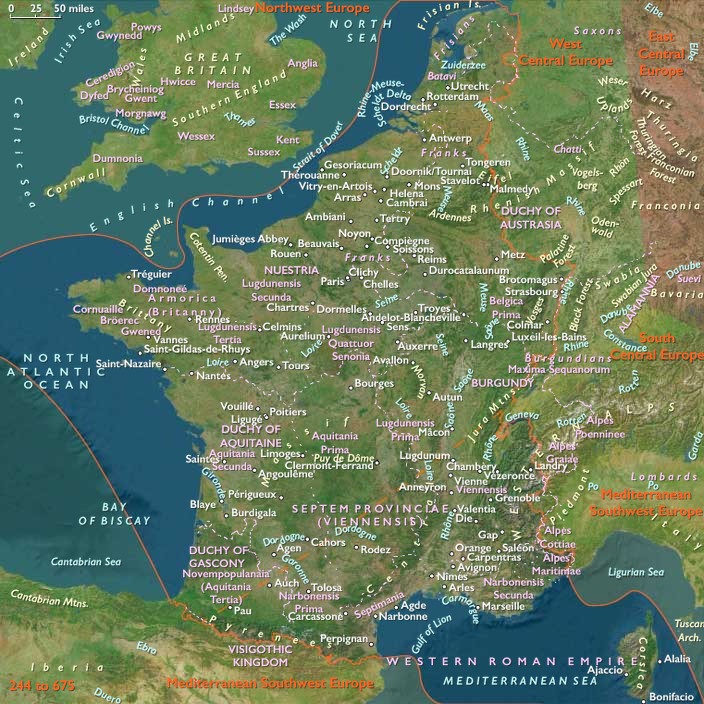
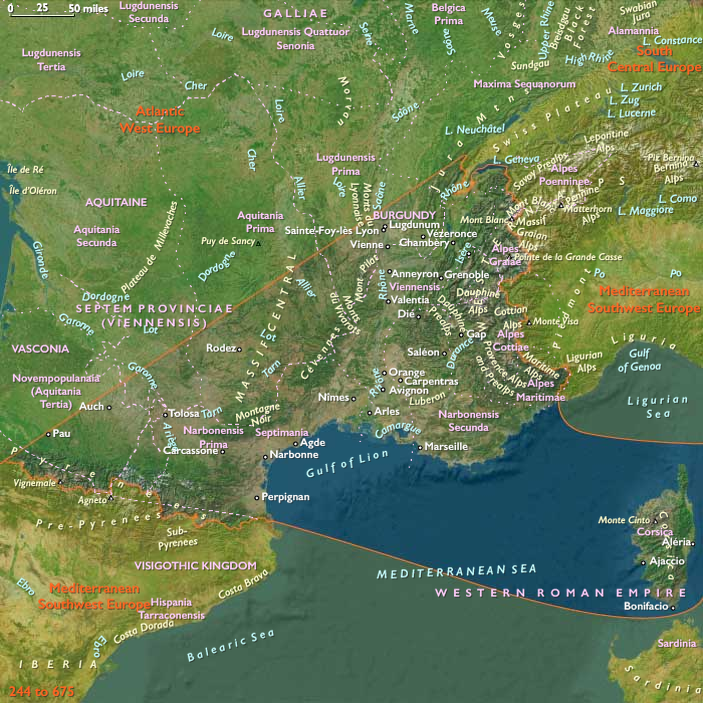
Aurelian first deals with disorder at Lugdunum (Lyon) in late 274.
Locations
People
Groups
Topics
- Classical antiquity
- Roman Age Optimum
- Crisis of the Third Century (Roman Civil “War” of 235-84)
- Aurelian's War against Tetricus
Commodoties
Subjects
Regions
Subregions
Related Events
Filter results
Showing 10 events out of 60208 total
Aurelian, turning east, next repels an invasion of Raetia by the Juthungi.
Aurelian, in officially ceding control of Dacia to the Goths in 274, has secured a long-lasting peace.
The Romans now construct a series of new forts on the south bank of the Danube, resettling soldiers and colonists here.
Moesia is a prosperous province, since surplus wheat from the Black Sea area is always assured of a market in the Roman Empire.
In the province's interior, agriculture and fruit growing flourish, and there is mineral wealth in the Balkan Mountains.
The province has suffered heavily from the barbarian invasions of the third century CE, and when the neighboring province of Dacia is abandoned in about 274, its inhabitants are largely transferred to Moesia.
The Romans have gradually evacuated Dacia over the past four years, abandoning the province to the Goths and Gepids.
Aurelian understands that defensible boundaries are essential for the long-term survival of the empire.
In 274, with the empire temporarily united, Aurelian concludes that Dacia is overexposed to invasion and makes the momentous decision to withdraw Roman troops from Dacia and resettle soldiers and settlers south of the Danube.
Virtually all the colonists, soldiers, imperial officials, and merchants depart (scholars, however, presume that many peasants remained).
Those Dacians who depart spread throughout the Balkans.
The Dacians apparently disperse as far as Macedonia and …
…the Peloponnesus (where their descendants still live). (These immigrants, who will call themselves Aromuni, i.e., “Romans,” are known to their present Slav and Greek neighbors as Tzintzars, denoting their inability to pronounce the Romanian cincl (five), or the somewhat insulting Kutzovlachs, meaning "lame Vlachs." Their native tongue, now still spoken by some five hundred thousand people in various Balkan countries, is Aromanian, an Eastern Romance language related most closely to Romanian but with strong Greek influences.)
Aurelian reclaims the balance of the western provinces within the next several months, and rejoins them to the Roman Empire.
A strict disciplinarian, Aurelian maintains that public support and spoils taken from the enemy should be sufficient for soldiers to leave the provincials' goods alone.
Having reintegrated the Gallic Empire into the Roman fold, Aurelian returns to Rome and displays his surrendered rival Tetricus in a triumphal march, together with Zenobia and two of her sons, Herennianus and Timolaus.
Later pardoned, Tetricus is rewarded with the governorship of Lucania in southern Italy; the younger Tetricus receives senatorial rank.
Zenobia will spend the remainder of her life in exile in Italy, marrying a wealthy Roman senator and presumably passing the rest of her days at his villa near Tibur (now Tivoli, Italy).
Aurelian now revises the monetary system of the empire, using the additional revenue from the recovered provinces, together with thorough reforms, to return the empire's treasury to a sound footing.
He also introduces measures to reduce embezzlement, extortion, and corruption among imperial and provincial administrations.
He revises the monthly dole of grain to a daily distribution of two pounds of bread and an occasional allotment of pork, oil, and salt.
The bed of the Tiber is cleared and its banks repaired.
Although Aurelian has abandoned Dacia to barbarian rule, he has in four years managed to reclaim large portions of imperial territory lost through war or secession, thus earning, more than most, his self-adopted title restitutor orbis ("Restorer of the World,") which he displays on his newly reformed coinage.
Sun worship is popular in the Roman army, and particularly on the Danube.
Aurelian, one of the great military emperors produced by that area in the third century, installs the Syrian god Sol Invictus ("Invincible Sun") as the unifying deity of the restored Roman Empire.
At Rome, Aurelian builds a colossal round structure set within a rectangular enclosure, dedicating the magnificent temple to the god on the third day after the solstice and day of rebirth of the Sun and endowing the Sun's temple with fifteen thousand pounds of gold.
This religion, which is in essence monotheistic, becomes the state religion of Rome.

Aurelian Rebuilds Genabum as Aurelium (273–274 CE)
In 273–274 CE, Emperor Aurelian (r. 270–275 CE) ordered the rebuilding of Genabum, renaming it Aurelium—a name from which the modern city of Orléans derives.
Historical Background: Genabum’s Strategic Importance
- Genabum, located on the Loire River, was originally a major Gallic oppidum of the Carnutes, playing a key role in trade and communication.
- The city was destroyed by Julius Caesar in 52 BCE as part of his campaign to crush Vercingetorix’s revolt.
- Over time, it was rebuilt as a Roman settlement and became an important commercial and military hub.
Aurelian’s Reconstruction and Renaming (273–274 CE)
- By the 3rd century CE, Genabum had become a strategic point in Roman Gaul, particularly during the Gallic Empire’s breakaway (260–274 CE).
- Following his victory at the Battle of Châlons (274 CE) and the reconsolidation of Gaul into the Roman Empire, Aurelian sought to restore and strengthen key cities.
- He reconstructed Genabum and renamed it Aurelium, in line with other Roman cities bearing imperial names.
Legacy of Aurelian’s Urban Renewal
- Aurelium remained an important city in Late Antiquity, later becoming a key center of power during the Merovingian period.
- Over time, the name evolved into Orléans, which played a crucial role in medieval French history, particularly during the Hundred Years' War.
- Aurelian’s rebuilding efforts contributed to the stability and resilience of Roman Gaul, ensuring the city’s continuity beyond the fall of the Western Roman Empire.
By rebuilding Genabum as Aurelium, Aurelian secured one of Gaul’s major settlements, reinforcing Roman control during a period of crisis and leaving a lasting mark on the historical and urban landscape of France.
The Battle of Châlons (274 CE): Aurelian’s Victory Over the Gallic Empire
In 274 CE, the forces of Emperor Aurelian met those of the Gallic Empire, led nominally by Tetricus I, at the Campi Catalaunii (modern Châlons-sur-Marne, France). This battle was the culmination of Aurelian’s campaign to reunify the Western Roman Empire, following the breakaway of the Gallic Empire in 260 CE.
The Betrayal of Tetricus and the Collapse of the Gallic Army
- Tetricus I, ruler of the Gallic Empire, had already lost support among his own troops and faced internal unrest.
- In a prearranged secret act of betrayal, Tetricus deserted to Aurelian’s side during the battle, leaving his leaderless troops to be slaughtered.
- With their command structure broken, the Gallic forces collapsed, suffering a decisive defeat at the hands of the Romans.
Aftermath: The End of the Gallic Empire
- With Tetricus in Roman hands, Aurelian formally reintegrated the Gallic provinces into the Roman Empire, marking the end of the Gallic Empire after fourteen years of independence (260–274 CE).
- Aurelian pardoned Tetricus, allowing him to live peacefully as a Roman senator and governor, rather than executing him.
- The victory reestablished Roman unity in the West, further securing Aurelian’s legacy as the "Restorer of the World" (Restitutor Orbis).
Significance of the Battle
- The Battle of Châlons (274 CE) was a turning point in Rome’s efforts to recover from the Crisis of the Third Century.
- Aurelian’s success stabilized Gaul, allowing for economic and military recovery.
- However, the fractures exposed by the Gallic Empire would resurface in later centuries, foreshadowing the eventual collapse of the Western Roman Empire in the 5th century.
By defeating the Gallic usurpers and reclaiming the lost western provinces, Aurelian temporarily restored the strength of the Roman Empire, paving the way for the reforms of Diocletian and the transition to Late Antiquity.
Aurelian marches to open a campaign against Persia early in 275, gathering an army as he continues eastwards.
In the autumn, after Aurelian's private secretary, charged with extortion, allegedly misleads a group of officers to mistakenly believe that they are marked for execution, the conspirators murder the emperor at Caenophrurium, a small Thracian town between Perinthus and Byzantium.
Years: 274 - 274
Locations
People
Groups
Topics
- Classical antiquity
- Roman Age Optimum
- Crisis of the Third Century (Roman Civil “War” of 235-84)
- Aurelian's War against Tetricus