
Augustus has traveled in Sicily, Greece, and …
Years: 19BCE - 19BCE
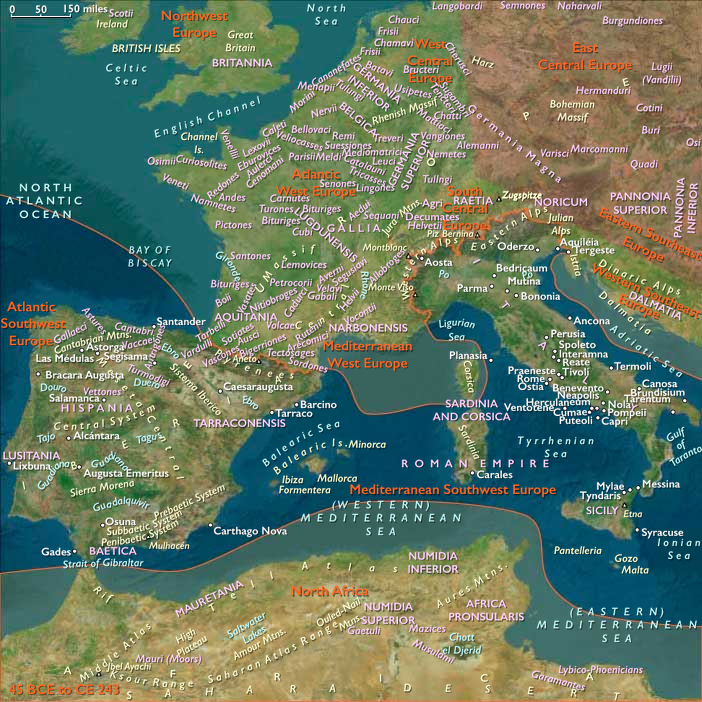
Augustus has traveled in Sicily, Greece, and Asia from 22 BCE to 19 BCE, effecting important reorganizations wherever he went.
Immense satisfaction to Rome is caused by an agreement in 20 BCE with Parthia, under which the Parthians recognize Rome's protectorate over Armenia and returns the legionary standards captured from Crassus thirty-three years earlier.
In 19 BCE, there is some adjustment of Augustus’ powers to allow him to exercise them more freely in Italy.
Comprehending well the importance of ideology and propaganda, Augustus sponsors and encourages the leading writers and artists of his time, such as the historian Livy and the poets Virgil and Horace.
Horace, whose interests have returned to the discursive mode of his earlier Satires, explores the possibilities of poetic moral essays in his 20 short Epistles, published in 20 BCE.
He publishes a longer Epistle on literary matters, entitled the “Art of Poetry,” in 19 BCE.
Roman elegiac poet Albius Tibullus, who (in the two books of poetry that can definitely be attributed to him) writes mostly on the subject of love, addresses his mistresses Delia and—later—Nemesis, as well as the young man Marathus.
Writing in a simple but elegant style, Tibullus often praises the life of rural seclusion in his bucolic poems.
He dies, probably in his late twenties, in 19 BCE.
Virgil, before setting out on a voyage to Greece and Asia during which he intends to complete the Aeneid ("the story of Aeneas”), requests that the work be destroyed if anything should happen to him before the poem is complete.
Catching a fever, he dies in Brundisium on September 21, 19 BCE.
Augustus overturns the author’s request and has the epic masterpiece published.
The poem, in twelve books, deals with the founding of Roman civilization by the Trojan Aeneas, of whose adventures Naevius and Ennius had previously written.
Virgil models the characters and events of the Aeneid after their Homeric predecessors: in the first six books, Virgil successfully unifies around the figure of Aeneas the searching theme of Homer's Odyssey; in the last six books, he analogizes that of the Iliad with his account of the war and final reconciliation of the Trojans and the Latins), creating multiple correspondences between both halves.
Through the judicious use of analogy, image, and symbol, Virgil emphasizes the cost in sacrifice and loss of humanity inherent in the ideals of Augustan Rome, while outwardly glorifying these same ideals.
The Aeneid, soon made a standard school text, becomes a national epic—an explanation of Augustan Rome’s origins and heroic past—and establishes Virgil, with Homer, as one of the great epic poets.
The huge, symmetrically planned Baths of Agrippa (Thermae Agrippae), built by Agrippa, are the first of the great thermae constructed in the city.
In their first form, constructed at the same time as the Pantheon and on axis with it, as a balaneion, they are apparently a hot-air bath with a cold plunge, not unlike a sauna.
With the completion of the Aqua Virgo, the aqueduct completed by Agrippa in 19 BCE, the baths are supplied with water and become regular thermae, with a large ornamental pool (Stagnum Agrippae) attached.
Agrippa furnishes his baths with decorations that may have been executed in glazed tiles and with works of art: the Apoxyomenos of Lysippus stands outside.
Locations
People
Groups
Topics
Commodoties
Subjects
- Commerce
- Writing
- Architecture
- Engineering
- Sculpture
- Painting and Drawing
- Environment
- Labor and Service
- Conflict
- Faith
- Government
- Technology
Regions
Subregions
Years: 19BCE - 19BCE
Locations
People
Groups
Topics
Commodoties
Subjects
- Commerce
- Writing
- Architecture
- Engineering
- Sculpture
- Painting and Drawing
- Environment
- Labor and Service
- Conflict
- Faith
- Government
- Technology
Regions
Subregions