
Augustus had planned invasions of Britain in …
Years: 100 - 100
Augustus had planned invasions of Britain in 34, 27 and 25 BCE, but circumstances were never favorable, and the relationship between Britain and Rome had settled into one of diplomacy and trade.
Strabo, writing late in Augustus's reign, claims that taxes on trade brought in more annual revenue than any conquest could.
Likewise, archaeology shows an increase in imported luxury goods in southeastern Britain.
Strabo also mentions British kings who sent embassies to Augustus, and Augustus' own Res Gestae refers to two British kings he received as refugees.
When some of Tiberius's ships were carried to Britain in a storm during his campaigns in Germany in CE 16, they were sent back by local rulers, telling tall tales of monsters.
Rome appears to have encouraged a balance of power in southern Britain, supporting two powerful kingdoms: the Catuvellauni, ruled by the descendants of Tasciovanus, and the Atrebates, ruled by the descendants of Commius.
This policy had been followed until CE 39 or 40, when Emperor Caligula received an exiled member of the Catuvellaunian dynasty and staged an invasion of Britain that collapsed in farcical circumstances before it left Gaul.
When Emperor Claudius successfully invaded in 43, it had been in aid of another fugitive British ruler, this time Verica of the Atrebates.
The Romans in the ensuing years had conquered more of the island, increasing the size of Roman Britain.
Governor Gnaeus Julius Agricola, father-in-law to the historian Tacitus, had in 78 conquered the Ordovices.
With XX Valeria Victrix, Agricola had defeated the Caledonians in 84 at the Battle of Mons Graupius, in what is today northern Scotland, marking the high tide mark of Roman territory in Britain; shortly after his victory, Agricola had been recalled from Britain back to Rome, and the Romans had retired to a more defensible line along the Forth-Clyde isthmus, freeing soldiers badly needed along other frontiers.
There is no historical source describing the decades that followed Agricola's recall.
Even the name of his replacement is unknown.
Archaeology has shown that some Roman forts south of the Forth-Clyde isthmus were rebuilt and enlarged, although others appear to have been abandoned.
Roman coins and pottery have been found circulating at native settlement sites in what are now the Scottish Lowlands in the years before 100, indicating growing Romanization.
Although there is some evidence of scattered Brython settlement in the area of what is today greater London, the first major settlement had been founded by the Romans in 43, following the Roman invasion of Britain.
This settlement was called Londinium, commonly believed to be the origin of the present-day name, although a Celtic origin is also possible.
The first London had lasted for just seventeen years.
The Iceni tribe of Celts led by Queen Boudica had stormed Londinium around 61, burning it to the ground.
The next, heavily planned incarnation of the city has prospered and in 100 supersedes Camulodunum as the capital of the Roman province of Britannia.
Tiberius Avidius Quietus, a friend of Thrasea Paetus, who had been executed by Emperor Nero in 66, had been made governor of Roman Britain in about 97; he holds the post until around 100.
Well into middle age by this time, he is also a friend of Plutarch and the late Pliny the Elder.
Locations
People
Groups
Topics
Commodoties
Subjects
- Commerce
- Watercraft
- Environment
- Labor and Service
- Conflict
- Faith
- Government
- Technology
- Archaeology
- Economics
Regions
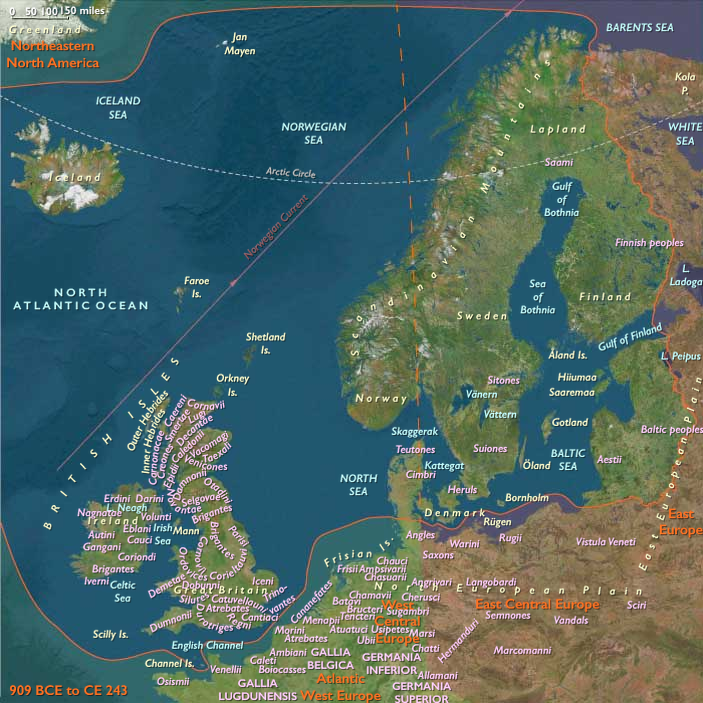
Subregions
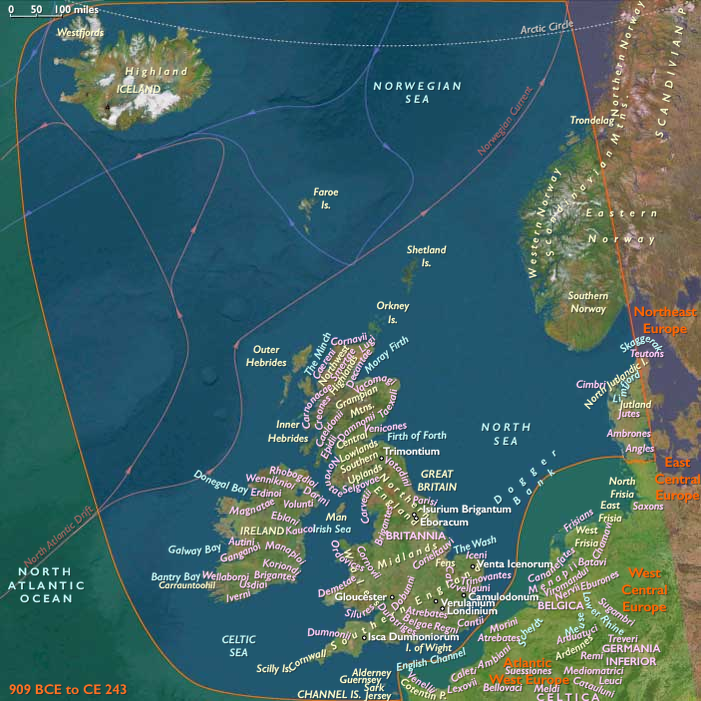
Related Events
Showing 2 events out of 2 total
Years: 100 - 100
Locations
People
Groups
Topics
Commodoties
Subjects
- Commerce
- Watercraft
- Environment
- Labor and Service
- Conflict
- Faith
- Government
- Technology
- Archaeology
- Economics
Regions
Subregions