
Augustine, born in the city of Thagaste …
Years: 384 - 384
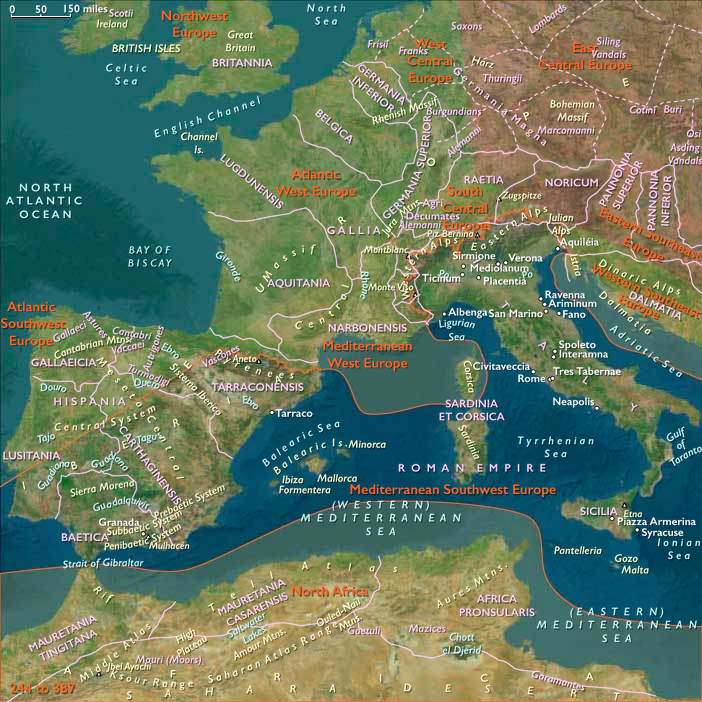
Augustine, born in the city of Thagaste (the present day Souk Ahras, Algeria) to a pagan father named Patricius and a devout Christian Berber mother named Monica, had at the age of eleven been sent to school at Madaurus, a small Numidian city about nineteen miles south of Thagaste noted for its pagan climate.
Here he had become familiar with Latin literature, as well as pagan beliefs and practices.
In 369 and 370, he had remained at home, where he read Cicero's dialogue Hortensius (now lost), which he will later describe as leaving a lasting impression on him and sparking his interest in philosophy.
At age seventeen, through the generosity of a fellow citizen Romanianus, he had moved to Carthage to continue his education in rhetoric.
Although raised as a Christian, Augustine had left the Church to follow the Manichaean religion, much to the despair of his mother.
As a youth, Augustine lived a hedonistic lifestyle for a time, associating with hooligans (Latin: euersores, literally meaning wreckers) who boasted of their experience with the opposite sex and urged the inexperienced boys, like Augustine, to seek out experiences with women or to make up stories about experiences in order to gain acceptance and avoid ridicule.
At a young age, he had developed a stable relationship with a young woman in Carthage, who would be his concubine for over thirteen years and who had given birth to his son, Adeodatus.
During the years 373 and 374, Augustine had taught grammar at Thagaste.
The following year, he had moved to Carthage to conduct a school of rhetoric, where he was to remain for the next nine years.
Disturbed by the unruly behavior of the students in Carthage, in 383 he had moved to establish a school in Rome, where he believed the best and brightest rhetoricians practiced.
However, Augustine was disappointed with the Roman schools, where he was met with apathy.
Once the time came for his students to pay their fees they simply fled.
Manichean friends introduce him to the prefect of the City of Rome, Symmachus, who has been asked to provide a professor of rhetoric for the imperial court at Milan.
Winning the job, the young provincial heads north to take up his position in late 384.
At age thirty, Augustine has won the most visible academic chair in the Latin world, at a time when such posts give ready access to political careers.
Although Augustine shows some fervor for Manichaeism, he has never become an initiate or "elect" but remains an "auditor", the lowest level in that sect's hierarchy.
Locations
People
Groups
- Polytheism (“paganism”)
- Berber people (also called Amazigh people or Imazighen, "free men", singular Amazigh)
- Manicheanism
- Italy, Diocese of
- Christianity, Arian
- Africa, Diocese of (Roman imperial diocese)
- Christianity, Nicene
- Italy, Praetorian prefecture of
- Roman Empire: Valentinian dynasty (Rome)
- Roman Empire: Theodosian dynasty (Constantinople)
Topics
Subjects
Regions

Subregions
Years: 384 - 384
Locations
People
Groups
- Polytheism (“paganism”)
- Berber people (also called Amazigh people or Imazighen, "free men", singular Amazigh)
- Manicheanism
- Italy, Diocese of
- Christianity, Arian
- Africa, Diocese of (Roman imperial diocese)
- Christianity, Nicene
- Italy, Praetorian prefecture of
- Roman Empire: Valentinian dynasty (Rome)
- Roman Empire: Theodosian dynasty (Constantinople)
Topics
Subjects
Regions
Subregions