
Atlantic West Europe (976–987): The Dawn of …
Years: 976 - 987
Atlantic West Europe (976–987): The Dawn of Capetian France and Emerging Feudal Orders
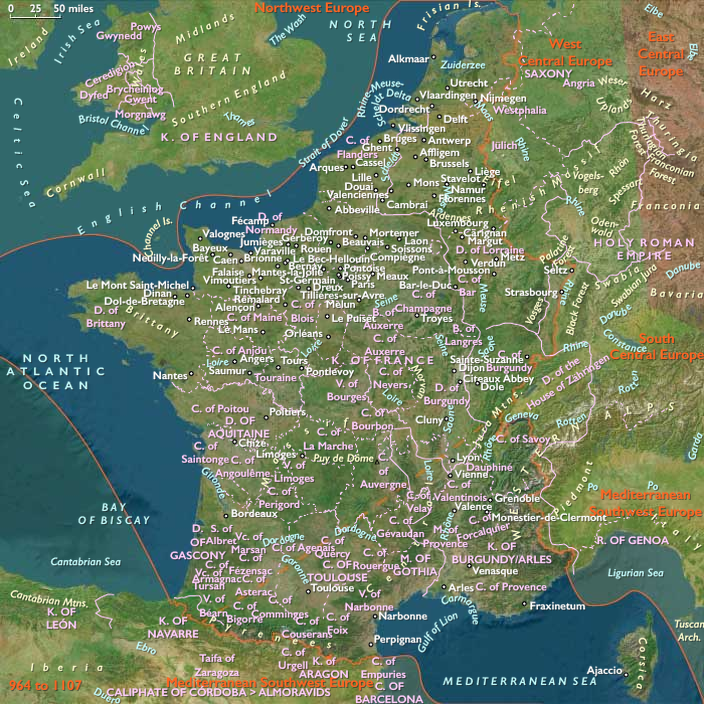
Between 976 and 987, Atlantic West Europe—encompassing the Low Countries, Normandy, Brittany, Aquitaine, Burgundy, central France, Alsace, and Franche-Comté—experienced pivotal shifts in power dynamics, marked by the end of Carolingian rule and the rise of the Capetian dynasty, coupled with continued regional autonomy and gradual stabilization.
Political and Military Developments
-
France: The Rise of the Capetian Dynasty
- Hugh Capet, Duke of the Franks and Count of Paris, solidified his control over northern France, culminating in his election as king in 987, ending Carolingian dominance and founding the Capetian dynasty.
- Louis V, the last Carolingian king, died in 987, marking a definitive end to Carolingian rule in West Francia.
-
Normandy: Consolidation under Richard I
- Richard I of Normandy (r. 942–996) strengthened the Duchy through political alliances, internal organization, and defensive military successes against external threats.
-
Aquitaine and Burgundy: Regional Independence
- William IV of Aquitaine (r. 963–990) continued to foster independence and prosperity, maintaining stability and encouraging regional autonomy.
- Otto-William became Count of Burgundy in 982, managing regional affairs with considerable independence from central royal authority.
-
Brittany: Stability and Local Autonomy
- Conan I (r. 990–992), building upon predecessors’ foundations, reinforced Breton autonomy amidst increasing influence from neighboring Normandy and the emerging Capetian France.
Economic and Social Developments
-
Growth of Feudal Structures
- The transition toward decentralized feudal systems accelerated, with powerful dukes and counts asserting greater control over their local domains.
- Economic stability emerged regionally, enabling modest urban and commercial growth, particularly in the Low Countries and Aquitaine.
-
Trade and Maritime Activity
- The Low Countries saw increasing maritime commerce, connecting northern European trade networks, particularly via Bruges and Ghent.
Cultural and Intellectual Developments
-
Monastic and Ecclesiastical Influence
- Benedictine monasteries, notably Cluny, wielded considerable cultural and spiritual influence, promoting monastic reform and ecclesiastical independence.
-
Intellectual Revival
- Modest intellectual revitalization occurred through monastic schools and scriptoria, preserving classical texts and theological scholarship.
Religious Developments
- Church Reform Movements
- The influence of Cluniac reforms expanded across the region, aiming to reduce secular interference in Church matters and elevating monastic discipline.
Legacy and Significance
The period 976–987 marked a significant turning point in Atlantic West Europe:
- Hugh Capet’s rise laid the groundwork for a long-lasting royal dynasty in France.
- Regional autonomy increased, with Normandy, Aquitaine, and Burgundy establishing distinct identities.
- The development of feudal structures provided stability that would shape medieval society for centuries.
- Cluniac reforms significantly influenced religious and cultural norms.
This era thus established foundations for medieval society’s social, political, and religious framework in the following centuries.
People
- Conan I of Rennes
- Hugh Capet
- Louis V, King of Western Francia
- Otto-William
- Richard I of Normandy
- William IV, Duke of Aquitaine
Groups
- Franks
- Aquitaine, (Carolingian) Kingdom of
- Francia Occidentalis (West Francia, or France), Kingdom of
- Normandy, Duchy of
- Arles, Kingdom of, or Second Kingdom of Burgundy
- Brittanny, Duchy of
- Burgundy, County of
- Aquitaine, (Angevin) Duchy of
- France, (Capetian) Kingdom of
Subjects
Regions
Subregions

Years: 976 - 987
People
- Conan I of Rennes
- Hugh Capet
- Louis V, King of Western Francia
- Otto-William
- Richard I of Normandy
- William IV, Duke of Aquitaine
Groups
- Franks
- Aquitaine, (Carolingian) Kingdom of
- Francia Occidentalis (West Francia, or France), Kingdom of
- Normandy, Duchy of
- Arles, Kingdom of, or Second Kingdom of Burgundy
- Brittanny, Duchy of
- Burgundy, County of
- Aquitaine, (Angevin) Duchy of
- France, (Capetian) Kingdom of
Subjects
Regions
Subregions