
Filters:
Atlantic West Europe (880–891): Renewed Carolingian Authority, …
Years: 880 - 891
Atlantic West Europe (880–891): Renewed Carolingian Authority, Regional Powers, and Viking Threats
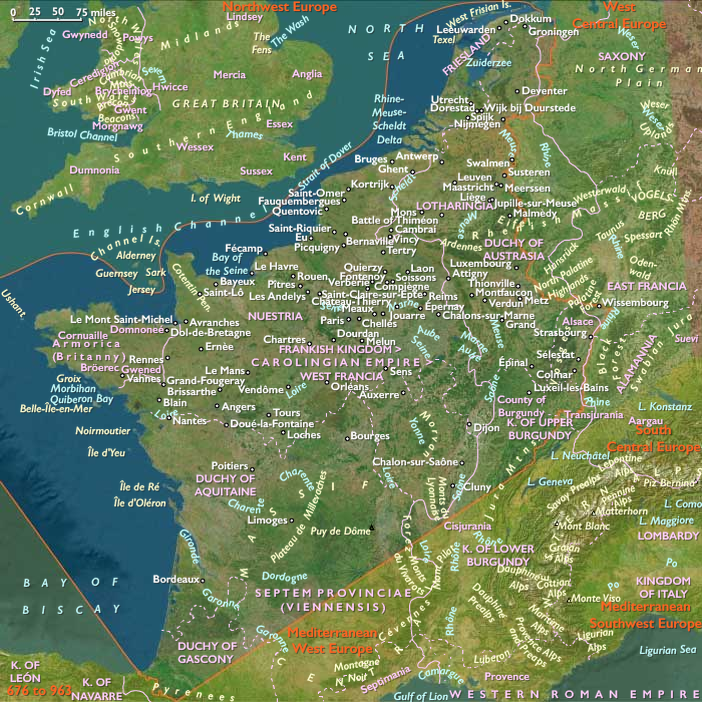
Between 880 and 891, Atlantic West Europe saw the resurgence of Carolingian power in West Francia, the ongoing fragmentation and consolidation of regional principalities like Flanders, Anjou, Aquitaine, Brittany, and Burgundy, and continued threats from Viking raids.
Political and Military Developments
-
West Francia: Restoration Under Charles the Fat
- Carolingian authority briefly consolidated under Emperor Charles the Fat (r. 881–888), who reunited Carolingian territories including West Francia.
- Charles proved largely ineffective, failing notably during the Viking siege of Paris (885–886), despite the heroic defense led by Count Odo of Paris.
-
Rise of Odo of Paris
- Odo, Count of Paris, emerged as a military hero by successfully defending Paris against the Vikings.
- Following Charles the Fat’s deposition in 887 and subsequent death in 888, West Francia's nobility elevated Odo to kingship, establishing him as the first non-Carolingian king since Charlemagne’s dynasty began.
-
Establishment of Principalities
- Flanders continued its growth under Baldwin II "the Bald," fortifying its independence by securing royal recognition and expanding its territories.
- Anjou steadily consolidated power under local counts, enhancing regional autonomy in the Loire Valley.
- Aquitaine experienced ongoing fragmentation among local nobles, though its regional identity and autonomy persisted.
- Brittany strengthened under Duke Alain I, successfully resisting Viking invasions and securing regional autonomy.
-
Upper and Lower Burgundy: Formation of Independent Kingdoms
- After the death of Charles the Fat (888), Upper Burgundy (the future Free County of Burgundy or Franche-Comté) established itself independently under Rudolph I.
- Concurrently, Lower Burgundy (later Kingdom of Provence or Cisjurane Burgundy) emerged under Boso, expanding regional autonomy.
Economic and Social Developments
-
Impact of Viking Raids
- Continued Viking raids disrupted trade routes along the Loire and Seine rivers, leading to fortified towns and castles as defensive measures.
- This further accelerated regional fragmentation and encouraged the rise of local strongholds.
-
Urbanization and Trade
- Despite disruptions, towns like Paris, Tours, and Bruges gradually enhanced their roles as centers of commerce and administrative power, especially with increasing fortifications.
Religious and Cultural Developments
- Monastic Revival and Cultural Preservation
- Monastic centers, despite Viking threats, continued intellectual preservation, notably at Saint-Martin of Tours and Saint-Bertin in Flanders.
- Manuscript illumination and Latin scholarship continued, albeit reduced by instability.
Legacy and Significance
By 891, Atlantic West Europe had experienced:
- The decisive failure and ultimate end of centralized Carolingian control, setting the stage for Odo’s accession and the eventual rise of the Robertian dynasty.
- Continued growth and regional consolidation in Flanders, Anjou, Brittany, and Burgundy, reinforcing political fragmentation into strong regional states.
- Significant cultural preservation despite ongoing disruptions, laying the foundations for regional identities and future political structures in the early medieval period.
This era firmly signaled the fragmentation of Carolingian authority, paving the way toward the feudal decentralization that characterized subsequent medieval Europe.
People
Groups
- Christianity, Chalcedonian
- Aquitaine, (Carolingian) Kingdom of
- Frankish, or Carolingian (Roman) Empire
- Brittany, Kingdom of
- Francia Occidentalis (West Francia, or France), Kingdom of
- Burgundy, Upper, Kingdom of
- Lotharingia, Kingdom of
- Flanders, County of
- Anjou, County of
- Burgundy, Lower, Kingdom of
Topics
Subjects
Regions

Subregions
Years: 880 - 891
People
Groups
- Christianity, Chalcedonian
- Aquitaine, (Carolingian) Kingdom of
- Frankish, or Carolingian (Roman) Empire
- Brittany, Kingdom of
- Francia Occidentalis (West Francia, or France), Kingdom of
- Burgundy, Upper, Kingdom of
- Lotharingia, Kingdom of
- Flanders, County of
- Anjou, County of
- Burgundy, Lower, Kingdom of
Topics
Subjects
Regions
Subregions