
Atlantic West Europe, 868–879: Deepening Fragmentation, Resistance …
Years: 868 - 879
Atlantic West Europe, 868–879: Deepening Fragmentation, Resistance to Vikings, and Shifts in Royal Power
Between 868 and 879, Atlantic West Europe—including West Francia, Normandy, Brittany, Aquitaine, Burgundy, and the Low Countries—witnessed continued political fragmentation, intensified Viking incursions, and important shifts in royal and regional power dynamics.
Political and Military Developments
-
Heightened Viking Incursions
- The Siege of Paris (885–886) was foreshadowed during this era as Vikings increasingly targeted the Seine Valley and other waterways, leading local nobles to take stronger defensive measures.
- Cities such as Rouen, Nantes, and Bordeaux were repeatedly assaulted, accelerating the region’s militarization.
-
Declining Carolingian Authority
- Charles the Bald (r. 843–877) struggled to maintain central authority; his rule increasingly relied on granting extensive privileges to regional counts and dukes.
- Following Charles the Bald’s death in 877, his successors, Louis the Stammerer (r. 877–879) and subsequently Louis III and Carloman II, inherited a fragmented realm with weakened royal power.
-
Rise of Regional Autonomy
- Nobles and regional counts (notably in Aquitaine, Anjou, and Flanders) consolidated their territorial control, governing almost autonomously and resisting centralized oversight.
- Brittany, under King Salomon (r. 857–874), reached the peak of its autonomy, even participating in diplomacy with external powers independent of West Francia.
Economic and Social Developments
-
Continued Growth of Fortified Settlements
- Increased Viking raids accelerated the fortification and settlement of towns, contributing to the growth of fortified urban centers that later emerged as key medieval cities.
- Towns along rivers like the Seine and Loire further developed trade and defensive structures, supporting nascent urban economies despite intermittent disruptions from Viking attacks.
-
Feudal Economy and Manorial System
- The fragmentation of central authority reinforced the feudal system, with local lords exerting stronger economic control through manorial estates and serfdom, reshaping rural societies.
Religious and Cultural Developments
-
The Church’s Role Amid Instability
- Bishops and abbots emerged as crucial political figures, offering spiritual and temporal leadership amid Viking threats and weakening royal control.
- Archbishop Hincmar of Rheims continued to assert considerable influence on West Frankish politics and theological disputes.
-
Preservation of Scholarship and Manuscripts
- Monasteries, despite suffering attacks, continued safeguarding manuscripts, maintaining the foundations of Carolingian intellectual heritage.
Legacy
The period 868–879 solidified the transition toward political decentralization and regional autonomy across Atlantic West Europe. Persistent Viking incursions shaped military, economic, and social structures, while weakened royal power set the stage for enduring feudal fragmentation and increased local governance.
People
Groups
- Christianity, Chalcedonian
- Francia (Carolingians)
- Aquitaine, (Carolingian) Kingdom of
- Frankish, or Carolingian (Roman) Empire
- Brittany, Kingdom of
- Francia Occidentalis (West Francia, or France), Kingdom of
- Burgundy, Upper, Kingdom of
- Lotharingia, Kingdom of
- Flanders, County of
- Anjou, County of
Topics
Subjects
Regions
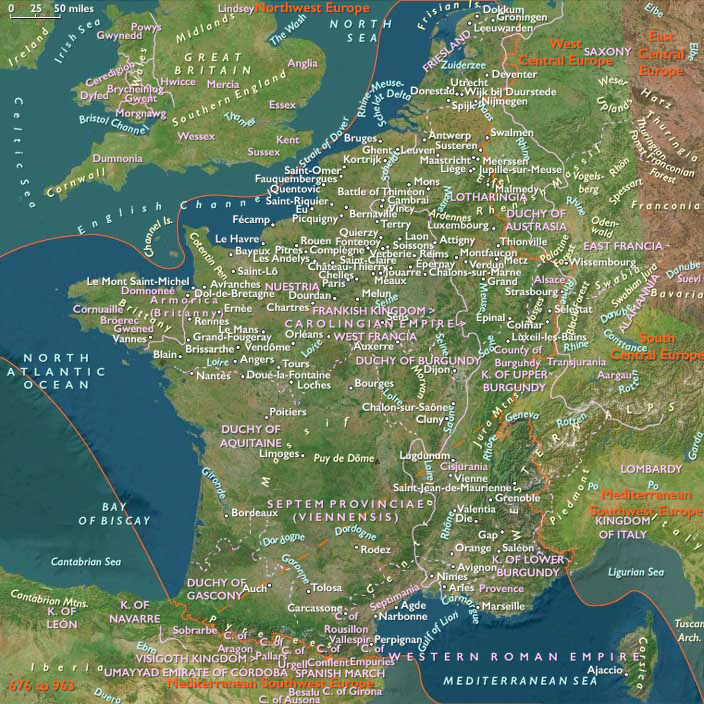
Subregions

Related Events
Showing 10 events out of 18 total
Years: 868 - 879
People
Groups
- Christianity, Chalcedonian
- Francia (Carolingians)
- Aquitaine, (Carolingian) Kingdom of
- Frankish, or Carolingian (Roman) Empire
- Brittany, Kingdom of
- Francia Occidentalis (West Francia, or France), Kingdom of
- Burgundy, Upper, Kingdom of
- Lotharingia, Kingdom of
- Flanders, County of
- Anjou, County of
Topics
Subjects
Regions
Subregions