
Atlantic West Europe, 712–723: Fragmentation, Islamic Expansion, …
Years: 712 - 723
Atlantic West Europe, 712–723: Fragmentation, Islamic Expansion, and Early Carolingian Rise
Between 712 and 723, Atlantic West Europe underwent a period of intense political fragmentation, significant military challenges from expanding Islamic forces, and the initial rise of the Carolingian dynasty under Charles Martel. This era saw critical territorial shifts, internal power struggles among Merovingian rulers, and early responses to external threats that shaped subsequent developments in the region.
Political and Military Developments
-
Umayyad Conquests in Southern Gaul
- Beginning in 719, Umayyad forces from Al-Andalus launched incursions across the Pyrenees, capturing Narbonne in 720.
- Their advance threatened Aquitaine and areas of southern France, posing a direct challenge to existing power structures and prompting local rulers to seek new alliances.
-
Fragmented Merovingian Rule
- Merovingian kings remained largely powerless figureheads, overshadowed by the increasing authority of powerful Mayors of the Palace, especially in Austrasia and Neustria.
- Internal struggles among the Frankish nobility exacerbated political fragmentation, weakening effective resistance to external threats.
-
Rise of Charles Martel
- Following the death of his father Pepin of Herstal in 714, Charles Martel initially faced strong opposition from rivals seeking control over Austrasia and Neustria.
- By 718, Charles decisively defeated rival Neustrian and Frisian factions at the Battle of Soissons (719), consolidating his position as Mayor of the Palace and emerging as the dominant power behind the Merovingian throne.
Economic and Social Developments
-
Disruptions from Conflict
- Repeated military incursions, notably from Umayyad forces and internal Frankish conflicts, disrupted agricultural productivity and trade, especially in southern and western territories.
- The region’s economy became increasingly localized, as disrupted trade routes necessitated greater self-sufficiency.
-
Land Redistribution and Proto-Feudal Structures
- Early signs of proto-feudal arrangements emerged as Charles Martel redistributed confiscated church and noble lands to loyal followers, creating a network of personal allegiances and laying the groundwork for future feudalism.
Religious and Cultural Developments
-
Church Authority and Land Controversies
- The redistribution of church lands by Charles Martel generated tensions between secular and ecclesiastical authorities, setting the stage for ongoing disputes about church autonomy and secular control.
-
Missionary Efforts and Conversion
- Saint Boniface began his missionary activities around 719, with initial efforts to convert Germanic peoples to Christianity supported by the Frankish rulers. These missions would have long-lasting impacts on European religious identity.
Intellectual and Artistic Developments
- Cultural Continuity Amid Turmoil
- Despite widespread disruption, monastic centers and bishoprics continued preserving classical texts and traditions, maintaining cultural continuity and literacy in a volatile period.
- Limited manuscript illumination and literary activity persisted, although growth remained modest due to instability.
Long-Term Significance
The period 712–723 was pivotal for Atlantic West Europe, marking the onset of sustained Islamic incursions from Al-Andalus into southern Gaul, challenging regional powers and reshaping military priorities. Internally, the emergence of Charles Martel represented a decisive shift away from fragmented Merovingian rule toward centralized Carolingian authority. His political consolidation laid critical foundations for subsequent decades, enabling the Franks to effectively respond to external threats and establishing the conditions for future Carolingian ascendancy.
People
Groups
- Franks
- Moors
- Christianity, Chalcedonian
- Aquitaine, (Frankish) Duchy of
- Islam
- Burgundy, Frankish Kingdom of
- Umayyad Caliphate (Damascus)
- Francia (mayors of the palaces of Austrasia and Neustria)
Topics
Commodoties
Subjects
Regions
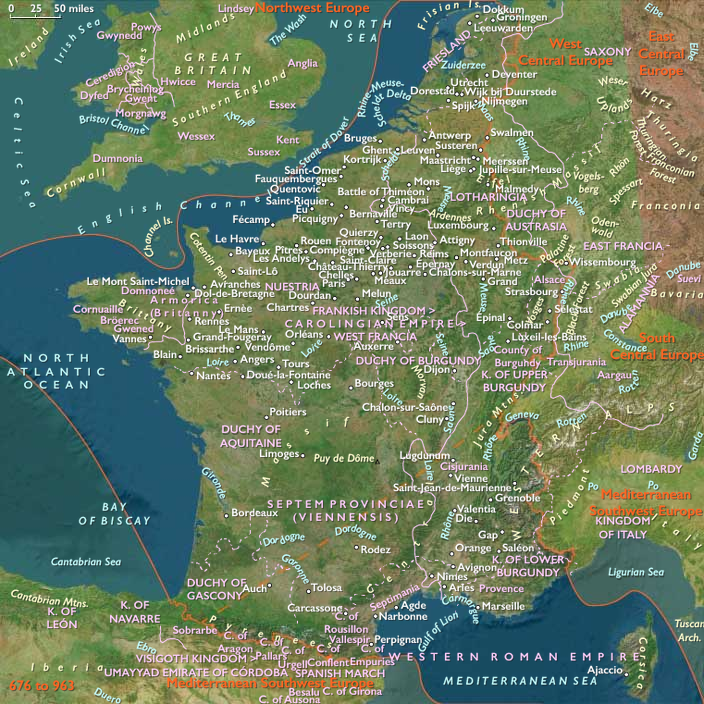
Subregions

Years: 712 - 723
People
Groups
- Franks
- Moors
- Christianity, Chalcedonian
- Aquitaine, (Frankish) Duchy of
- Islam
- Burgundy, Frankish Kingdom of
- Umayyad Caliphate (Damascus)
- Francia (mayors of the palaces of Austrasia and Neustria)
Topics
Commodoties
Subjects
Regions
Subregions