
Atlantic West Europe, 688–699: Pepin of Herstal …
Years: 688 - 699
Atlantic West Europe, 688–699: Pepin of Herstal and the Consolidation of Frankish Power
Between 688 and 699, Atlantic West Europe saw the firm establishment of Pepin of Herstal’s authority as Mayor of the Palace across the Frankish realms. This era solidified Austrasian dominance, reinforced Carolingian foundations, and brought relative stability after decades of internal conflict.
Political and Military Developments
-
Consolidation of Pepin of Herstal’s Authority
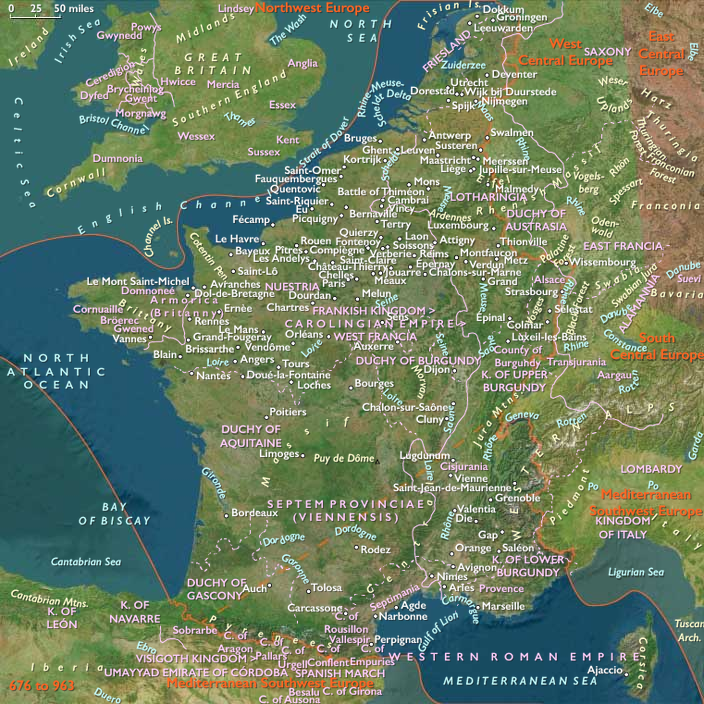
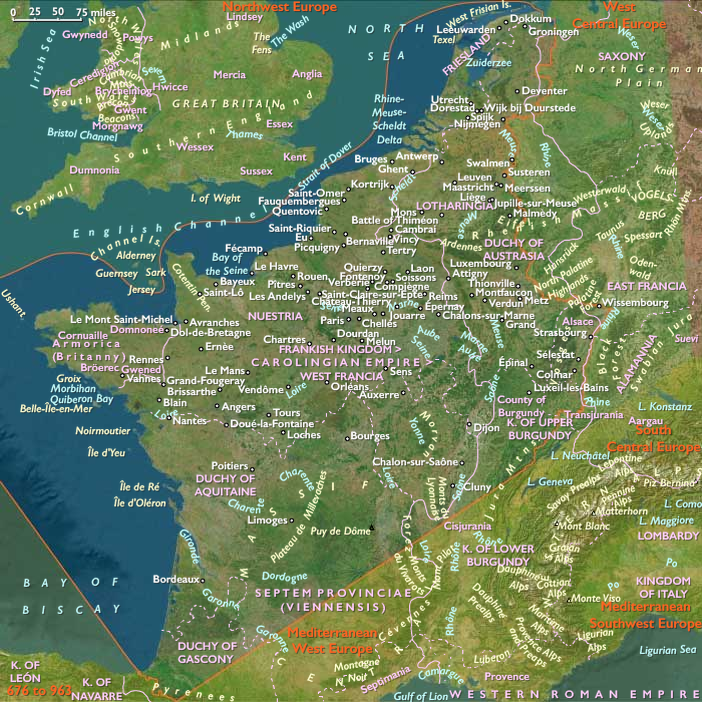
- Following his decisive victory at the Battle of Tertry (687), Pepin of Herstal effectively ruled Austrasia, Neustria, and Burgundy, uniting the Frankish kingdoms under Austrasian hegemony.
- Pepin established his capital at Metz, reinforcing Austrasia’s central political role within the broader Frankish realm.
-
Weakening of Merovingian Kings
- Merovingian kings, notably Theuderic III (d. 691) and Clovis IV (r. 691–695), served largely symbolic roles as royal authority became increasingly concentrated in the office of Mayor of the Palace.
- By the late 690s, Pepin’s rule was uncontested, significantly reducing internal factionalism between Neustria and Austrasia.
Economic and Social Developments
-
Revival of Stability and Economic Activity
- Pepin's effective rule provided a more stable environment for agriculture and trade, allowing regional economies in Austrasia, Neustria, and Burgundy to slowly recover from prior disruptions.
- Improved governance and security fostered local market activities, laying the foundations for economic recovery that would continue into the early 8th century.
-
Emerging Proto-Feudalism
- Land grants and patronage networks began to solidify, establishing early feudal relationships where military allegiance to mayors and local lords gained prominence.
Religious and Cultural Developments
-
Church Alliances and Monastic Growth
- Pepin of Herstal maintained close relationships with powerful ecclesiastical institutions, relying on monasteries like Saint Arnulf in Metz and Saint-Denis near Paris to strengthen his legitimacy.
- Monasteries continued to thrive as cultural and educational hubs, notably Corbie, Luxeuil, and Saint Wandrille.
-
Missionary Activity
- Frankish monks continued their missionary outreach, preparing the ground for later missions, especially into Germanic territories beyond the Rhine.
Intellectual and Artistic Developments
- Continued Monastic Scholarship
- Scriptoria at Metz, Corbie, and Luxeuil preserved religious and classical texts, though artistic innovation was modest during this period.
- Manuscripts produced in this era combined Merovingian traditions with early influences that would later flourish under the Carolingians.
Long-Term Significance
The era 688–699 was critical in establishing Austrasian dominance under Pepin of Herstal, marking the practical decline of Merovingian kingship and the rise of Carolingian rule. By consolidating authority, Pepin brought stability and laid essential foundations for subsequent political developments and Carolingian ascendancy.
People
Groups
- Franks
- Christianity, Chalcedonian
- Burgundy, Frankish Kingdom of
- Francia (mayors of the palaces of Austrasia and Neustria)
Topics
Subjects
Regions
Subregions
Related Events
Showing 10 events out of 55975 total
Years: 688 - 699
People
Groups
- Franks
- Christianity, Chalcedonian
- Burgundy, Frankish Kingdom of
- Francia (mayors of the palaces of Austrasia and Neustria)
Topics
Subjects
Regions
Subregions