
Filters:
Atlantic West Europe, 676–687: Shifting Power and …
Years: 676 - 687
Atlantic West Europe, 676–687: Shifting Power and Frankish Realignments
The period from 676 to 687 in Atlantic West Europe was marked by renewed internal divisions within the Frankish kingdoms, the continued fragmentation of Merovingian authority, and the rising prominence of Austrasian power—setting the stage for the Carolingian ascendancy.
Political and Military Developments
-
Fragmentation of Merovingian Power
- After the death of Childeric II (675), the Frankish kingdoms plunged into renewed chaos, exacerbating rivalries between Austrasia, Neustria, and Burgundy.
- Kings such as Dagobert II (Austrasia, r. 676–679) and Theuderic III (Neustria, intermittently 673–691) struggled to assert meaningful authority amid powerful court factions.
-
Rise of Austrasian Mayors
- Pepin of Herstal emerged as a pivotal figure in Austrasia, strengthening the region’s autonomy and building political networks.
- Tensions between Neustria and Austrasia culminated in the decisive Battle of Tertry (687), where Pepin secured Austrasian dominance over Neustria, dramatically altering the power dynamics of the Frankish kingdoms.
-
Weakening of Neustria and Burgundy
- Neustrian authority diminished significantly, with Mayor of the Palace Ebroin's death (680/681) creating a leadership vacuum that Pepin of Herstal exploited.
- Burgundy increasingly fell under Austrasian influence following the Austrasian victory at Tertry.
Economic and Social Developments
- Instability and Economic Disruption
- Prolonged civil strife hindered economic stability, leading to disruptions in trade, agriculture, and local governance.
- Rural communities increasingly depended on local lords and ecclesiastical estates for protection and support, further entrenching proto-feudal structures.
Religious and Cultural Developments
- Monastic Expansion Amid Instability
- Despite political turmoil, monastic communities such as Luxeuil, Corbie, and Saint-Denis thrived, becoming vital centers of stability, education, and manuscript production.
- The church continued to assert moral and political influence, offering a counterbalance to secular factionalism.
Intellectual and Artistic Developments
- Continuing Merovingian Manuscript Culture
- Monastic scriptoria preserved classical and Christian texts, maintaining cultural continuity despite political disruptions.
- Artistic expression continued in illuminated manuscripts, blending late-Roman artistic traditions with Merovingian motifs.
Long-Term Significance
The era 676–687 marked the critical transition from divided Merovingian rule toward Austrasian hegemony under Pepin of Herstal, paving the way for the Carolingian dynasty's rise. The decisive Battle of Tertry represented a fundamental turning point, reshaping political structures that would define Frankish governance for generations.
People
Groups
- Franks
- Christianity, Chalcedonian
- Austrasia, Frankish Kingdom of
- Neustria and Burgundy, Frankish Kingdom of
- Burgundy, Frankish Kingdom of
- Francia (mayors of the palaces of Austrasia and Neustria)
Topics
Subjects
Regions
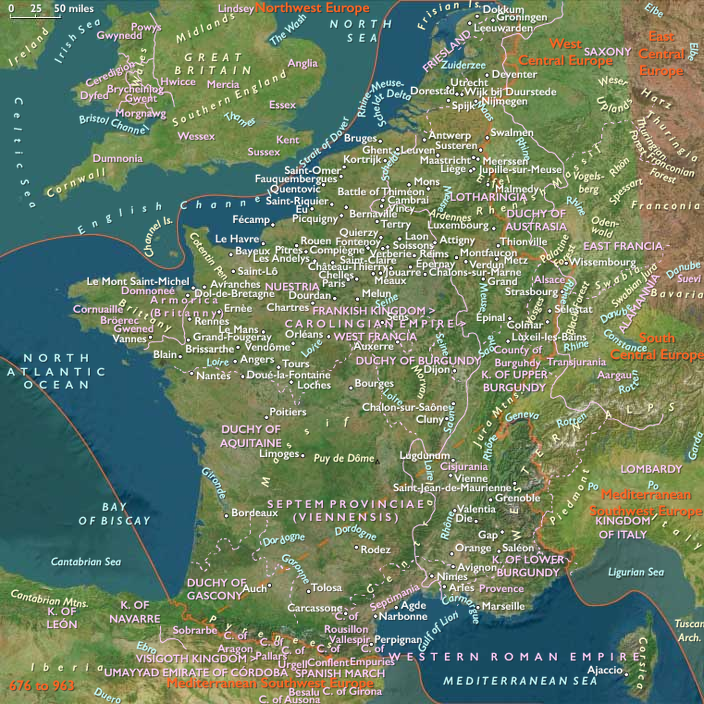
Subregions
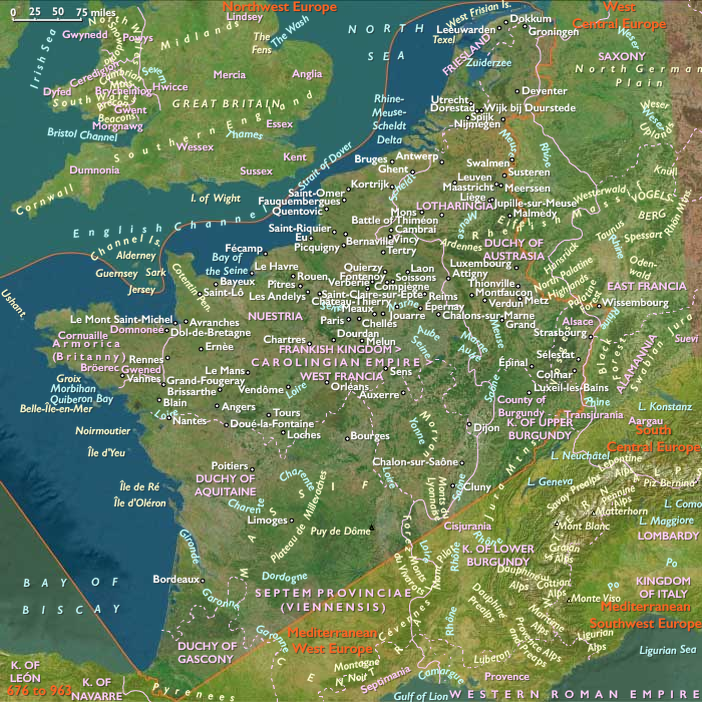
Years: 676 - 687
People
Groups
- Franks
- Christianity, Chalcedonian
- Austrasia, Frankish Kingdom of
- Neustria and Burgundy, Frankish Kingdom of
- Burgundy, Frankish Kingdom of
- Francia (mayors of the palaces of Austrasia and Neustria)
Topics
Subjects
Regions
Subregions