
Atlantic West Europe (664–675): Aristocratic Dominance, Monastic …
Years: 664 - 675
Atlantic West Europe (664–675): Aristocratic Dominance, Monastic Expansion, and the Rise of Austrasian Influence
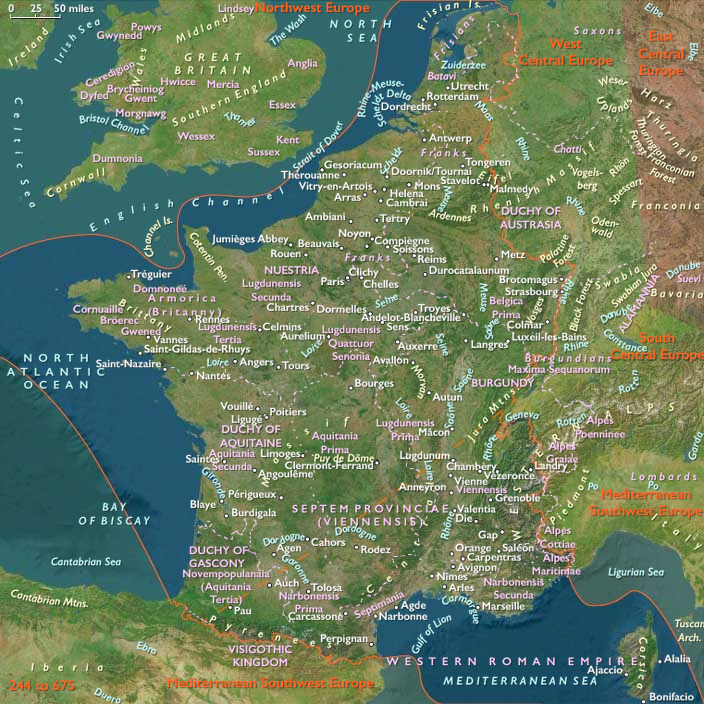
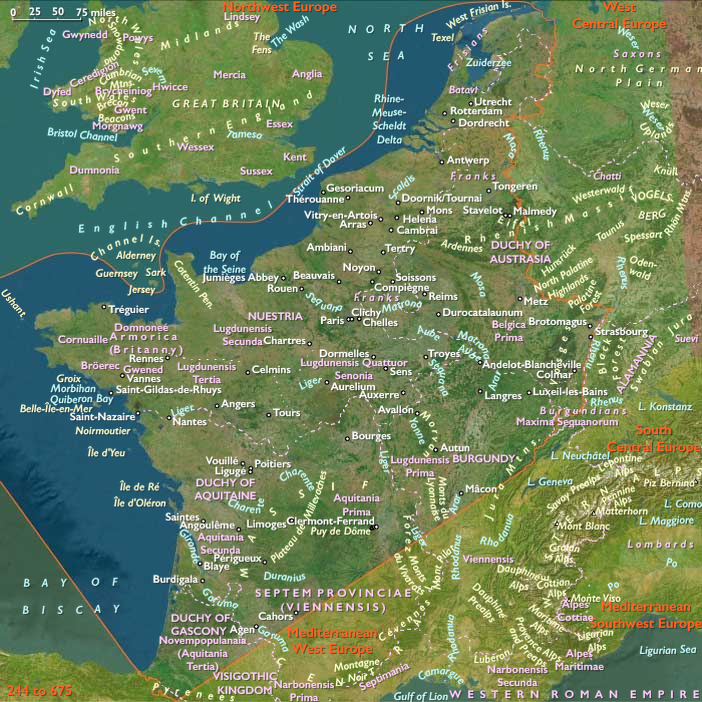
Between 664 and 675, Atlantic West Europe—including Neustria, Austrasia, Burgundy, Aquitaine, and adjoining regions—continued to experience declining Merovingian royal authority, aristocratic ascendancy, increased monastic influence, and the beginnings of Austrasian dominance that would shape future political developments.
Political and Military Developments
Continued Decline of Royal Authority
-
Chlothar III (r. 657–673, Neustria and Burgundy) and Childeric II (r. 662–675, Austrasia; briefly unified all Frankish realms 673–675) held nominal royal power overshadowed by their mayors of the palace.
-
Central authority weakened further as aristocratic factions solidified power, leaving Merovingian kings largely symbolic rulers.
Rise and Fall of Ebroin in Neustria
-
Ebroin, the powerful Neustrian mayor of the palace (658–673, and again 675–680), imposed firm control, briefly stabilizing the region but sparking intense aristocratic resistance and rivalries.
-
Ebroin's authoritarian rule provoked revolts, culminating in his temporary imprisonment (673), demonstrating the volatility of aristocratic politics.
Austrasian Ascendancy Under Pepin of Herstal
-
Pepin of Herstal (Pepin II), gaining prominence in Austrasia, began consolidating power as mayor of the palace (from around 675), laying foundations for Carolingian ascendancy.
-
Pepin’s power represented a critical shift, positioning Austrasia as the dominant political force within the Frankish realms.
Increasing Regional Autonomy in Aquitaine and Brittany
-
Aquitaine’s dukes consolidated semi-independent authority, distancing themselves further from Merovingian control.
-
Brittany maintained its independence, navigating between Frankish and regional influences.
Economic and Social Developments
Aristocratic Estates and Feudal Beginnings
-
Aristocratic families strengthened their control over land, solidifying early feudal structures marked by powerful landholding elites.
-
Large estates increasingly became self-contained economic units, managed independently of royal oversight.
Trade and Regional Economies
-
Internal trade networks continued, though primarily localized due to weakened central governance.
-
Coastal trade flourished in Brittany and Aquitaine, linking these regions economically with British Isles and the Iberian Peninsula.
Religious and Cultural Developments
Expansion of Monasticism and Irish Influence
-
Monastic foundations grew extensively, notably Luxeuil Abbey and Corbie Abbey, becoming cultural and economic centers.
-
Irish missionaries, following Columbanus's tradition, continued founding monasteries across Neustria and Austrasia, fostering cultural exchange and ecclesiastical reform.
Intellectual and Artistic Continuity
-
Monastic scriptoria produced illuminated manuscripts, such as early copies of religious texts, preserving classical and early medieval scholarship.
-
Bishops and abbots increasingly assumed leadership roles, both spiritually and politically, reinforcing ecclesiastical influence over society.
Church Synods and Reform Movements
-
Continued ecclesiastical councils and synods, notably the Council of Autun (670), reaffirmed Church discipline and sought to impose uniform religious practices.
-
The Church emerged as a stabilizing force amid political instability and royal weakness.
Legacy and Significance
The period 664–675 further entrenched aristocratic power, witnessed the rise of Austrasian dominance under Pepin of Herstal, and saw the continued flourishing of monastic and ecclesiastical authority. These developments critically set the stage for the transition from the Merovingian to the Carolingian era, profoundly shaping Atlantic West Europe’s medieval trajectory.
People
Groups
- Franks
- Christianity, Chalcedonian
- Aquitaine, (Frankish) Duchy of
- Reims and Metz (eventually Austrasia), Frankish Kingdom of
- Austrasia, Frankish Kingdom of
- Neustria and Burgundy, Frankish Kingdom of
- Basque people
Topics
Commodoties
Subjects
Regions
Subregions
Years: 664 - 675
People
Groups
- Franks
- Christianity, Chalcedonian
- Aquitaine, (Frankish) Duchy of
- Reims and Metz (eventually Austrasia), Frankish Kingdom of
- Austrasia, Frankish Kingdom of
- Neustria and Burgundy, Frankish Kingdom of
- Basque people
Topics
Commodoties
Subjects
Regions
Subregions