
Atlantic West Europe (652–663): Aristocratic Rivalries, Dynastic …
Years: 652 - 663
Atlantic West Europe (652–663): Aristocratic Rivalries, Dynastic Instability, and Increasing Regional Autonomy
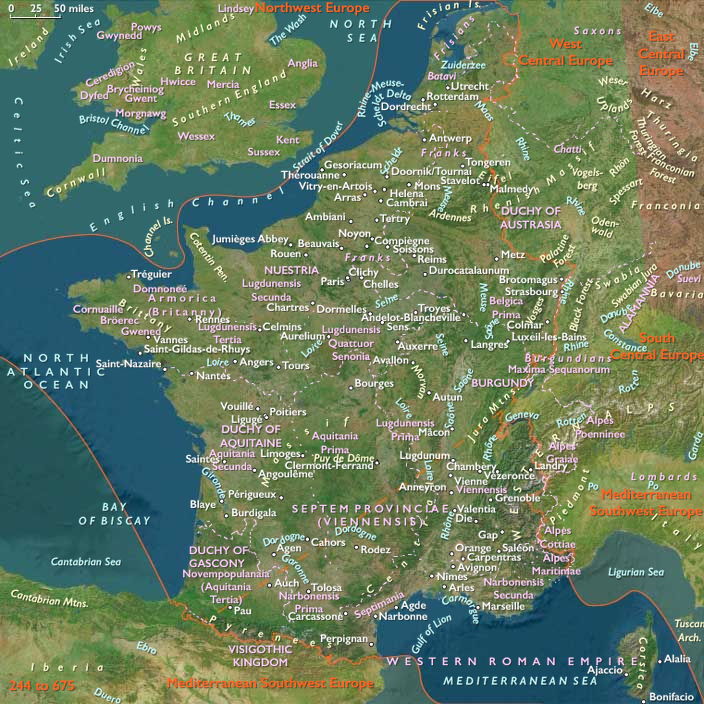
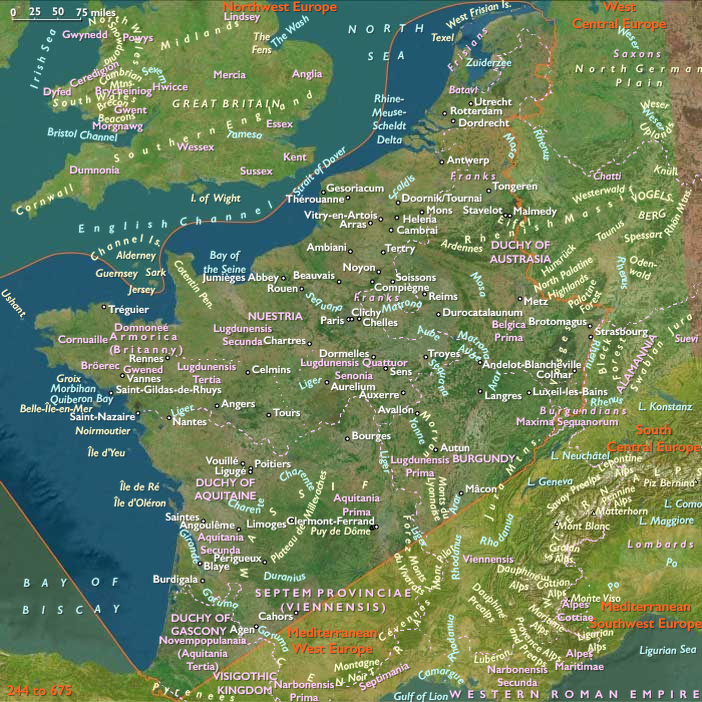
Between 652 and 663, Atlantic West Europe—including Neustria, Austrasia, Burgundy, Aquitaine, and adjacent regions—saw further fragmentation of royal authority, characterized by intensified aristocratic rivalries, political instability, and growing regional autonomy, setting the stage for a shift toward feudal decentralization.
Political and Military Developments
Weakening of Merovingian Royal Power
-
Kings Clovis II (r. 639–657, Neustria and Burgundy) and Sigebert III (r. 634–656, Austrasia) continued to hold nominal power, but real authority lay increasingly with aristocratic factions and their leaders.
-
The role of mayors of the palace, notably Grimoald the Elder in Austrasia and Erchinoald in Neustria, further eclipsed royal authority, transforming their positions into effective rulers.
Grimoald's Coup in Austrasia (656)
-
Upon Sigebert III’s death (656), Grimoald executed a daring coup, placing his own son, Childebert the Adopted, briefly on the Austrasian throne, bypassing Sigebert's legitimate heir, Dagobert II.
-
Grimoald’s move intensified aristocratic tensions and led to political instability and infighting across Austrasia and Neustria.
Heightened Regional Autonomy
-
Aquitaine, under local dukes, increasingly distanced itself from Merovingian central authority, establishing semi-independent rule.
-
Brittany and Gascony similarly consolidated autonomy, managing internal affairs independently, and occasionally clashing with Frankish border forces.
Economic and Social Developments
Continued Decentralization of Economy
-
Economic management became further localized as central authority diminished, with individual aristocratic estates and monasteries driving regional economies.
-
Trade and commercial activities within regions remained robust, but wider economic integration weakened due to political instability and localized governance.
Growing Aristocratic Land Control
-
Noble families expanded their power bases by acquiring additional lands and rights through royal grants, inheritance, and forceful appropriations, shaping early feudal structures.
-
Serfdom and dependence on aristocratic landlords solidified, laying foundations for future feudal relationships.
Religious and Cultural Developments
Expansion of Monastic and Ecclesiastical Influence
-
Monastic centers, particularly Luxeuil Abbey, Saint-Denis, and Irish-founded institutions, continued to expand their economic and cultural influence amidst political fragmentation.
-
Bishops and abbots assumed even greater political roles, often acting as intermediaries and stabilizing forces amid aristocratic rivalries.
Religious Reform and Synods
-
Church councils and synods intensified efforts to enforce ecclesiastical discipline, notably the ongoing Synod of Chalon (647–653), emphasizing Church authority over local religious life and morality.
-
The Church thus became a critical source of authority and social coherence, partially compensating for weakened royal governance.
Artistic and Intellectual Continuity
-
Monastic scriptoria continued producing illuminated manuscripts, reflecting cultural vitality despite political instability.
-
Theological and scholarly writings flourished within monasteries, ensuring intellectual continuity and transmission of knowledge.
Legacy and Significance
The period 652–663 deepened the shift from centralized Merovingian rule toward aristocratic dominance, regional autonomy, and ecclesiastical authority. Political instability, such as Grimoald's coup, further eroded royal power, creating a fractured landscape that would pave the way for Carolingian consolidation in the following century.
People
Groups
- Franks
- Christianity, Chalcedonian
- Aquitaine, (Frankish) Duchy of
- Reims and Metz (eventually Austrasia), Frankish Kingdom of
- Austrasia, Frankish Kingdom of
- Neustria and Burgundy, Frankish Kingdom of
- Basque people
Topics
Commodoties
Subjects
Regions
Subregions
Years: 652 - 663
People
Groups
- Franks
- Christianity, Chalcedonian
- Aquitaine, (Frankish) Duchy of
- Reims and Metz (eventually Austrasia), Frankish Kingdom of
- Austrasia, Frankish Kingdom of
- Neustria and Burgundy, Frankish Kingdom of
- Basque people
Topics
Commodoties
Subjects
Regions
Subregions