
Atlantic West Europe (628–639): Dagobert I’s Reign, …
Years: 628 - 639
Atlantic West Europe (628–639): Dagobert I’s Reign, Royal Revival, and Monastic Flourishing
Between 628 and 639, Atlantic West Europe—including Neustria, Austrasia, Burgundy, Aquitaine, and surrounding regions—experienced a brief revival of Merovingian royal authority under Dagobert I, consolidation of political and administrative structures, and significant growth in ecclesiastical and monastic institutions.
Political and Military Developments
Dagobert I’s Unification and Centralization
-
Dagobert I (r. 629–639) became sole ruler of all Frankish territories upon the death of his father, Chlothar II, in 629, marking the last significant period of centralized Merovingian rule.
-
His active involvement in administration strengthened royal authority temporarily, mitigating noble autonomy and renewing central oversight through effective diplomacy and governance.
Administrative Reforms
-
Dagobert established a more centralized and professional administrative apparatus, appointing capable advisors such as Pepin of Landen and Arnulf of Metz—ancestors of the later Carolingians—thus laying the groundwork for future political structures.
-
He maintained robust regional governance by balancing central authority with noble cooperation, ensuring relative stability within his extensive domains.
Military Engagements and Border Stability
-
Dagobert successfully subdued Basque and Gascon rebellions, strengthening Frankish dominance in Aquitaine and consolidating control along the Pyrenean frontier.
-
His reign witnessed relative peace within core territories, although frontier regions remained periodically contested by peripheral powers.
Economic and Social Developments
Economic Prosperity and Market Expansion
-
The peace and administrative efficiency fostered under Dagobert led to increased agricultural production and the stabilization of local economies.
-
Urban growth continued, with flourishing markets and fairs developing around key cities and monastic centers, particularly Tours, Nantes, Paris, and Bordeaux.
Aristocratic Patronage and Wealth Consolidation
-
The aristocratic elite consolidated their economic power through royal grants, land acquisitions, and strategic marital alliances.
-
Landed estates managed by monasteries and noble families served as key economic centers, reinforcing feudal social structures.
Religious and Cultural Developments
Expansion of Monastic and Ecclesiastical Institutions
-
Dagobert generously patronized monastic foundations, most famously Saint-Denis Abbey, which became the royal necropolis and a major spiritual and political center.
-
Irish monastic influence continued through foundations such as Luxeuil and Bobbio, promoting scholarship, asceticism, and manuscript production.
Growth of Ecclesiastical Authority
-
Bishops and abbots extended their political and social influence, integrating closely into secular governance structures and becoming key advisors to the king and nobility.
-
Church councils convened regularly, enforcing ecclesiastical discipline, standardizing liturgical practices, and strengthening the Church’s social authority.
Artistic and Intellectual Flourishing
-
Under Dagobert’s patronage, Saint-Denis Abbey emerged as a leading center of artistic innovation, exemplified by the exquisite metalwork, manuscripts, and religious artifacts produced there.
-
Monastic scriptoria across the region produced significant illuminated manuscripts, fostering literacy and intellectual growth.
Legacy and Significance
The era 628–639 represented the zenith of Merovingian centralized authority under Dagobert I, characterized by strengthened royal governance, economic prosperity, monastic expansion, and ecclesiastical consolidation. Although the unity achieved under Dagobert was short-lived, his reign profoundly impacted subsequent political, social, and cultural developments, setting the foundations upon which Carolingian power would later rise.
People
Groups
- Franks
- Christianity, Chalcedonian
- Soissons (eventually Neustria), Frankish Kingdom of
- Paris, Frankish Kingdom of
- Orléans (eventually Burgundy), Frankish Kingdom of
- Aquitaine, (Frankish) Duchy of
- Reims and Metz (eventually Austrasia), Frankish Kingdom of
- Austrasia, Frankish Kingdom of
- Basque people
Topics
Commodoties
Subjects
Regions
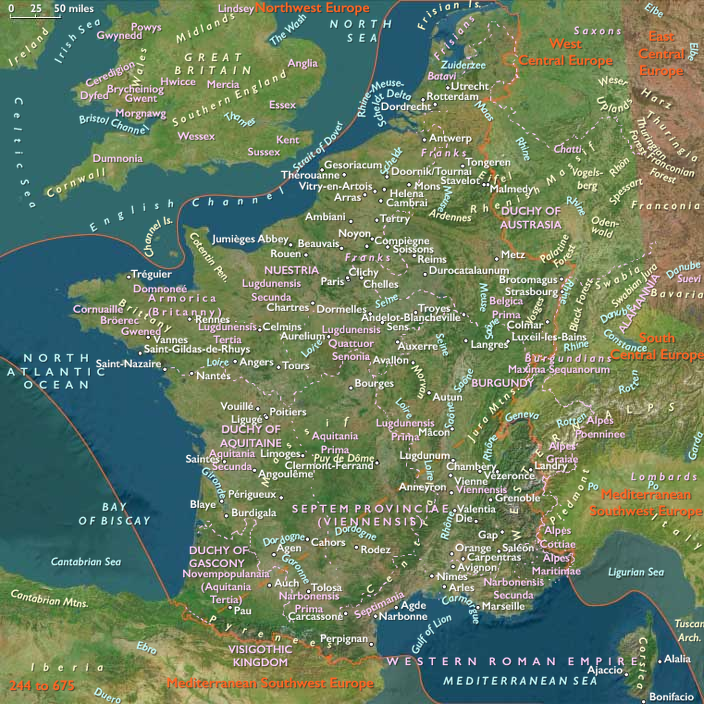
Subregions
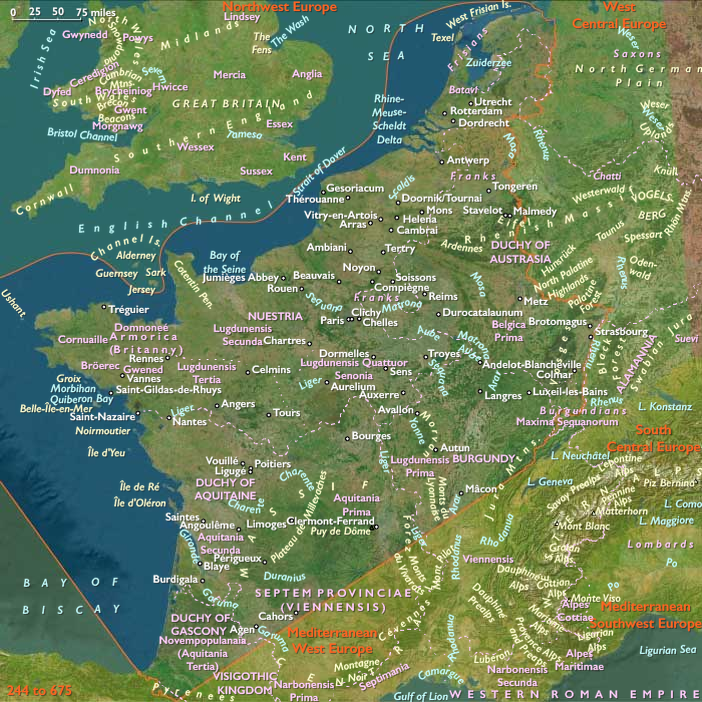
Years: 628 - 639
People
Groups
- Franks
- Christianity, Chalcedonian
- Soissons (eventually Neustria), Frankish Kingdom of
- Paris, Frankish Kingdom of
- Orléans (eventually Burgundy), Frankish Kingdom of
- Aquitaine, (Frankish) Duchy of
- Reims and Metz (eventually Austrasia), Frankish Kingdom of
- Austrasia, Frankish Kingdom of
- Basque people
Topics
Commodoties
Subjects
Regions
Subregions