
Atlantic West Europe (544–555): Consolidation, Dynastic Struggles, …
Years: 544 - 555
Atlantic West Europe (544–555): Consolidation, Dynastic Struggles, and Ecclesiastical Growth
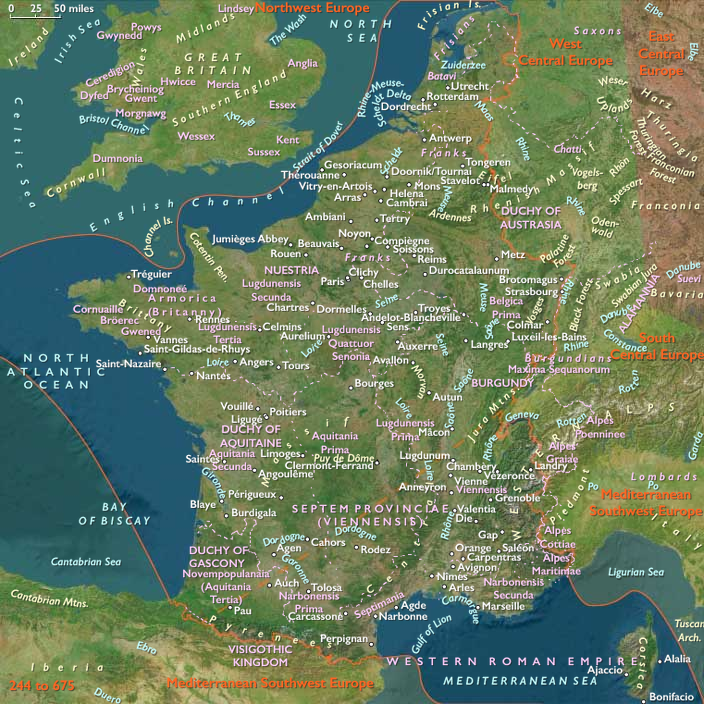
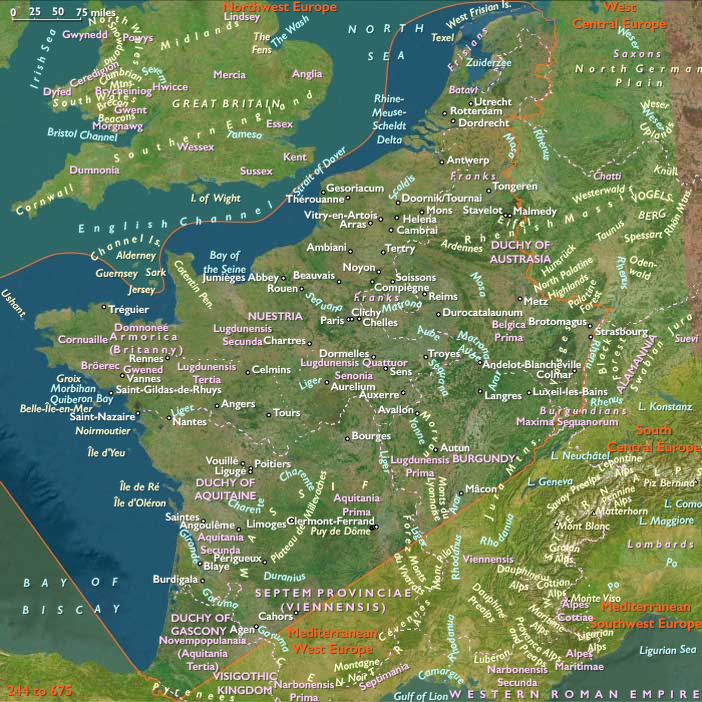
Between 544 and 555, Atlantic West Europe—covering modern-day France (Gaul), Burgundy, and the Low Countries—continued to witness Merovingian dynastic rivalries, territorial consolidation, and expanding ecclesiastical influence. During this era, Frankish kingdoms navigated internal political divisions and solidified their authority, fostering early medieval stability and Christianization.
Political and Military Developments
Merovingian Power Dynamics and Territorial Consolidation
- The Frankish kingdoms, ruled by Childebert I, Chlothar I, and Theudebert I, experienced shifting alliances and rivalries.
- Chlothar I, after consolidating Burgundy with his brother Childebert, gradually increased his influence, particularly in Neustria and Aquitaine, aiming at broader unification.
- Theudebert I (r. 533–548), ruler of Austrasia (northeast Gaul), expanded eastward into Germanic territories, enhancing Austrasian prestige and economic strength.
Conflicts and Dynastic Rivalries
- Following Theudebert I's death in 548, his son, Theudebald (r. 548–555), ascended but struggled to maintain Austrasia's earlier momentum, weakening Austrasian influence relative to Neustria under Chlothar I.
- Tensions between Frankish rulers, including rivalry over succession and territorial control, led to intermittent localized conflicts.
Economic and Social Developments
Stabilization of Rural Estates
- Rural estates (villae) continued to underpin the economy, maintained by aristocratic elites and monastic orders, supporting gradual economic stability after decades of upheaval.
- Increased integration of Burgundy brought valuable agricultural and viticultural lands firmly into Frankish economic systems.
Urban Centers and Local Trade
- Towns like Paris, Tours, Dijon, and Bordeaux retained their ecclesiastical and administrative importance, though urban populations remained modest.
- Local trade persisted along river systems (Loire, Seine, Rhône, Rhine), sustaining regional economic connections despite limited commercial activity.
Religious and Cultural Developments
Growth of Ecclesiastical Power
- Bishops increasingly acted as powerful local administrators and social leaders, influencing governance and societal norms across Gaul.
- The Council of Orléans (549) convened by King Childebert I reinforced church discipline, monastic standards, and ecclesiastical control over local communities.
Expansion of Monasticism
- Monastic communities flourished, notably the monastery of Saint-Germain-des-Prés, founded by Childebert I near Paris in 558, becoming a major cultural and religious hub.
- Monastic foundations, inspired by Benedictine principles, spread steadily, strengthening ecclesiastical networks and cultural continuity.
Cultural Achievements
- Merovingian craftsmanship advanced, as seen in intricate metalwork, jewelry, and manuscript illumination, blending Roman, Germanic, and Christian artistic motifs.
Legacy and Significance
Between 544 and 555, Atlantic West Europe solidified its early medieval identity through Merovingian consolidation, religious development, and cultural synthesis. Despite internal dynastic tensions, this period further entrenched Merovingian rule, established lasting ecclesiastical structures, and deepened Christianization, profoundly shaping the region’s future trajectory.
People
Groups
- Franks
- Christianity, Chalcedonian
- Soissons (eventually Neustria), Frankish Kingdom of
- Paris, Frankish Kingdom of
- Orléans (eventually Burgundy), Frankish Kingdom of
- Reims, Frankish Kingdom of
Topics
Commodoties
Subjects
Regions
Subregions
Related Events
Showing 10 events out of 57704 total
Years: 544 - 555
People
Groups
- Franks
- Christianity, Chalcedonian
- Soissons (eventually Neustria), Frankish Kingdom of
- Paris, Frankish Kingdom of
- Orléans (eventually Burgundy), Frankish Kingdom of
- Reims, Frankish Kingdom of
Topics
Commodoties
Subjects
Regions
Subregions