
Atlantic West Europe (508–519): Frankish Consolidation, Burgundian …
Years: 508 - 519
Atlantic West Europe (508–519): Frankish Consolidation, Burgundian Stability, and Ecclesiastical Strengthening
Between 508 and 519, Atlantic West Europe saw the Merovingian Franks consolidate territorial and political gains following the decisive Battle of Vouillé (507). The Frankish Kingdom under Clovis I stabilized its dominance over Gaul, integrating Gallo-Roman traditions, legal structures, and ecclesiastical institutions. Meanwhile, the Burgundian kingdom preserved a degree of autonomy under careful diplomacy, and the Visigothic presence receded definitively into Iberia.
Political and Military Developments
-
Frankish Kingdom: Consolidation under Clovis I
-
Following the conquest of Visigothic territories in Gaul, Clovis I secured his gains by establishing stable governance across Aquitaine and southwestern Gaul, aligning closely with regional bishops and Gallo-Roman aristocrats.
-
He actively fostered administrative continuity by adopting Roman law traditions, notably issuing the Lex Salica (Salic Law) in revised form around 511, blending Roman and Germanic customs.
-
-
Division of the Frankish Kingdom (511):
-
Clovis’s death in 511 led to the division of the Frankish kingdom among his four sons: Theuderic, Chlodomer, Childebert, and Chlothar.
-
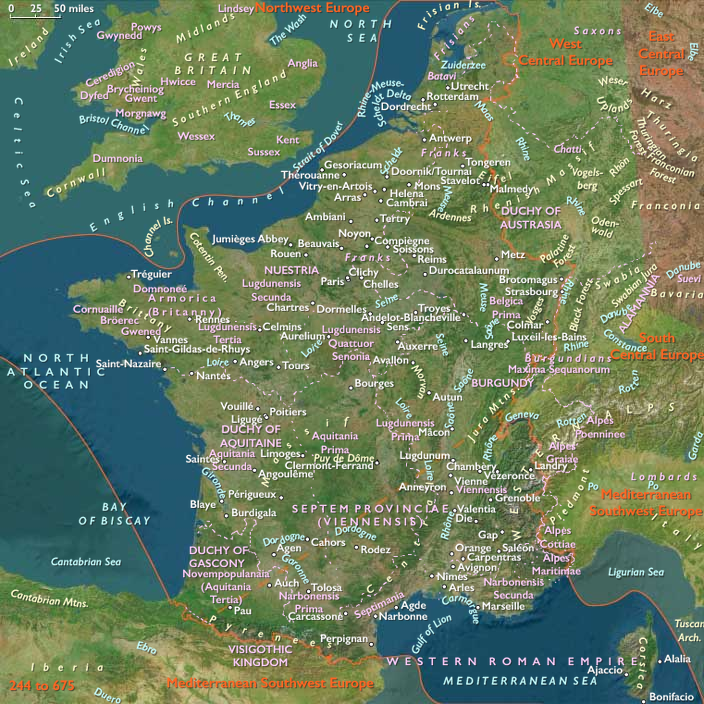
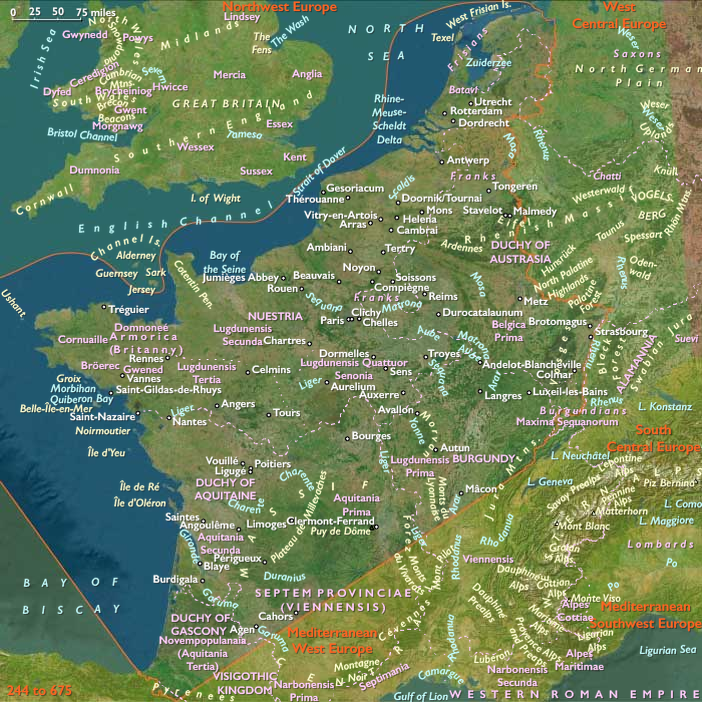
Each son governed a portion of the realm from their regional capitals: Metz (Theuderic), Orléans (Chlodomer), Paris (Childebert), and Soissons (Chlothar). This partition initiated a complex phase of dynastic rivalries, although unity was maintained against external threats.
-
-
Burgundian Stability under Gundobad and Sigismund:
-
King Gundobad (d. 516) maintained careful diplomatic relations with the Frankish rulers, preserving Burgundian territorial integrity.
-
His successor, Sigismund (r. 516–524), continued this balancing act, though Frankish pressures intensified. The kingdom remained autonomous, emphasizing internal governance and legal reforms.
-
-
Visigothic Kingdom Retreat and Reorientation:
-
Visigothic territories north of the Pyrenees had been largely lost by 508. The remaining Visigothic kingdom reorganized south of the Pyrenees under King Theodoric the Great of the Ostrogoths, who intervened as regent following internal Visigothic strife.
-
Visigothic focus shifted definitively toward Iberia, leading to a long-term reorientation of Visigothic culture and governance toward Hispania.
-
Economic and Social Developments
-
Integration of Roman and Frankish Economic Structures:
-
The Frankish kingdom's economic foundation became increasingly tied to extensive agricultural estates managed by bishops and aristocrats, who served as intermediaries between royal authority and local populations.
-
Economic integration between northern and southern Gaul expanded, driven by regional trade networks that benefited from the Frankish peace and internal stability.
-
-
Growing Role of Aristocracy and Church:
-
Frankish and Burgundian aristocrats strengthened their roles in managing land and resources, often controlling local governance in cooperation with bishops.
-
Episcopal estates grew, becoming significant centers of economic and social power, further linking secular and religious authority.
-
Religious and Cultural Developments
-
Strengthening of Catholic Orthodoxy:
-
Clovis’s embrace of Catholic Christianity continued to reshape religious identity. The Catholic Church gained unprecedented influence, with episcopal leaders such as Remigius of Reims playing crucial political roles.
-
Ecclesiastical synods (e.g., Council of Orléans in 511) helped standardize religious practices, clarify episcopal authority, and support Merovingian royal legitimacy.
-
-
Continued Decline of Arianism:
-
Arian Christianity, previously dominant among Visigothic elites, rapidly diminished north of the Pyrenees under Frankish Catholic rule.
-
Catholicism’s dominance set the stage for religious uniformity and reduced sectarian tensions within the Frankish realms.
-
Legacy and Significance
By 519, Atlantic West Europe had undergone significant political and cultural reorientation:
-
The Frankish kingdom consolidated its hold on Gaul, successfully blending Roman traditions with Frankish governance, and laying foundations for future medieval monarchies.
-
Burgundy retained stability through skillful diplomacy and internal reform but increasingly operated in Frankish orbit.
-
The Catholic Church emerged stronger than ever, closely intertwined with secular governance, significantly shaping Western Europe's religious, social, and cultural trajectories.
This era thus established enduring political structures and religious patterns that profoundly influenced the development of early medieval Europe.
People
- Avitus of Vienne
- Childebert I
- Chlodomer
- Chlothar I
- Clovis I
- Gesalec
- Gundobad
- Saint Remigius
- Sigismund of Burgundy
- Theoderic the Great
- Theuderic I
Groups
- Polytheism (“paganism”)
- Franks
- Gallo-Roman culture
- Armorica
- Saxons
- Burgundians (East Germanic tribe)
- Christianity, Arian
- Gaul, Praetorian prefecture of
- Britain, Sub-Roman
- Burgundians, (second) Kingdom of the
- Christianity, Chalcedonian
- Francia (Merovingians)
- Ostrogoths, Italian Kingdom of the
- Visigothic Kingdom of Spain
- Soissons (eventually Neustria), Frankish Kingdom of
- Reims, Frankish Kingdom of
- Paris, Frankish Kingdom of
- Orléans (eventually Burgundy), Frankish Kingdom of
Topics
Commodoties
Subjects
Regions
Subregions
Related Events
Showing 10 events out of 625 total
Years: 508 - 519
People
- Avitus of Vienne
- Childebert I
- Chlodomer
- Chlothar I
- Clovis I
- Gesalec
- Gundobad
- Saint Remigius
- Sigismund of Burgundy
- Theoderic the Great
- Theuderic I
Groups
- Polytheism (“paganism”)
- Franks
- Gallo-Roman culture
- Armorica
- Saxons
- Burgundians (East Germanic tribe)
- Christianity, Arian
- Gaul, Praetorian prefecture of
- Britain, Sub-Roman
- Burgundians, (second) Kingdom of the
- Christianity, Chalcedonian
- Francia (Merovingians)
- Ostrogoths, Italian Kingdom of the
- Visigothic Kingdom of Spain
- Soissons (eventually Neustria), Frankish Kingdom of
- Reims, Frankish Kingdom of
- Paris, Frankish Kingdom of
- Orléans (eventually Burgundy), Frankish Kingdom of
Topics
Commodoties
Subjects
Regions
Subregions