
Atlantic West Europe (484–495): Visigothic and Burgundian …
Years: 484 - 495
Atlantic West Europe (484–495): Visigothic and Burgundian Consolidation Amid Frankish Ambitions
Between 484 and 495, Atlantic West Europe saw the Visigothic and Burgundian kingdoms solidify their territorial control, while the Salian Franks emerged as a significant new force. This era witnessed growing stability in the Visigothic territories, internal consolidation under Burgundian King Gundobad, and the rise of Clovis I, whose ambitions foreshadowed the eventual reshaping of the region.
Political and Military Developments
-
Visigothic Kingdom under Alaric II (r. 484–507):
-
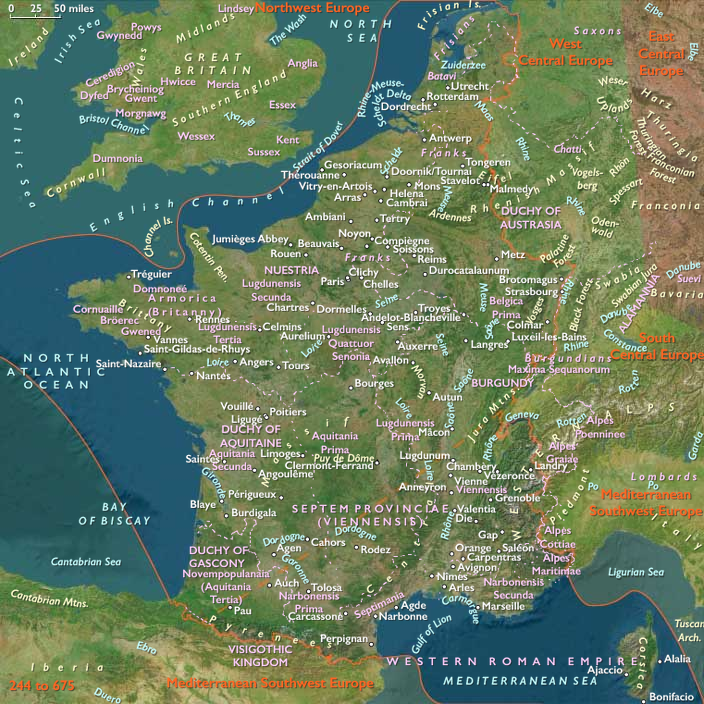
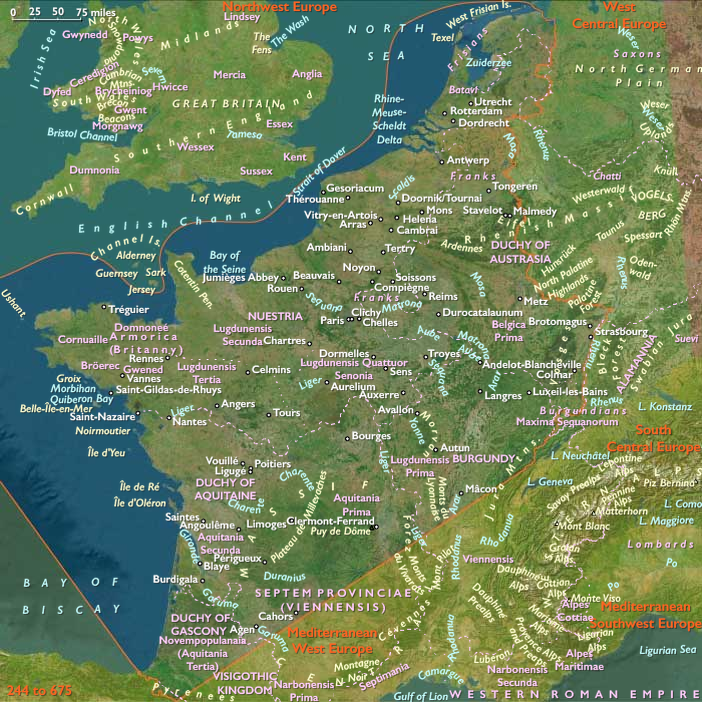
After Euric's death in 484, his son Alaric II inherited a vast kingdom extending from Aquitaine across the southern and western regions of Gaul.
-
Alaric II maintained diplomatic relations with neighboring kingdoms and strengthened governance by codifying laws, balancing Visigothic authority and Roman legal traditions.
-
-
Burgundian Kingdom’s Internal Stability:
-
King Gundobad (r. 473–516) solidified control in Burgundy, quelling internal rivalries through diplomacy and force, centralizing governance around Lyon and Geneva.
-
Gundobad issued the Lex Burgundionum (c. late 5th century), codifying laws for his kingdom that balanced Germanic and Roman elements, securing internal cohesion.
-
-
Rise of the Salian Franks under Clovis I (r. 481–511):
-
The ambitious Merovingian King Clovis I united various Frankish tribes north of the Loire, significantly expanding his influence into northern Gaul.
-
His defeat of the Roman official Syagrius at the Battle of Soissons (486) ended Roman political authority in northern Gaul, marking the rise of Frankish dominance in the region.
-
Economic and Social Developments
-
Gradual Ruralization and Villa Economies:
-
With the continued decline of urban centers, rural villa estates became central to economic life, focusing on localized agricultural productivity.
-
Powerful aristocratic families and ecclesiastical institutions consolidated their landholdings, strengthening economic and political ties with the Germanic rulers.
-
-
Economic Realignment and Trade Networks:
-
Trade and commerce increasingly shifted toward regional patterns, reflecting the decentralized political environment. Bordeaux and Lyon remained significant centers of commerce, maintaining trade connections with Italy, the Mediterranean, and Iberia.
-
Despite disruptions, river systems such as the Rhône and Loire facilitated internal commerce, sustaining the exchange of luxury goods and basic commodities.
-
Religious and Cultural Developments
-
Episcopal and Aristocratic Leadership:
-
Bishops continued to consolidate their dual roles as spiritual and civic leaders, managing religious affairs and local governance. This role was exemplified by Remigius of Reims (later instrumental in Clovis's conversion) and Avitus of Vienne, who mediated between Gundobad’s Burgundian court and Roman cultural traditions.
-
Aristocratic families actively supported ecclesiastical foundations, enhancing the role of the Church in daily life, governance, and education.
-
-
Continued Religious Tolerance and Arianism:
-
Alaric II maintained his kingdom’s official Arian Christianity, tolerating the Catholic majority, ensuring internal harmony and stability.
-
Burgundian King Gundobad, though initially Arian, showed increasing openness to Catholic influences, creating an environment favorable to religious coexistence and eventual integration.
-
Legacy and Significance
By 495, Atlantic West Europe had stabilized into distinct political territories, each adapting elements of Roman governance and law:
-
Visigothic rule under Alaric II provided relative stability, maintaining coexistence of Roman and Germanic traditions.
-
Gundobad's Burgundian kingdom emerged politically cohesive, with internal stability secured by legal and cultural accommodations.
-
Clovis’s rise and expansion of Frankish power began reshaping the political landscape of Gaul, setting the stage for future regional unification and shifts in power dynamics.
This period thus laid critical foundations for the medieval political and cultural structures that would characterize the following centuries.
People
Groups
- Polytheism (“paganism”)
- Franks
- Gallo-Roman culture
- Armorica
- Gallia Lugdunensis (Roman province)
- Gallia Belgica (Roman province)
- Gallia Aquitania (Roman province)
- Saxons
- Burgundians (East Germanic tribe)
- Christianity, Arian
- Gaul, Praetorian prefecture of
- Visigoths, Realm of the
- Roman Empire, Western (Ravenna)
- Britain, Sub-Roman
- Visigothic Kingdom of Toulouse
- Burgundians, (second) Kingdom of the
- Christianity, Chalcedonian
Topics
- Roman Age Optimum
- Late Antiquity
- Migration Period
- Fall of the Western Roman Empire
- Saxon Raids of 407-550
- Visigothic Raids on the Roman Empire, Later
Commodoties
Subjects
Regions
Subregions
Related Events
Showing 10 events out of 58465 total
Years: 484 - 495
People
Groups
- Polytheism (“paganism”)
- Franks
- Gallo-Roman culture
- Armorica
- Gallia Lugdunensis (Roman province)
- Gallia Belgica (Roman province)
- Gallia Aquitania (Roman province)
- Saxons
- Burgundians (East Germanic tribe)
- Christianity, Arian
- Gaul, Praetorian prefecture of
- Visigoths, Realm of the
- Roman Empire, Western (Ravenna)
- Britain, Sub-Roman
- Visigothic Kingdom of Toulouse
- Burgundians, (second) Kingdom of the
- Christianity, Chalcedonian
Topics
- Roman Age Optimum
- Late Antiquity
- Migration Period
- Fall of the Western Roman Empire
- Saxon Raids of 407-550
- Visigothic Raids on the Roman Empire, Later
Commodoties
Subjects
Regions
Subregions