
Atlantic West Europe (460–471): The Final Days …
Years: 460 - 471
Atlantic West Europe (460–471): The Final Days of Roman Gaul and Consolidation of Germanic Rule
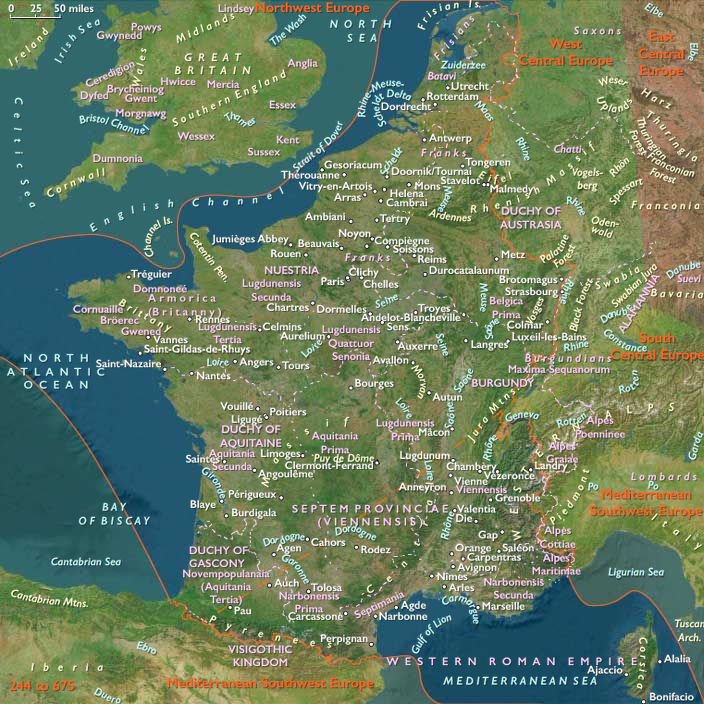
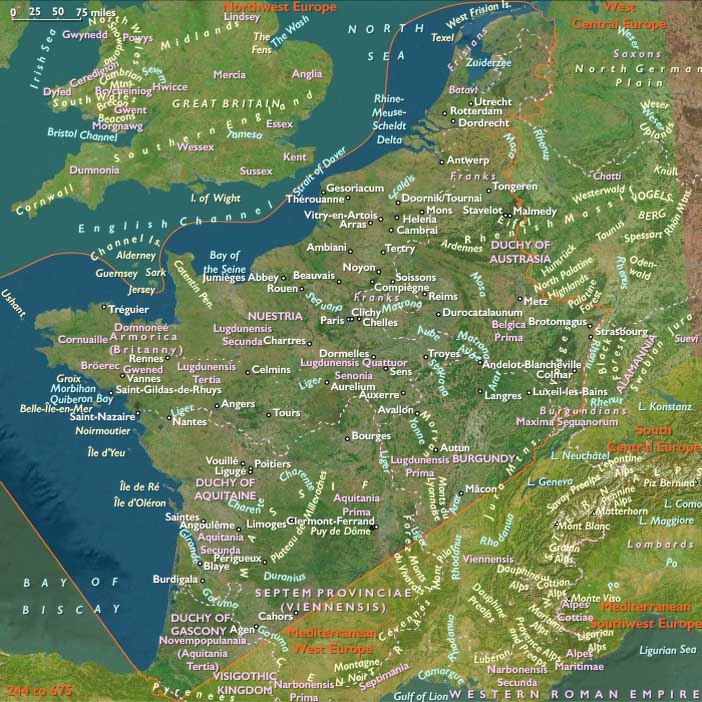
Between 460 and 471, Atlantic West Europe—encompassing northern and western Gaul, Aquitaine, Burgundy, and the Rhône valley—witnessed the definitive collapse of Roman authority and the consolidation of independent Germanic kingdoms, notably the Visigoths and the Burgundians. As Roman control retreated, regional bishops, aristocrats, and Germanic rulers navigated the formation of new political and social frameworks that blended Roman legacy with emerging medieval structures.
Political and Military Developments
-
Collapse of Roman Authority:
-
Following the assassination of General Aetius in 454 and the deposition of Emperor Avitus (r. 455–456), Roman administrative authority in Gaul rapidly disintegrated.
-
Power shifted decisively to local Germanic rulers, particularly the Visigoths under Theodoric II (r. 453–466), and subsequently Euric (r. 466–484), who expanded Visigothic authority from Toulouse across Aquitaine and further into the Loire Valley.
-
-
Rise and Expansion of Visigothic Gaul:
-
King Euric notably strengthened Visigothic rule, aggressively expanding territory to include large portions of Aquitaine and extending north toward the Loire.
-
Euric’s reign marked the transformation of the Visigothic realm from a federate ally of Rome into a fully independent Germanic kingdom.
-
-
Stabilization of Burgundian Rule:
-
King Gundioc (r. c. 437–473) solidified Burgundian rule in the Rhône Valley, with Lyon as a central administrative and cultural hub, integrating Roman governance traditions with Germanic military strength.
-
The Burgundian kingdom maintained relative peace with the Visigoths and other neighboring polities, strengthening its territorial coherence.
-
Economic and Social Developments
-
Acceleration of Urban Decline:
-
Roman urban administrative structures further eroded, with many cities becoming smaller, fortified strongholds rather than vibrant urban centers.
-
Economic activity shifted further towards rural villa estates, monasteries, and bishop-controlled territories, reflecting broader trends of ruralization and local self-sufficiency.
-
-
Romano-Gallic Aristocratic Influence:
-
Aristocratic families, often allied through marriage or cooperation with Germanic rulers, retained prominence, adapting to the new political landscape.
-
Many Gallo-Roman aristocrats served in high administrative roles within the Visigothic and Burgundian kingdoms, preserving elements of Roman governance and social hierarchy.
-
Religious and Cultural Developments
-
Growth of Episcopal Power and Influence:
-
Bishops, such as Sidonius Apollinaris of Clermont, played increasingly pivotal roles, becoming prominent civic leaders who negotiated between Roman traditions and Germanic rulers.
-
The episcopal office began to hold considerable secular authority, overseeing cities, mediating disputes, and influencing royal decisions.
-
-
Religious Integration of Germanic Kingdoms:
-
The Visigothic and Burgundian kings maintained close, though complex, relationships with the Catholic Church, often supporting bishops to gain legitimacy among the Roman populace.
-
Despite the Visigoths' adherence to Arian Christianity, there was relative religious tolerance, allowing Catholic institutions to persist and even thrive under Germanic rule.
-
Legacy and Significance
By 471, Atlantic West Europe had undergone a decisive transformation:
-
The Roman Empire’s presence in Gaul had ended, replaced by stable, independent Germanic kingdoms that integrated Roman administrative, cultural, and religious traditions.
-
The influence of Romano-Gallic aristocracy persisted, reshaping itself within a Germanic-dominated political context.
-
Bishops emerged as central political and social leaders, guiding regional stability and continuity amid profound changes.
People
Groups
- Polytheism (“paganism”)
- Franks
- Gallo-Roman culture
- Armorica
- Gallia Lugdunensis (Roman province)
- Gallia Belgica (Roman province)
- Gallia Aquitania (Roman province)
- Saxons
- Burgundians (East Germanic tribe)
- Christianity, Arian
- Gaul, Praetorian prefecture of
- Visigoths, Realm of the
- Roman Empire, Western (Ravenna)
- Britain, Sub-Roman
- Visigothic Kingdom of Toulouse
- Burgundians, (second) Kingdom of the
- Christianity, Chalcedonian
Topics
- Roman Age Optimum
- Late Antiquity
- Migration Period
- Hun Raids on the Roman Empire
- Saxon Raids of 407-550
- Visigothic Raids on the Roman Empire, Later
- Catalaunian Plains, Battle of the
Commodoties
Subjects
Regions
Subregions
Related Events
Showing 10 events out of 58640 total
Years: 460 - 471
People
Groups
- Polytheism (“paganism”)
- Franks
- Gallo-Roman culture
- Armorica
- Gallia Lugdunensis (Roman province)
- Gallia Belgica (Roman province)
- Gallia Aquitania (Roman province)
- Saxons
- Burgundians (East Germanic tribe)
- Christianity, Arian
- Gaul, Praetorian prefecture of
- Visigoths, Realm of the
- Roman Empire, Western (Ravenna)
- Britain, Sub-Roman
- Visigothic Kingdom of Toulouse
- Burgundians, (second) Kingdom of the
- Christianity, Chalcedonian
Topics
- Roman Age Optimum
- Late Antiquity
- Migration Period
- Hun Raids on the Roman Empire
- Saxon Raids of 407-550
- Visigothic Raids on the Roman Empire, Later
- Catalaunian Plains, Battle of the
Commodoties
Subjects
Regions
Subregions