
Atlantic West Europe, 424–435: Consolidation of Barbarian …
Years: 424 - 435
Atlantic West Europe, 424–435: Consolidation of Barbarian Kingdoms and Continued Roman Withdrawal
Political and Military Developments
-
Visigothic Consolidation and Expansion
-
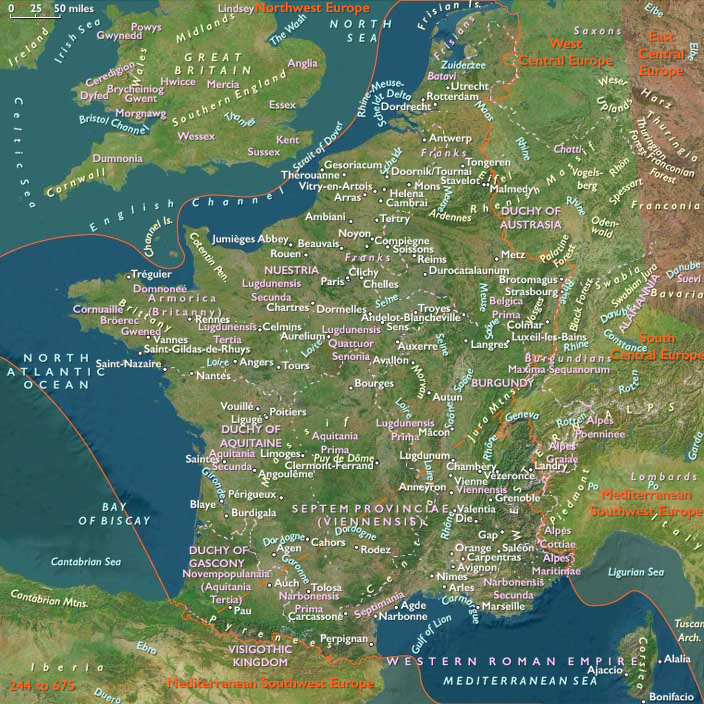
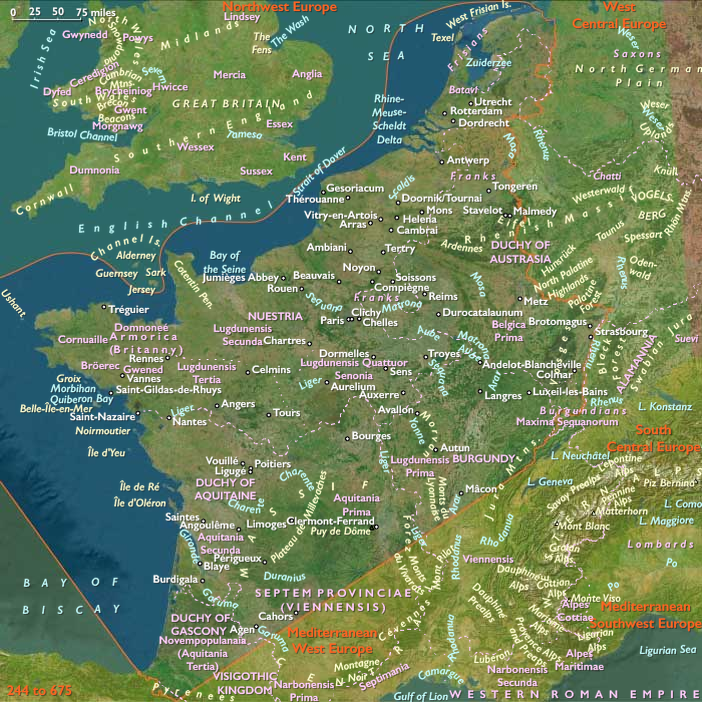
Under King Theodoric I (r. 418–451), the Visigoths strengthened the Kingdom of Toulouse, firmly establishing themselves across Aquitania, influencing western Gaul, and building stable governance based on Roman administrative models.
-
-
Burgundian Kingdom in the Rhône Valley
-
The Burgundians under Gundahar solidified their presence along the Rhine and later, driven by pressure from the Huns, moved deeper into southeastern Gaul, beginning to consolidate territories around Lyon and Geneva.
-
-
Franks Strengthen Their Hold in Northern Gaul
-
Frankish chieftains expanded their territories in the Belgica region, with groups under the Merovingian dynasty increasing dominance in the Somme and Meuse valleys, positioning themselves for further territorial expansion.
-
-
Armorican Autonomy and Defensive Organization
-
Armorica (Brittany) continued to assert independence from centralized authority, increasingly defending itself against Saxon raids and maintaining distinct local rule.
-
-
Roman Retreat and Power Vacuum
-
The Roman central authority continued its gradual withdrawal. The influence of Flavius Aetius (appointed commander in Gaul c. 429) partially stabilized Roman authority along the Loire valley and central Gaul but failed to reestablish full control over the regions dominated by barbarians.
-
Economic and Social Developments
-
Localized Economies and Rural Stability
-
Trade became increasingly regionalized and agriculture-centered. Local economies adapted to the presence of barbarian kingdoms, with self-sufficient manorial structures emerging.
-
-
Decline of Urban Centers
-
Roman cities declined further, many becoming smaller fortified towns (oppida) or bishoprics, as the former infrastructure and trade networks disintegrated.
-
Religious and Cultural Developments
-
Strengthening of the Gallic Church
-
The Gallic Church grew more influential politically and socially. Bishops like Germanus of Auxerre (who led missions to Britain around 429) gained prominence as regional leaders and negotiators.
-
-
Monastic Communities as Cultural Centers
-
Monastic foundations, influenced by Eastern ascetic traditions and local movements, expanded their role as centers of cultural preservation, spiritual guidance, and intellectual activity.
-
The years 424–435 thus reinforced the transition from Roman to barbarian governance in Atlantic West Europe. The region became more clearly divided into emergent kingdoms, each beginning to evolve distinct identities, governance structures, and cultural forms that defined the subsequent early medieval period.
People
Groups
- Polytheism (“paganism”)
- Franks
- Gallo-Roman culture
- Armorica
- Gallia Lugdunensis (Roman province)
- Gallia Belgica (Roman province)
- Gallia Aquitania (Roman province)
- Saxons
- Burgundians (East Germanic tribe)
- Christianity, Nicene
- Gaul, Praetorian prefecture of
- Hunnic Empire
- Visigoths, Realm of the
- Roman Empire, Western (Ravenna)
- Britain, Sub-Roman
- Burgundians, (first) Kingdom of the
- Visigothic Kingdom of Toulouse
Topics
Commodoties
Subjects
Regions
Subregions
Related Events
Showing 10 events out of 45 total
Years: 424 - 435
People
Groups
- Polytheism (“paganism”)
- Franks
- Gallo-Roman culture
- Armorica
- Gallia Lugdunensis (Roman province)
- Gallia Belgica (Roman province)
- Gallia Aquitania (Roman province)
- Saxons
- Burgundians (East Germanic tribe)
- Christianity, Nicene
- Gaul, Praetorian prefecture of
- Hunnic Empire
- Visigoths, Realm of the
- Roman Empire, Western (Ravenna)
- Britain, Sub-Roman
- Burgundians, (first) Kingdom of the
- Visigothic Kingdom of Toulouse
Topics
Commodoties
Subjects
Regions
Subregions