
Atlantic West Europe (1828–1971 CE) Industrial …
Years: 1828 - 1971
Atlantic West Europe (1828–1971 CE)
Industrial Ports, Wars of Empire, and European Integration
Geography & Environmental Context
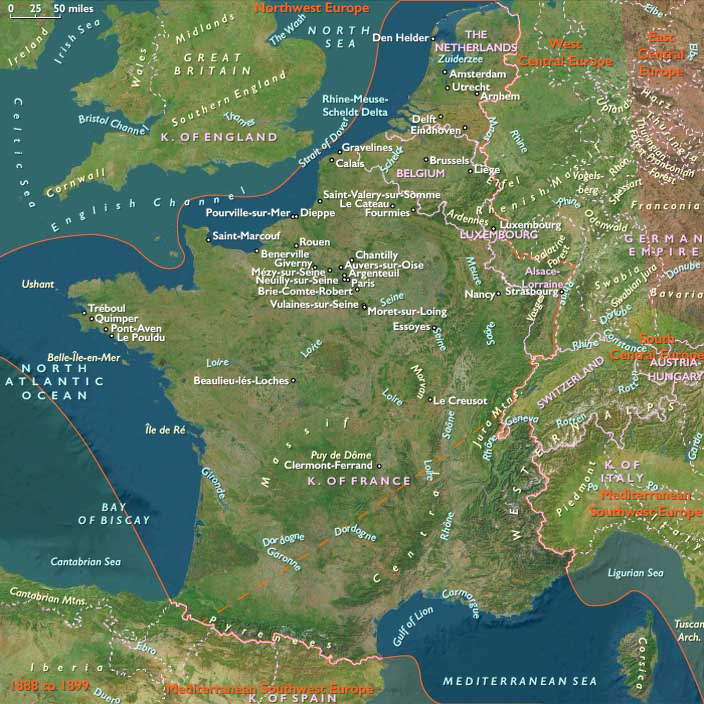
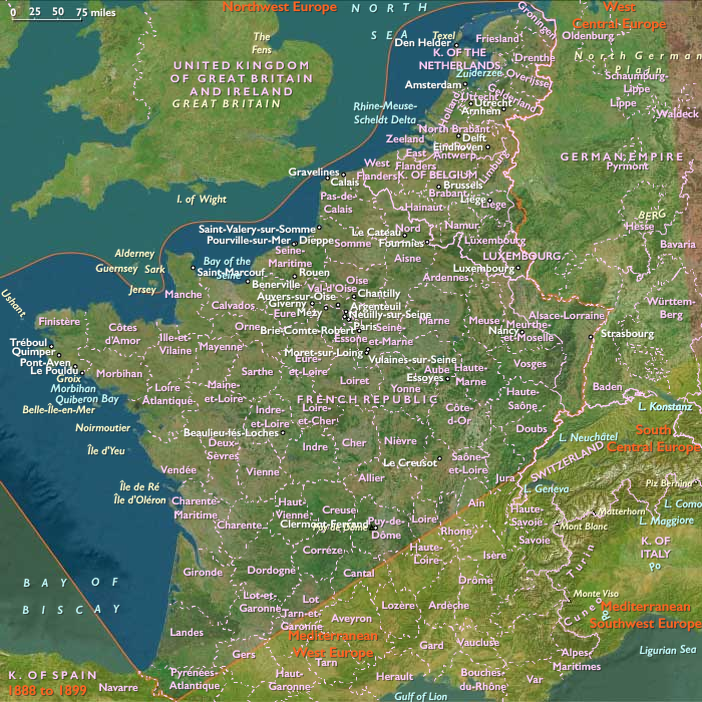
Atlantic West Europe includes the Atlantic and English Channel coasts of France as well as the Loire Valley, Burgundy, northern France (including Paris), and the Low Countries: Belgium, the Netherlands, and Luxembourg. Anchors include the Seine, Loire, Somme, Scheldt, Meuse, and Rhine–Meuse–Scheldt delta, the Paris Basin, the Loire vineyards, and the Dutch–Flemish polders. The region combines fertile lowlands, coastal estuaries, and riverine arteries that fed both agriculture and industrialization.
Climate & Environmental Shifts
A temperate oceanic climate prevailed. Floods along the Scheldt and Rhine–Meuse delta periodically tested Dutch and Belgian dikes; the North Sea flood of 1953 devastated the Netherlands, accelerating modern flood-control systems like the Delta Works. Wine regions (Loire, Burgundy) endured variable vintages, with phylloxera in the late 19th century destroying vineyards before recovery through grafting. Industrial coalfields in Belgium (Sillon industriel) and northern France polluted air and water, but postwar recovery programs and environmental reforms after the 1960s began to restore ecosystems.
Subsistence & Settlement
-
19th century agriculture: Wheat, rye, and sugar beet dominated the Paris Basin; vineyards thrived in Burgundy and the Loire; dairying spread in Flanders and the Netherlands.
-
Urbanization: Paris, Brussels, Antwerp, Amsterdam, Rotterdam, and Luxembourg grew as industrial and financial hubs. Coastal ports like Le Havre, Nantes, and Bordeaux tied agriculture and manufacturing to Atlantic trade.
-
Industrial regions: Belgian coal and steel, French textile towns (Roubaix, Lille), and Dutch shipping expanded dramatically after 1850.
-
20th century shifts: By mid-century, agriculture mechanized, while cities rebuilt after war. Rotterdam emerged as one of the world’s largest ports; Paris modernized with Haussmann boulevards, then postwar suburbs.
Technology & Material Culture
-
Transport: Railways spread in the 19th century; canals modernized; Paris and Brussels became railway hubs. In the 20th century, motorways and airports (Orly, Schiphol, Zaventem) extended reach.
-
Industry: Coal mining, metallurgy, and textiles dominated in the 19th century. After WWII, new industries—chemicals, automobiles, oil refining—emerged, tied to the Rhine–Scheldt delta.
-
Everyday life: Urban apartments filled with industrial textiles, ceramics, and later radios, televisions, and consumer goods by the 1950s–60s. Café culture, fashion (Paris haute couture), and newspapers flourished.
-
Architecture: Neo-classical Paris, Art Nouveau Brussels, and modernist rebuilding after WWII in Le Havre, Rotterdam, and Antwerp.
Movement & Interaction Corridors
-
Maritime trade: Rotterdam, Antwerp, and Le Havre handled coal, grain, and later oil, feeding Europe’s industrial and consumer economy.
-
Riverine corridors: Seine, Scheldt, Meuse, and Rhine–Meuse–Scheldt systems tied inland regions to Atlantic ports.
-
Colonial links: French ports (Nantes, Bordeaux, Le Havre, Marseille) and Belgian Antwerp linked Europe to Africa and Asia until decolonization after WWII.
-
Wars & occupation: Rail and river corridors were militarized during the Franco-Prussian War (1870–71), World War I (1914–18), and World War II (1940–45). German occupations devastated Belgium, Luxembourg, and northern France.
-
Postwar integration: The Benelux union (1944), the European Coal and Steel Community (1951), and the EEC (1957) tied Atlantic West Europe into continental recovery and cooperation.
Cultural & Symbolic Expressions
-
Paris: Capital of Romanticism, Impressionism, and modernism; intellectual center from Hugo and Zola to Sartre and de Beauvoir.
-
Belgium & Netherlands: Art Nouveau (Horta, van de Velde), Dutch modernist design, and Flemish Catholic festivals; strong socialist and labor movement traditions.
-
Luxembourg: Catholic and liberal traditions coexisted; financial and legal institutions grew.
-
Everyday identity: Pilgrimages (Lourdes), parish festivals, and urban cafés shaped cultural life. Football clubs, cinemas, and postwar television became mass cultural anchors.
Environmental Adaptation & Resilience
-
Agricultural reform: Mechanization, fertilizers, and crop diversification reduced famine risk.
-
Flood defenses: Dutch polders and Belgian levees were reinforced repeatedly, culminating in the Delta Works (1950s–70s).
-
Urban resilience: Rebuilding of Rotterdam, Le Havre, Antwerp, and northern French towns after WWII modernized infrastructure.
-
Social welfare: Postwar welfare states in France, Belgium, Luxembourg, and the Netherlands improved resilience against poverty, unemployment, and health crises.
Political & Military Shocks
-
Revolutions of 1830: Belgium gained independence; Paris staged the July Revolution.
-
1848 Revolutions: Paris uprisings echoed through the region.
-
Franco-Prussian War (1870–71): Loss of Alsace-Lorraine, siege of Paris.
-
World War I: Western Front scarred northern France, Belgium, and Luxembourg.
-
World War II: German blitzkrieg (1940) swept across France and the Low Countries; occupation, resistance, and liberation (1944–45) reshaped the region.
-
Post-1945: Recovery under the Marshall Plan; founding members of European integration; NATO bases tied Atlantic West Europe to the Cold War order.
Transition
Between 1828 and 1971, Atlantic West Europe moved from agrarian economies to a fully industrial and urbanized core of Europe. Paris remained its cultural capital; Belgium and Luxembourg its industrial corridor; the Netherlands its maritime giant. The scars of two world wars gave way to reconstruction and integration, with Atlantic ports and river basins anchoring one of the world’s most productive and interconnected regions. By 1971, Atlantic West Europe stood as a symbol of both the devastation of modern warfare and the promise of European cooperation, prosperity, and global connectivity.
People
Groups
- Christians, Roman Catholic
- Protestantism
- Britain (United Kingdom of Great Britain and Ireland)
- France, constitutional monarchy of
- Belgium, Kingdom of
- Netherlands, Kingdom of The
- France, Second Republic of
- France, Second Empire of
- France (French republic); the Third Republic
- France, German-occupied (Vichy)
- France, Free
- France (French republic); the Fourth Republic
- NATO (North Atlantic Treaty Organization)
Topics
- French Revolution of 1830 (July Revolution)
- Belgian Revolution
- 1848, Revolutions of
- Franco-Prussian War
- Industrial Revolution, Second
- World War, First (World War I)
- Depression, Great
- World War, Second (World War II)
Commodoties
- Grains and produce
- Textiles
- Strategic metals
- Fuels, lubricants and sealants
- Industrial chemicals
- Electric power
- Telecommunications
Subjects
- Writing
- Watercraft
- Painting and Drawing
- Performing Arts
- Public health
- Labor and Service
- Conflict
- Faith
- Scholarship
- Custom and Law
- Human Migration
- art movements
- political movement
- workers' movement
- social movements
Regions
Subregions
Years: 1828 - 1971
People
Groups
- Christians, Roman Catholic
- Protestantism
- Britain (United Kingdom of Great Britain and Ireland)
- France, constitutional monarchy of
- Belgium, Kingdom of
- Netherlands, Kingdom of The
- France, Second Republic of
- France, Second Empire of
- France (French republic); the Third Republic
- France, German-occupied (Vichy)
- France, Free
- France (French republic); the Fourth Republic
- NATO (North Atlantic Treaty Organization)
Topics
- French Revolution of 1830 (July Revolution)
- Belgian Revolution
- 1848, Revolutions of
- Franco-Prussian War
- Industrial Revolution, Second
- World War, First (World War I)
- Depression, Great
- World War, Second (World War II)
Commodoties
- Grains and produce
- Textiles
- Strategic metals
- Fuels, lubricants and sealants
- Industrial chemicals
- Electric power
- Telecommunications
Subjects
- Writing
- Watercraft
- Painting and Drawing
- Performing Arts
- Public health
- Labor and Service
- Conflict
- Faith
- Scholarship
- Custom and Law
- Human Migration
- art movements
- political movement
- workers' movement
- social movements
Regions
Subregions