
Atlantic West Europe (1888–1899): Industrial Peak, Social …
Years: 1888 - 1899
Atlantic West Europe (1888–1899): Industrial Peak, Social Reform, and Cultural Shifts
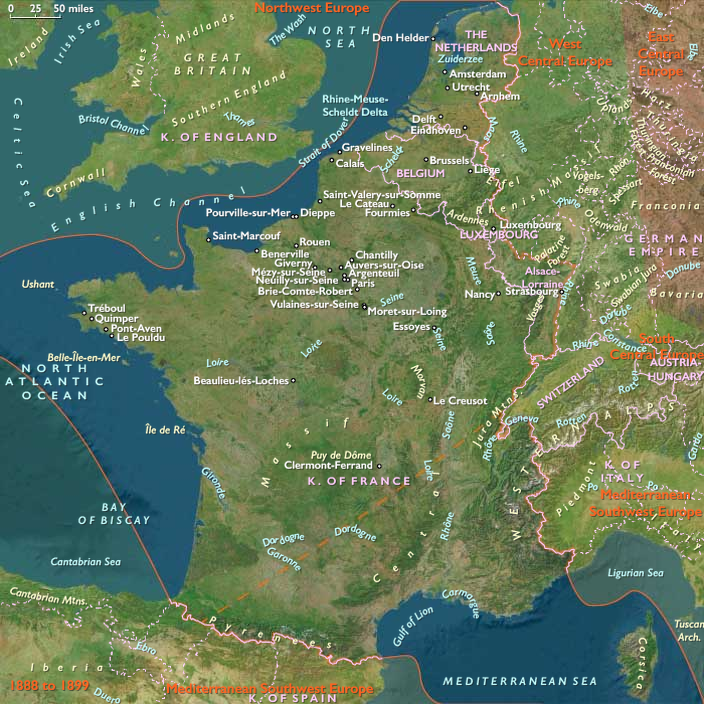
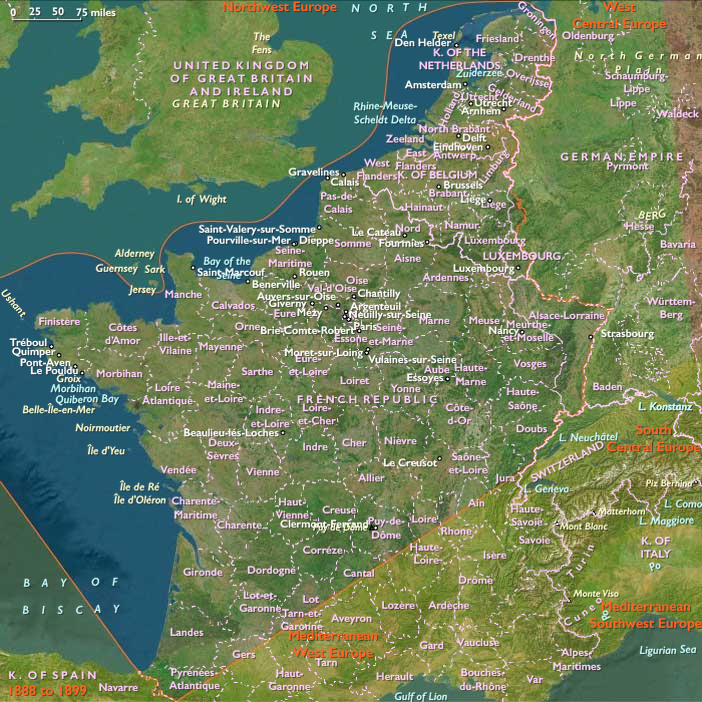
From 1888 to 1899, Atlantic West Europe—encompassing northern France, Belgium, the Netherlands, Luxembourg, and regions along the Atlantic and English Channel coasts—experienced continued industrial growth, deepening colonial engagements, significant social reforms, and dynamic cultural shifts. This era was marked by the heightening of class tensions, major advances in science and technology, intensified colonial rivalries, and profound cultural innovation at the turn of the century.
Political and Military Developments
Stability and Dreyfus Affair in France
-
France’s Third Republic enjoyed relative stability under presidents Sadi Carnot (1887–1894) and Félix Faure(1895–1899), but internal divisions intensified dramatically with the Dreyfus Affair (1894–1899), which polarized French society, exacerbating political and social tensions between republicans, conservatives, and anti-Semitic factions.
Belgian Colonial Consolidation
-
Under King Leopold II, Belgium intensified its exploitation of the Congo Free State, extracting vast resources (rubber, ivory, minerals) through brutal forced labor, leading to international criticism and humanitarian condemnation by the decade’s end.
-
Domestically, Belgium maintained parliamentary stability, balancing liberal reforms with conservative interests amid growing demands for social change.
Continued Parliamentary Stability in the Netherlands and Luxembourg
-
The Netherlands, under Queen Wilhelmina (from 1890), sustained political stability, with progressive social reforms gradually addressing labor conditions and expanding democratic participation.
-
Luxembourg remained politically tranquil and economically prosperous, leveraging its strategic neutrality and banking sector to strengthen its economy.
Economic Developments: Industrial Peak and Technological Innovation
Industrial Dominance and Technological Progress
-
Northern France solidified its industrial leadership, particularly in textiles, coal, and metallurgy. Cities like Lille, Roubaix, and Dunkirk expanded significantly, driven by advances in steel manufacturing and chemical industries.
-
Belgium’s coalfields in Wallonia, steel industries in Liège, and expanding infrastructure sustained rapid industrial growth, despite underlying social inequalities and labor tensions.
Expansion of Maritime Commerce
-
The ports of Antwerp, Rotterdam, Amsterdam, Dunkirk, and Le Havre flourished, dramatically expanding trade capacity. Rotterdam's harbor expansion notably established it as Europe's most significant maritime trade hub by the century's end.
-
Maritime infrastructure improvements facilitated growing international trade, reinforcing Atlantic West Europe's economic integration within global markets.
Technological Innovations and Infrastructure
-
Significant advancements in electricity, telecommunications, railways, and manufacturing technology boosted productivity. The Netherlands and Belgium notably pioneered electrical infrastructure projects, lighting urban centers and powering industrial expansion.
-
Rapid railroad expansion facilitated internal trade, labor mobility, and urbanization across the region.
Social Developments: Rising Labor Movements and Social Legislation
Labor Unrest and Socialist Advocacy
-
Industrial workers in France and Belgium increasingly mobilized, demanding better working conditions, higher wages, and political rights. Significant strikes, notably the Belgian general strikes (1886, 1893), pressured governments into granting incremental reforms.
-
Socialist parties in France (POF, led by Jules Guesde and Jean Jaurès), Belgium (Belgian Workers’ Party, founded in 1885), and the Netherlands gained political influence, pushing progressive agendas in national parliaments.
Expansion of Social Legislation
-
Influenced by persistent labor unrest and socialist advocacy, Belgium and the Netherlands introduced significant social legislation: improved factory safety laws, reduced working hours, and early social insurance schemes for accidents and illness.
Women’s Rights Movements
-
Growing feminist activism emerged prominently in France, Belgium, and the Netherlands, advocating women's suffrage, education reform, and greater economic independence. Notable figures such as Hubertine Auclert (France) actively promoted women’s rights, laying foundations for later suffrage successes.
Cultural and Intellectual Developments
Artistic Movements: Post-Impressionism and Symbolism
-
The artistic scene transitioned from Impressionism to Post-Impressionism and Symbolism, profoundly reshaping European visual culture. Artists like Vincent van Gogh, active in France and the Netherlands during this decade, and Paul Gauguin transformed painting, exploring emotional depth, bold colors, and symbolic imagery.
-
Belgium became a center of Symbolist art, particularly through artists like Fernand Khnopff and James Ensor, who captured modern anxieties and mystical themes.
Literary and Philosophical Innovations
-
Literary movements reflected deeper psychological introspection and social critique. In France, writers such as Émile Zola and Guy de Maupassant produced works that vividly portrayed contemporary social realities, while Symbolist poets like Stéphane Mallarmé and Paul Verlaine explored new literary aesthetics and emotional expression.
Advances in Science and Technology
-
Scientific advancements flourished, notably the discoveries of Henri Becquerel in radioactivity (1896), followed by research from Marie and Pierre Curie, fundamentally reshaping physics and chemistry.
-
Technological breakthroughs in electricity, communications (telephone and telegraph networks), and early automotive engineering positioned Atlantic West Europe at the forefront of innovation.
Religious and Educational Developments
Secularization and Church-State Conflicts
-
Secularization deepened, particularly in France, where ongoing struggles between the Catholic Church and secular republicans intensified with the Dreyfus Affair, fueling political polarization and reinforcing secular education and civil institutions.
Education and Literacy Expansion
-
France, Belgium, and the Netherlands continued investing in universal primary education, significantly increasing literacy rates, promoting social mobility, and stimulating vibrant intellectual discourse.
Urbanization and Social Dynamics
Rapid Urbanization and Infrastructure
-
Major cities such as Paris, Brussels, Antwerp, Amsterdam, and Rotterdam rapidly expanded infrastructure, including transportation networks (tramways, railways), sanitation systems, and public services, reflecting significant municipal investment in urban planning and public health.
Persistent Social Inequalities
-
Despite economic prosperity, stark inequalities persisted. Wealth concentrated among industrialists, merchants, and financial elites contrasted sharply with urban working-class poverty, fueling continued social activism and political tension.
Long-Term Consequences and Historical Significance
The period 1888–1899 represented a crucial phase in Atlantic West Europe’s transition to modernity:
-
Politically, the Dreyfus Affair highlighted profound ideological and social divisions, foreshadowing future political and social conflicts within France.
-
Economically, the region reached a peak in industrial and maritime expansion, integrating deeply into global trade networks, while technological innovation laid groundwork for 20th-century modernity.
-
Socially, the growth of labor, socialist, and women’s movements fostered incremental social reforms, setting important precedents for the welfare states of the 20th century.
-
Culturally, artistic and literary innovation significantly influenced European aesthetics, ushering in modernist sensibilities, while scientific discoveries established new paradigms in global thought.
By 1899, Atlantic West Europe stood as a culturally dynamic, economically prosperous, yet socially divided region—poised on the threshold of dramatic social, political, and technological transformations that would characterize the tumultuous early decades of the 20th century.
People
- Guy de Maupassant
- Henri Becquerel
- Hubertine Auclert
- James Ensor
- Jean Jaurès
- Jules Guesde
- Leopold II of Belgium
- Marie Curie
- Marie François Sadi Carnot
- Paul Gauguin
- Paul Verlaine
- Pierre Curie
- Stéphane Mallarmé
- Vincent van Gogh
- Wilhelmina of the Netherlands
- Émile Zola
Groups
- Christians, Roman Catholic
- Lutheranism
- Protestantism
- Huguenots (the “Reformed”)
- Britain (United Kingdom of Great Britain and Ireland)
- Belgium, Kingdom of
- Netherlands, Kingdom of The
- France (French republic); the Third Republic
- Congo Free State (King Leopold's Congo)
Topics
Commodoties
- Fish and game
- Grains and produce
- Textiles
- Slaves
- Salt
- Sweeteners
- Beer, wine, and spirits
- Fuels, lubricants and sealants
- Stimulants
- Spices
Subjects
- Writing
- Watercraft
- Painting and Drawing
- Public health
- Labor and Service
- Conflict
- Scholarship
- Custom and Law
- Medicine
- Chemistry
- Finance
- religious movement
- Metallurgy
- Human Migration
Regions
Subregions
Years: 1888 - 1899
People
- Guy de Maupassant
- Henri Becquerel
- Hubertine Auclert
- James Ensor
- Jean Jaurès
- Jules Guesde
- Leopold II of Belgium
- Marie Curie
- Marie François Sadi Carnot
- Paul Gauguin
- Paul Verlaine
- Pierre Curie
- Stéphane Mallarmé
- Vincent van Gogh
- Wilhelmina of the Netherlands
- Émile Zola
Groups
- Christians, Roman Catholic
- Lutheranism
- Protestantism
- Huguenots (the “Reformed”)
- Britain (United Kingdom of Great Britain and Ireland)
- Belgium, Kingdom of
- Netherlands, Kingdom of The
- France (French republic); the Third Republic
- Congo Free State (King Leopold's Congo)
Topics
Commodoties
- Fish and game
- Grains and produce
- Textiles
- Slaves
- Salt
- Sweeteners
- Beer, wine, and spirits
- Fuels, lubricants and sealants
- Stimulants
- Spices
Subjects
- Writing
- Watercraft
- Painting and Drawing
- Public health
- Labor and Service
- Conflict
- Scholarship
- Custom and Law
- Medicine
- Chemistry
- Finance
- religious movement
- Metallurgy
- Human Migration
Regions
Subregions