
Atlantic West Europe (1864–1875): Industrial Maturity, National …
Years: 1864 - 1875
Atlantic West Europe (1864–1875): Industrial Maturity, National Conflicts, and Social Reform
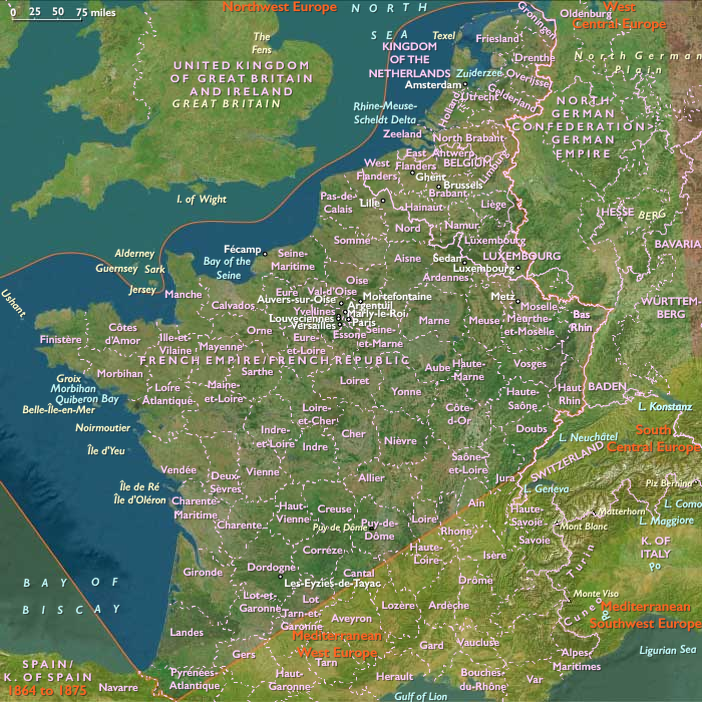
From 1864 to 1875, Atlantic West Europe—including northern France, Belgium, the Netherlands, Luxembourg, and the Atlantic and English Channel coasts—entered a crucial phase marked by sustained industrial maturity, increased national tensions culminating in the Franco-Prussian War, significant urban and social transformations, and the emergence of deeper political divisions driven by class, religion, and nationalism.
Political and Military Developments
The Franco-Prussian War (1870–1871)
-
The era’s defining political event was the Franco-Prussian War, triggered in part by France’s ambitions under Napoleon III and manipulated by Prussian Chancellor Otto von Bismarck to unify Germany.
-
France’s devastating defeat, highlighted by Napoleon III’s capture at the Battle of Sedan (1870), ended the Second French Empire and led to the proclamation of the Third French Republic.
-
The humiliating loss and subsequent occupation by Prussian troops, including parts of northern France, profoundly impacted French national identity and political stability.
Emergence of the French Third Republic
-
The newly established Third Republic (1870) began navigating internal political instability, social tensions, and lingering monarchist aspirations. Under Adolphe Thiers and later Patrice de MacMahon, the republic struggled to consolidate its institutions and heal national divisions.
Belgium: Stability amid Neutrality and Reform
-
Belgium, under King Leopold II (r.1865–1909), continued its policy of neutrality but faced growing internal tensions between liberals and Catholics. Electoral reforms expanded suffrage modestly, setting the stage for future democratization.
-
Leopold II began focusing on overseas ambitions in Africa, laying early foundations for Belgian colonialism.
Netherlands and Luxembourg: Liberal Reforms and Stability
-
The Netherlands under King William III remained politically stable, with liberal parliamentary forces pushing progressive reforms in education, infrastructure, and public administration.
-
Luxembourg, following the Luxembourg Crisis of 1867, was reaffirmed as an independent and perpetually neutral state, ending previous Dutch sovereignty, and entering a new era of political autonomy.
Economic Developments: Industrial Consolidation and Growth
Post-War Economic Resilience in France
-
Despite political turmoil, northern French industry rapidly recovered after the Franco-Prussian War. Cities such as Lille, Roubaix, Dunkirk, and Le Havre continued to expand, driven by textiles, steel production, shipbuilding, and railways.
-
The Suez Canal’s opening (1869), though geographically distant, enhanced French maritime trade routes, indirectly benefiting Atlantic ports.
Belgian Industrial Strength and Expansion
-
Belgium sustained significant industrial growth, particularly in iron, coal, and textiles. Antwerp continued its ascent as a major global trade hub, while Wallonia’s steel and coal production surged, powering broader economic expansion.
Dutch Maritime Commerce and Industrial Diversification
-
The Netherlands experienced continued growth in maritime commerce, shipbuilding, and agricultural exports. Rotterdam emerged as a vital port city, increasingly surpassing Amsterdam as the nation’s primary commercial gateway.
-
New industrial sectors developed, including chemical manufacturing, textiles, and machinery production, enhancing economic diversification and resilience.
Social Developments: Labor Activism and Urbanization
Labor Movements and the Paris Commune (1871)
-
In France, profound social tensions emerged after the Franco-Prussian War, notably culminating in the revolutionary uprising known as the Paris Commune (March–May 1871), reflecting urban working-class dissatisfaction, socialist aspirations, and republican ideals.
-
Although brutally suppressed by government forces, the Commune deeply influenced European socialist thought and labor movements, inspiring workers and radical intellectuals across Atlantic West Europe.
Belgian and Dutch Labor Activism
-
Belgium experienced significant labor activism, particularly in industrial regions such as Liège, Antwerp, and Ghent, with workers demanding improved working conditions, higher wages, and political representation.
-
In the Netherlands, the rise of trade unions and early socialist movements, especially in urban centers such as Rotterdam and Amsterdam, signaled a gradual but increasing demand for social reform.
Cultural and Intellectual Developments
Realism and Naturalism in Literature and Art
-
Cultural life remained profoundly shaped by realism and emerging naturalism, notably in France, through writers like Émile Zola, whose works (beginning with Thérèse Raquin, 1867) highlighted the stark realities of industrial urban life and social inequalities.
-
Painters such as Édouard Manet and early Impressionists challenged traditional academic art, focusing instead on modern urban experiences and candid portrayals of daily life, reshaping artistic expression throughout Europe.
Advancements in Science and Technology
-
Significant advancements occurred in industrial technology, chemistry, medicine, and sanitation. These improvements supported rapid urban growth and increased industrial productivity, notably through innovations in steel production and public health infrastructure.
Religious Developments
Continued Secularization and Religious Conflict
-
Secularization intensified, particularly in France, where the Catholic Church's political influence was increasingly challenged by republican governments and secular intellectuals.
-
Belgium continued experiencing significant tensions between Catholic conservatives and liberal secularists, particularly over educational reforms and church-state relations, shaping the country's long-term political landscape.
Urbanization and Social Dynamics
Accelerated Urban Growth and Infrastructure
-
Urbanization accelerated dramatically, driven by industrial expansion and rural migration. Major cities—Paris, Lille, Roubaix, Antwerp, Rotterdam, Brussels, and Amsterdam—expanded rapidly, investing significantly in urban infrastructure, public transportation, and sanitation systems.
Deepening Class Divisions
-
Economic prosperity was unevenly distributed, deepening class divides. Wealthier merchant and industrialist classes thrived, especially in urban centers, while industrial workers faced difficult living conditions and periodic unemployment, fueling labor unrest and demands for reform.
Long-Term Consequences and Historical Significance
The era 1864–1875 represented a crucial phase in Atlantic West Europe’s historical trajectory:
-
Politically, the fall of Napoleon III and the establishment of the Third Republic reshaped France’s internal dynamics and European alliances, profoundly influencing subsequent geopolitical alignments.
-
Economically, the region demonstrated resilience and sustained industrial maturity, firmly integrating into global trade networks and setting foundations for late 19th-century prosperity.
-
Socially, intensified labor activism, epitomized by the Paris Commune, revealed growing class tensions and demands for political and social reforms that would drive subsequent European socialist and democratic movements.
-
Culturally, realism and emerging naturalism influenced European literature, art, and intellectual thought, reflecting a deeper engagement with social realities and the complexities of modern industrial life.
By 1875, Atlantic West Europe had emerged from a turbulent decade politically transformed, economically vibrant, socially dynamic, and culturally influential—poised for continued prominence in the rapidly modernizing Europe of the late 19th century.
People
- Adolphe Thiers
- Leopold II of Belgium
- Napoleon III
- Otto von Bismarck
- Patrice de Mac-Mahon, Duke of Magenta
- William III of the Netherlands
- Édouard Manet
- Émile Zola
Groups
- Christians, Roman Catholic
- Lutheranism
- Protestantism
- Huguenots (the “Reformed”)
- Britain, Kingdom of Great
- Netherlands, Kingdom of The United
- Belgium, Kingdom of
- Netherlands, Kingdom of The
- France, Second Empire of
- France (French republic); the Third Republic
Topics
Commodoties
- Fish and game
- Grains and produce
- Textiles
- Slaves
- Salt
- Sweeteners
- Beer, wine, and spirits
- Fuels, lubricants and sealants
- Stimulants
- Spices
Subjects
- Writing
- Watercraft
- Painting and Drawing
- Public health
- Labor and Service
- Conflict
- Scholarship
- Custom and Law
- Medicine
- Chemistry
- Finance
- religious movement
- Metallurgy
- Human Migration
Regions

Subregions
Years: 1864 - 1875
People
- Adolphe Thiers
- Leopold II of Belgium
- Napoleon III
- Otto von Bismarck
- Patrice de Mac-Mahon, Duke of Magenta
- William III of the Netherlands
- Édouard Manet
- Émile Zola
Groups
- Christians, Roman Catholic
- Lutheranism
- Protestantism
- Huguenots (the “Reformed”)
- Britain, Kingdom of Great
- Netherlands, Kingdom of The United
- Belgium, Kingdom of
- Netherlands, Kingdom of The
- France, Second Empire of
- France (French republic); the Third Republic
Topics
Commodoties
- Fish and game
- Grains and produce
- Textiles
- Slaves
- Salt
- Sweeteners
- Beer, wine, and spirits
- Fuels, lubricants and sealants
- Stimulants
- Spices
Subjects
- Writing
- Watercraft
- Painting and Drawing
- Public health
- Labor and Service
- Conflict
- Scholarship
- Custom and Law
- Medicine
- Chemistry
- Finance
- religious movement
- Metallurgy
- Human Migration
Regions
Subregions