
West Europe (1828–1971 CE) Industrial Democracies, …
Years: 1828 - 1971
West Europe (1828–1971 CE)
Industrial Democracies, Colonial Decline, and Cultural Renaissance
Geography & Environmental Context
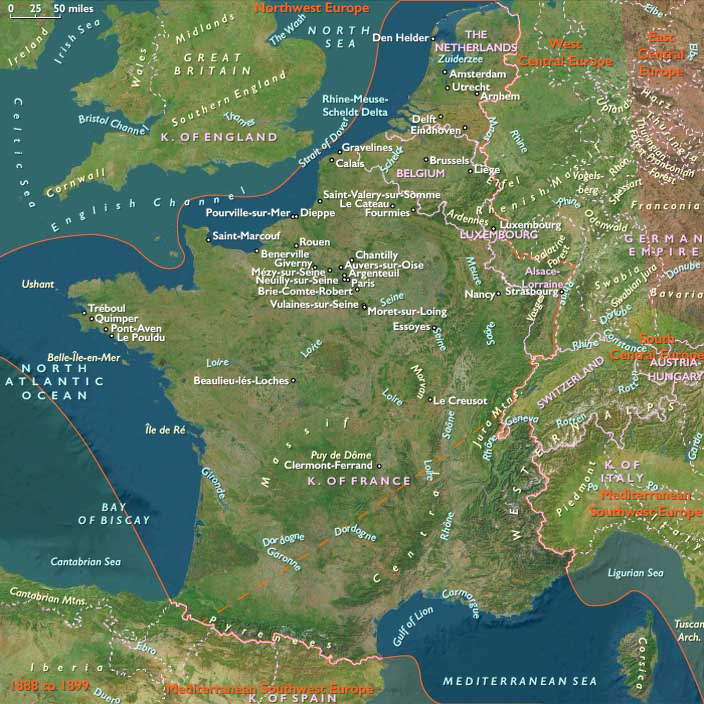
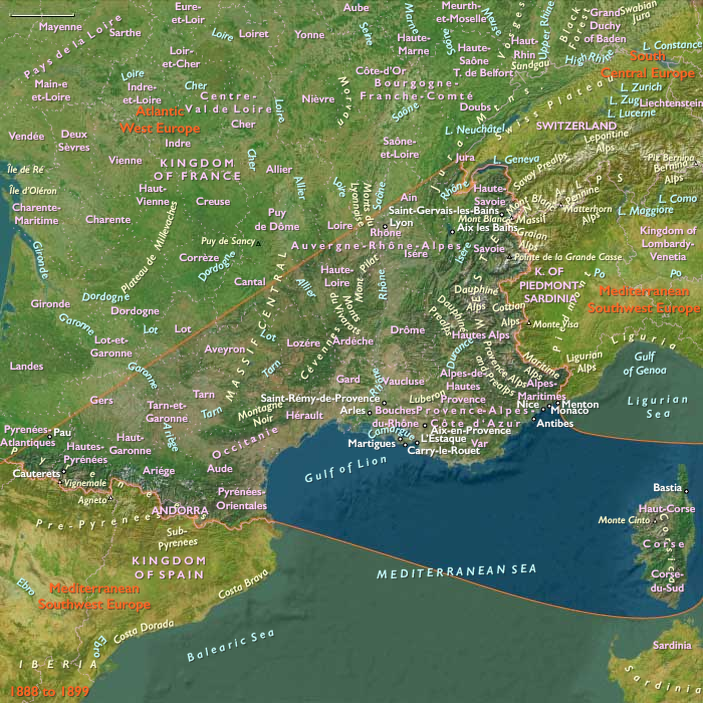
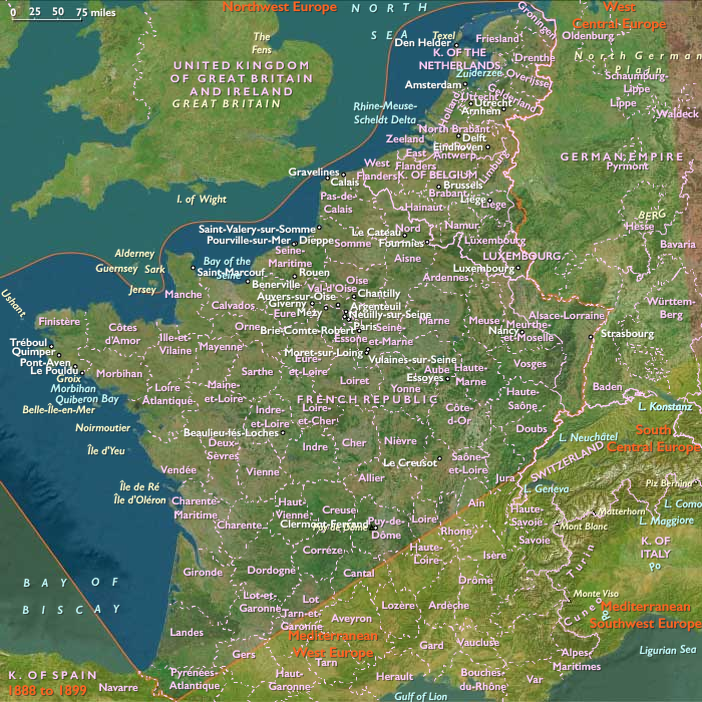
West Europe includes two fixed subregions:
-
Atlantic West Europe — the Atlantic and English Channel coasts of France, the Loire Valley, Burgundy, northern France (including Paris), and the Low Countries: Belgium, the Netherlands, and Luxembourg.
-
Mediterranean West Europe — southern France, Monaco, and Corsica, including the Rhone Valley, Marseille–Arles–Camargue corridor, and the French Pyrenees.
Anchors include the Seine, Loire, and Rhone River systems, the Pyrenees, and the North Sea and Mediterraneancoasts. Major cities—Paris, Marseille, Lyon, Bordeaux, Brussels, Amsterdam, and Rotterdam—defined the region’s economic and cultural life. Its temperate climate, fertile river basins, and extensive coastlines made it the historical heartland of European trade, innovation, and political revolution.
Climate & Environmental Shifts
The region’s moderate maritime climate supported agriculture and industry. The 19th century saw deforestation replaced by replanting and the emergence of viticulture and dairy farming as staples. Urban coal use caused heavy pollution in industrial basins until cleaner technologies spread mid-20th century. Coastal reclamation in the Netherlands expanded farmland, while the Camargue and Rhone deltas experienced seasonal flooding. Postwar modernization brought hydroelectric dams in the Alps and Pyrenees, and nuclear energy development in France by the 1960s.
Subsistence & Settlement
-
Agriculture modernized through mechanization, fertilizers, and scientific breeding. Northern France and the Low Countries became Europe’s breadbasket; southern France specialized in wine, olives, and fruits.
-
Industrialization: Belgium’s coalfields, northern France’s steel plants, and Dutch shipyards fueled 19th-century economic growth. The Industrial Revolution diffused westward from Britain, reshaping urban centers like Lille, Liège, and Rouen.
-
Urbanization: Paris remained Europe’s artistic and intellectual capital, while Marseille, Lyon, Brussels, and Amsterdam became hubs of trade and manufacturing. After WWII, suburban growth and reconstruction replaced bombed quarters with modern infrastructure.
-
Migration: Rural workers moved to cities, and later, immigrants from southern Europe and North Africa filled industrial labor demands in the 1950s–60s.
Technology & Material Culture
Steam locomotives and canal systems integrated markets by mid-19th century; telegraphs and railways linked Paris to Brussels, Amsterdam, and Marseille. The Eiffel Tower (1889) symbolized technological modernity. The 20th century brought electrification, automobiles (notably Citroën and Renault), aviation, and nuclear engineering. Architecture ranged from Haussmann’s boulevards to Le Corbusier’s modernism. Cafés, cinemas, and department stores became emblematic of urban life.
Movement & Interaction Corridors
-
Maritime networks: Le Havre, Bordeaux, Marseille, Antwerp, and Rotterdam handled global trade linking Europe to Africa, Asia, and the Americas.
-
Rail corridors: Connected industrial zones and capitals; after 1945, highways and airports redefined mobility.
-
Colonial routes: French and Dutch empires tied the region to overseas possessions in Africa and Asia until decolonization after 1945.
-
European integration: The Benelux Customs Union (1944) and founding of the European Economic Community (1957) in Treaty of Rome began the long process of continental unity.
Cultural & Symbolic Expressions
West Europe shaped modern art, philosophy, and politics.
-
Romanticism and Realism: Writers like Victor Hugo, Honoré de Balzac, and Émile Zola portrayed the industrial and moral upheavals of 19th-century France.
-
Impressionism and Modernism: Artists such as Monet, Cézanne, and Picasso (working in France) revolutionized visual art.
-
Music and thought: Composers Debussy and Ravel, philosophers Auguste Comte, Jean-Paul Sartre, and Simone de Beauvoir reflected France’s cultural reach.
-
Cinema and design: The Lumière brothers pioneered film; postwar realism and New Wave directors (Truffaut, Godard) redefined global cinema.
-
Catholicism, Protestantism, and secular republicanism coexisted, with laïcité (secularism) enshrined in French political life after 1905.
Environmental Adaptation & Resilience
Rural electrification and cooperative farming modernized villages. Coastal engineering protected the Netherlands from floods (Delta Works, initiated 1953). Postwar housing programs rebuilt cities, while reforestation and pollution controls revived industrial landscapes. Agricultural cooperatives and Common Market policies (from 1957) stabilized food supply and prices.
Political & Military Shocks
-
Revolutions and nationhood: The Revolution of 1830 and 1848 uprisings shaped French republicanism.
-
Franco-Prussian War (1870–71): Led to the fall of the Second Empire and the Third Republic.
-
World War I (1914–18): Northern France and Belgium became the Western Front’s main battlefield; millions died amid trench warfare.
-
Interwar instability: Economic crises and political polarization set the stage for World War II (1939–45), during which France was occupied and Belgium and the Netherlands invaded.
-
Liberation and reconstruction: Allied landings (1944) restored independence; the Marshall Plan (1948) fueled recovery.
-
Decolonization: The loss of Indochina (1954) and Algeria (1962) ended France’s empire; Dutch withdrawal from Indonesia (1949) reshaped global relations.
-
Cold War politics: France pursued independent nuclear policy under Charles de Gaulle; the Low Countries aligned with NATO and European integration.
Transition
Between 1828 and 1971, West Europe transitioned from monarchies and empires to democratic, industrial, and globally connected states. Revolution and war shaped political identity, while artistic innovation and social movements redefined culture. The devastation of two world wars gave way to reconstruction and unity through European institutions. From the factories of Liège and the vineyards of Provence to the docks of Marseille and the canals of Amsterdam, the region blended tradition and modernity, anchoring the cultural and economic core of postwar Western Europe.
People
Groups
- Christians, Roman Catholic
- Protestantism
- Britain (United Kingdom of Great Britain and Ireland)
- France, constitutional monarchy of
- Belgium, Kingdom of
- Netherlands, Kingdom of The
- France, Second Republic of
- France, Second Empire of
- France (French republic); the Third Republic
- France, German-occupied (Vichy)
- France, Free
- France (French republic); the Fourth Republic
- NATO (North Atlantic Treaty Organization)
Topics
- French Revolution of 1830 (July Revolution)
- Belgian Revolution
- 1848, Revolutions of
- Franco-Prussian War
- Industrial Revolution, Second
- World War, First (World War I)
- Depression, Great
- World War, Second (World War II)
Commodoties
- Grains and produce
- Textiles
- Strategic metals
- Fuels, lubricants and sealants
- Industrial chemicals
- Electric power
- Telecommunications
Subjects
- Writing
- Watercraft
- Painting and Drawing
- Performing Arts
- Public health
- Labor and Service
- Conflict
- Faith
- Scholarship
- Custom and Law
- Human Migration
- art movements
- political movement
- workers' movement
- social movements
Regions
Subregions
Related Events
Showing 10 events out of 19829 total
Years: 1828 - 1971
People
Groups
- Christians, Roman Catholic
- Protestantism
- Britain (United Kingdom of Great Britain and Ireland)
- France, constitutional monarchy of
- Belgium, Kingdom of
- Netherlands, Kingdom of The
- France, Second Republic of
- France, Second Empire of
- France (French republic); the Third Republic
- France, German-occupied (Vichy)
- France, Free
- France (French republic); the Fourth Republic
- NATO (North Atlantic Treaty Organization)
Topics
- French Revolution of 1830 (July Revolution)
- Belgian Revolution
- 1848, Revolutions of
- Franco-Prussian War
- Industrial Revolution, Second
- World War, First (World War I)
- Depression, Great
- World War, Second (World War II)
Commodoties
- Grains and produce
- Textiles
- Strategic metals
- Fuels, lubricants and sealants
- Industrial chemicals
- Electric power
- Telecommunications
Subjects
- Writing
- Watercraft
- Painting and Drawing
- Performing Arts
- Public health
- Labor and Service
- Conflict
- Faith
- Scholarship
- Custom and Law
- Human Migration
- art movements
- political movement
- workers' movement
- social movements
Regions
Subregions