
Atlantic West Europe (1828–1839): Liberal Revolutions, Nationalism, …
Years: 1828 - 1839
Atlantic West Europe (1828–1839): Liberal Revolutions, Nationalism, and Early Industrial Expansion
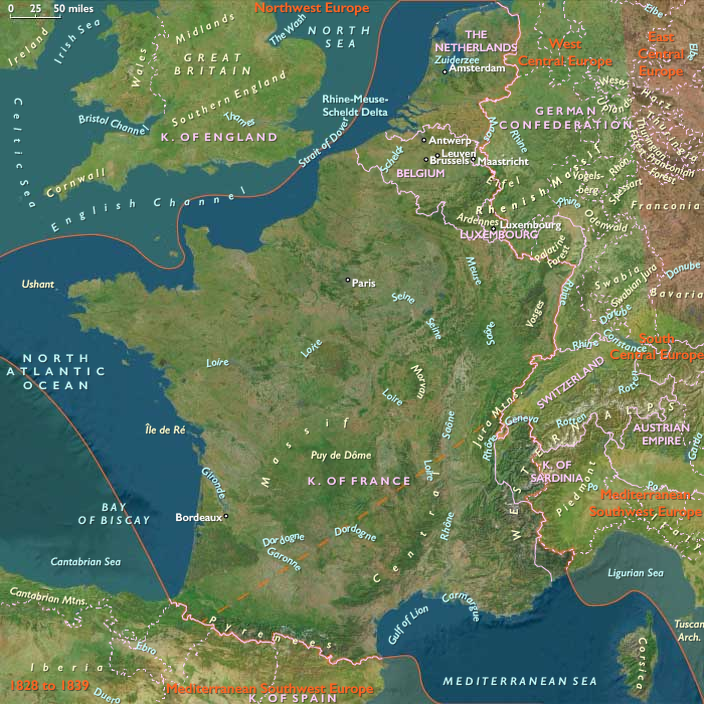
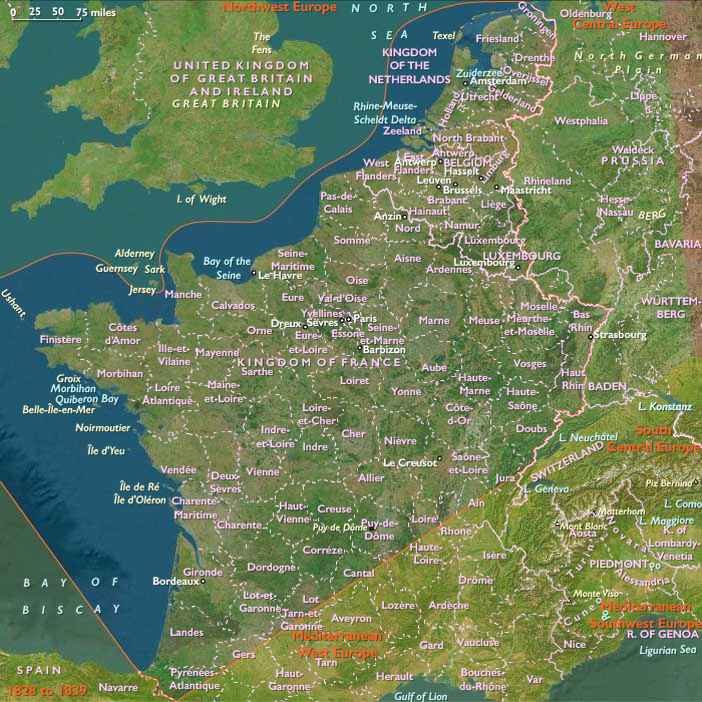
From 1828 to 1839, Atlantic West Europe—encompassing northern France, the Low Countries (Belgium, Netherlands, Luxembourg), and coastal areas along the Atlantic and English Channel—entered an era of profound political upheaval, early industrial acceleration, and rising nationalism. This period was defined by liberal challenges to conservative rule, industrial transformations reshaping economies and societies, and national movements significantly altering political boundaries and regional identities.
Political and Military Developments
The Belgian Revolution and Independence (1830–1839)
-
Belgium erupted in revolution against Dutch rule in 1830, driven by liberal demands for constitutional governance and resistance to Dutch linguistic and religious dominance.
-
Initial revolts in Brussels rapidly expanded, leading to a provisional government, independence declaration, and the adoption of a liberal constitution in 1831, establishing Belgium as a parliamentary monarchy under King Leopold I.
-
Belgium’s independence was formally recognized by the Treaty of London (1839), confirming its neutrality and reshaping Atlantic West Europe’s political map.
July Revolution in France (1830)
-
In France, the July Revolution (1830) dramatically transformed politics by overthrowing the conservative Bourbon King Charles X and installing the more liberal Louis-Philippe, the "Citizen King."
-
This shift solidified the influence of the middle class, strengthening constitutional monarchy and liberal policies, yet fell short of radical republican aspirations, laying foundations for future political conflicts.
Stability and Constitutional Reform in the Netherlands and Luxembourg
-
The Netherlands, having lost Belgium, consolidated politically under King William I, though the loss profoundly altered its national identity and reduced its economic and strategic influence.
-
Luxembourg emerged in 1839 as a distinct state (Grand Duchy), maintaining a complex relationship of autonomy under Dutch sovereignty while also part of the German Confederation, symbolizing the region's complex nationalist and political dynamics.
Economic and Social Developments
Early Industrial Revolution
-
Belgium emerged as an industrial pioneer in continental Europe, notably in textiles, coal mining, and metallurgy. Regions around Liège, Ghent, and Charleroi saw rapid industrial growth driven by British technology transfers and local innovation.
-
Northern France, particularly around Lille, Roubaix, and Tourcoing, experienced rapid industrial expansion in textiles and coal mining, accelerating urbanization and fostering a significant working-class presence.
Expansion of Transport Infrastructure
-
Infrastructure improvements, notably railways, roads, and canals, accelerated dramatically. Belgium inaugurated its first steam-powered railway between Brussels and Mechelen in 1835, significantly enhancing economic integration and mobility.
-
France also invested heavily in transportation infrastructure, notably railways connecting industrial centers, facilitating raw material transport, industrial production, and commercial trade.
Cultural and Intellectual Developments
Romantic Nationalism and Literary Expression
-
Romanticism flourished, expressing nationalist and liberal ideals in literature, poetry, art, and music. Victor Hugo, prominent during this period, reflected these revolutionary and nationalist ideals in his work, especially in "Les Misérables" (though published later, his literary prominence began in this era).
-
Flemish and Walloon cultural identities gained momentum through literature and arts, reinforcing emerging Belgian nationalism distinct from Dutch identity.
Education and Secularization Reforms
-
Educational reforms expanded literacy and secular instruction, especially in Belgium and France, emphasizing civic values and national identity. The rise of secular, state-run schools reduced church influence, reflecting liberal ideals.
Religious Developments
Religious Divides and Secularization
-
Catholicism maintained a strong social and cultural influence, especially in Belgium and northern France, though increasingly challenged by liberal secular reforms promoting separation of church and state.
-
Protestantism in the Netherlands continued fostering liberal and intellectual traditions, reinforcing its cultural divergence from predominantly Catholic Belgium.
Social and Urban Dynamics
Rapid Urbanization and Social Changes
-
Industrial growth significantly transformed urban landscapes, with cities like Lille, Brussels, Liège, Ghent, and Antwerp experiencing rapid demographic expansion, creating new urban social dynamics, including influential working-class and bourgeois communities.
-
Social tensions rose due to industrialization-related issues such as labor conditions, urban overcrowding, poverty, and class divisions, foreshadowing future social conflicts and demands for reform.
Long-Term Consequences and Historical Significance
The years 1828–1839 set the stage for profound transformations in Atlantic West Europe:
-
Politically, the liberal revolutions established constitutional governance, notably Belgium’s successful independence and France’s transition to constitutional monarchy, fundamentally reshaping national identities.
-
Economically, early industrialization significantly boosted regional prosperity and integration, positioning the region as a continental industrial powerhouse.
-
Culturally and intellectually, the period reinforced Romantic nationalism, fueling future nationalist movements, artistic innovations, and socio-political activism.
-
Socially, industrialization and urbanization triggered critical socio-economic challenges, laying foundations for labor movements, social reforms, and the emerging class politics that would define subsequent decades.
By 1839, Atlantic West Europe stood at the forefront of continental transformation, firmly on a trajectory toward political modernity, industrial prominence, and intense national consciousness, significantly shaping Europe's broader historical evolution.
People
Groups
- Christians, Roman Catholic
- Lutheranism
- Protestantism
- Huguenots (the “Reformed”)
- Britain, Kingdom of Great
- France, constitutional monarchy of
- German Confederation
- Netherlands, Kingdom of The United
- Belgium, Kingdom of
- Netherlands, Kingdom of The
Topics
Commodoties
- Fish and game
- Grains and produce
- Textiles
- Slaves
- Salt
- Sweeteners
- Beer, wine, and spirits
- Fuels, lubricants and sealants
- Spices
Subjects
- Writing
- Watercraft
- Painting and Drawing
- Labor and Service
- Conflict
- Scholarship
- Custom and Law
- Metallurgy
- Finance
- Human Migration
- religious movement
Regions
Subregions
Years: 1828 - 1839
People
Groups
- Christians, Roman Catholic
- Lutheranism
- Protestantism
- Huguenots (the “Reformed”)
- Britain, Kingdom of Great
- France, constitutional monarchy of
- German Confederation
- Netherlands, Kingdom of The United
- Belgium, Kingdom of
- Netherlands, Kingdom of The
Topics
Commodoties
- Fish and game
- Grains and produce
- Textiles
- Slaves
- Salt
- Sweeteners
- Beer, wine, and spirits
- Fuels, lubricants and sealants
- Spices
Subjects
- Writing
- Watercraft
- Painting and Drawing
- Labor and Service
- Conflict
- Scholarship
- Custom and Law
- Metallurgy
- Finance
- Human Migration
- religious movement
Regions
Subregions