
Atlantic West Europe (1744–1755): Conflict, Enlightenment Critique, …
Years: 1744 - 1755
Atlantic West Europe (1744–1755): Conflict, Enlightenment Critique, and Emerging Structural Reforms
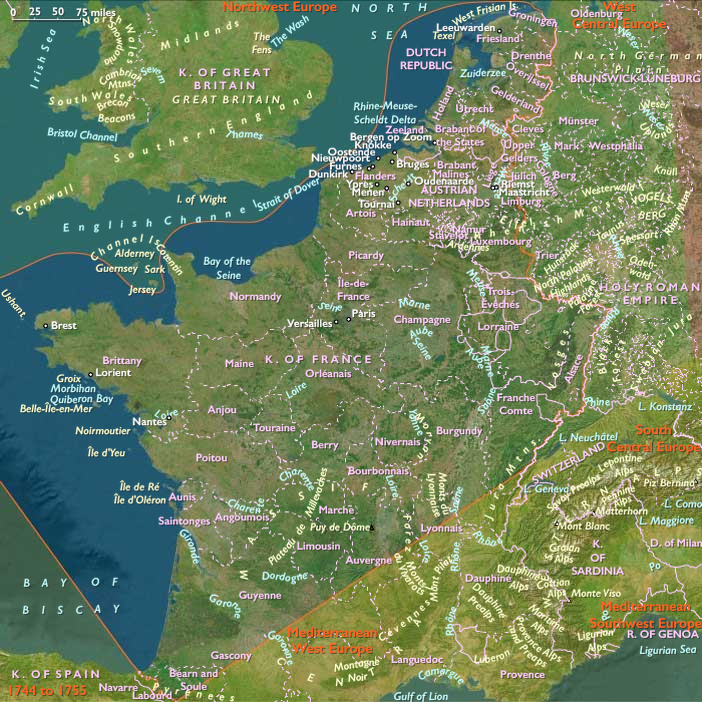
From 1744 to 1755, Atlantic West Europe—encompassing northern France, the Low Countries (modern Belgium, Netherlands, Luxembourg), and regions along the Atlantic and English Channel—experienced heightened military tensions, economic strains from ongoing warfare, robust Enlightenment critiques of governance and society, and intensified efforts at structural reform. This era was marked primarily by the latter stages of the War of the Austrian Succession and the initial developments leading into the broader global conflict of the Seven Years’ War.
Political and Military Developments
War of the Austrian Succession (1740–1748): Impact and Resolution
-
Between 1744 and 1748, Atlantic West Europe bore the brunt of escalating warfare, particularly in the Austrian Netherlands, as French armies invaded and occupied several key cities, including Brussels and Antwerp. Fighting and occupation severely disrupted regional economies and civilian life.
-
In 1745, Louis XV’s forces achieved notable victories, including the Battle of Fontenoy (1745), a major triumph over a British-Dutch-Austrian coalition. This bolstered French military prestige but exhausted national finances.
-
The war concluded with the Treaty of Aix-la-Chapelle (1748), restoring territories to their pre-war boundaries. While this treaty temporarily stabilized regional politics, underlying rivalries persisted, sowing seeds for future conflicts.
Preparations for Renewed Conflict
-
In the aftermath of peace, both France and Britain strengthened their naval capabilities and colonial military resources, anticipating further confrontation, reflecting the persistent Franco-British rivalry that would soon culminate in the Seven Years’ War (1756–1763).
-
Northern French ports such as Brest, Rochefort, and Nantes notably expanded military dockyards and naval fortifications, preparing strategically for renewed maritime confrontations.
Economic Developments: War, Recovery, and Structural Changes
Economic Strains and Postwar Recovery
-
Continuous warfare (1744–1748) severely strained the region's economies, disrupting trade routes and commerce, particularly affecting the textile and maritime industries in Flanders and Brabant.
-
After 1748, economic recovery became a priority. Ports such as Bordeaux, Nantes, Antwerp, and Amsterdam gradually resumed prosperous maritime trade, though the region faced ongoing challenges from British naval dominance and competition.
Agricultural and Industrial Reforms
-
Postwar economic reforms accelerated, particularly under French Minister of Finance, Jean-Baptiste de Machault d’Arnouville, who pursued tax and administrative reforms (1749–1754) aimed at strengthening royal finances and stimulating agricultural and industrial production.
-
Agricultural modernization efforts, inspired by Enlightenment ideals, increased productivity through crop diversification, improved farming techniques, and irrigation systems, especially evident in northern France and the southern Netherlands.
Intellectual and Cultural Developments
Enlightenment Critique and Calls for Reform
-
Intellectual critique intensified markedly during this era, with Enlightenment thinkers such as Montesquieu, whose landmark The Spirit of the Laws (1748) profoundly influenced political philosophy by advocating the separation of powers and critiquing absolute monarchy.
-
Criticism of governmental inefficiency, corruption, and excessive taxation became increasingly common in Enlightenment discourse, fostering widespread intellectual dissatisfaction with absolutist governance.
Scientific and Philosophical Progress
-
Scientific advancements continued apace. The French mathematician and astronomer Pierre-Louis Maupertuis famously published findings from the Arctic geodesic expedition, solidifying Enlightenment principles of empirical inquiry and global scientific collaboration.
-
Universities and scientific societies across Paris, Amsterdam, Brussels, and Antwerp maintained vibrant intellectual activity, nurturing an atmosphere of rigorous scholarly debate and innovation.
Religious and Social Developments
Continued Religious Moderation and Secularization
-
Gradual religious moderation and secularization deepened, particularly evident in urban centers like Amsterdam and Brussels, where Calvinist orthodoxy became more tolerant of intellectual dissent and religious plurality.
-
In France, although Catholicism remained dominant, critical Enlightenment perspectives increasingly questioned the church's influence over education, governance, and social policy.
Growing Social Critique and Calls for Justice
-
Enlightenment intellectuals vigorously attacked aristocratic privilege, corruption, and social injustice, reflecting growing dissatisfaction among urban merchant classes and educated bourgeoisie in cities like Paris, Brussels, Antwerp, and Amsterdam.
-
Salons and cafés throughout Atlantic West Europe served as influential platforms for spreading Enlightenment ideas, fostering civic debate, and encouraging public critique of established authority.
Cultural and Artistic Flourishing
Rococo and Early Neoclassical Transitions
-
Rococo style continued its cultural dominance, though signs of an emerging Neoclassical aesthetic began to appear, emphasizing clarity, rationality, and classical forms, particularly in French and Low Countries' architecture and painting.
-
Artistic patronage by affluent merchant elites and royal courts facilitated a vibrant cultural atmosphere, exemplified by artists like François Boucher and early works of Jean-Baptiste Greuze.
Literary and Musical Developments
-
Literary production flourished, particularly influenced by Enlightenment writers such as Montesquieu and Voltaire, whose philosophical novels and critiques of society significantly impacted intellectual life.
-
Musical life in the region thrived, with significant activity in cities like Paris and Brussels, where composers and musicians contributed to an expanding European musical tradition, bridging Baroque styles toward early Classical forms.
Urban and Social Transformations
Urban Growth and Commercial Vitality
-
Despite wartime disruptions, urban centers in Atlantic West Europe, including Amsterdam, Brussels, Bordeaux, and Nantes, continued urban expansion and infrastructure improvements. Economic recovery efforts significantly enhanced commercial vitality and trade activity.
-
Urban merchant elites further consolidated their social influence, supporting public works, cultural patronage, and civic improvements, creating a foundation for sustained urban prosperity.
Increased Social Tensions and Emerging Reform Movements
-
Social tensions escalated amid critiques of social inequities, aristocratic privileges, and tax burdens. Emerging reform movements advocated for fiscal fairness, government accountability, and enhanced civic participation, particularly among educated urban populations.
Legacy and Historical Significance
The period 1744–1755 proved critical in shaping the trajectory of Atlantic West Europe toward modernity:
-
Politically, the conclusion of the War of the Austrian Succession temporarily stabilized the region yet intensified preparations for future global conflicts, setting the stage for the Seven Years’ War.
-
Economically, postwar recovery, structural reforms, and agricultural modernization laid the groundwork for future growth and industrial development.
-
Intellectually, Enlightenment ideals profoundly impacted governance, philosophy, and scientific inquiry, fueling demands for political and social reform that anticipated later revolutionary movements.
-
Culturally and socially, heightened artistic production, intellectual critique, and urban transformation strengthened civic identities and broadened public participation in political discourse.
Ultimately, this era reinforced Atlantic West Europe's dynamic role as a leading economic, cultural, and intellectual hub, preparing the ground for the transformative challenges of the late 18th and early 19th centuries.
People
- François Boucher
- Jean-Baptiste Greuze
- Jean-Baptiste de Machault, comte d'Arnouville, seigneur de Garge et de Gonesse
- Montesquieu
- Pierre-Louis Maupertuis
- Voltaire
Groups
- Jews
- Flanders, County of
- Normandy, Duchy of
- Liège, Prince-Bishopric of
- Namur, County of
- Christians, Roman Catholic
- Limburg, Duchy of
- Austria, Archduchy of
- Brabant, Duchy of
- Lorraine, (second) Duchy of
- Luxemburg, Duchy of
- Holy Roman Empire
- Lutheranism
- Protestantism
- Huguenots (the “Reformed”)
- Spain, Habsburg Kingdom of
- Netherlands, Southern (Spanish)
- Netherlands, United Provinces of the (Dutch Republic)
- France, (Bourbon) Kingdom of
- Dutch East India Company (Vereenigde Oostindische Compagnie or VOC in Dutch, literally "United East Indies Company")
- Dutch West India Company
- Prussia, Kingdom of
- Britain, Kingdom of Great
Topics
Commodoties
Subjects
- Writing
- Watercraft
- Painting and Drawing
- Labor and Service
- Conflict
- Scholarship
- Custom and Law
- Finance
- Human Migration
- religious movement
Regions
Subregions
Years: 1744 - 1755
People
- François Boucher
- Jean-Baptiste Greuze
- Jean-Baptiste de Machault, comte d'Arnouville, seigneur de Garge et de Gonesse
- Montesquieu
- Pierre-Louis Maupertuis
- Voltaire
Groups
- Jews
- Flanders, County of
- Normandy, Duchy of
- Liège, Prince-Bishopric of
- Namur, County of
- Christians, Roman Catholic
- Limburg, Duchy of
- Austria, Archduchy of
- Brabant, Duchy of
- Lorraine, (second) Duchy of
- Luxemburg, Duchy of
- Holy Roman Empire
- Lutheranism
- Protestantism
- Huguenots (the “Reformed”)
- Spain, Habsburg Kingdom of
- Netherlands, Southern (Spanish)
- Netherlands, United Provinces of the (Dutch Republic)
- France, (Bourbon) Kingdom of
- Dutch East India Company (Vereenigde Oostindische Compagnie or VOC in Dutch, literally "United East Indies Company")
- Dutch West India Company
- Prussia, Kingdom of
- Britain, Kingdom of Great
Topics
Commodoties
Subjects
- Writing
- Watercraft
- Painting and Drawing
- Labor and Service
- Conflict
- Scholarship
- Custom and Law
- Finance
- Human Migration
- religious movement
Regions
Subregions