
Atlantic West Europe (1708–1719): Resolution, Reconstruction, and …
Years: 1708 - 1719
Atlantic West Europe (1708–1719): Resolution, Reconstruction, and Early Enlightenment Flourishing
Between 1708 and 1719, Atlantic West Europe—including northern France, the Low Countries (Belgium, Netherlands, Luxembourg), and regions along the Atlantic and English Channel coasts—witnessed critical resolutions to earlier dynastic conflicts, economic stabilization, and a renewed cultural and intellectual dynamism. The decade's pivotal moment was the conclusion of the War of the Spanish Succession, which profoundly reshaped geopolitical alignments, allowed economic recovery, and intensified intellectual exchanges that laid foundations for the Enlightenment.
Political and Military Developments
Climax of the War of the Spanish Succession
-
The decisive allied victory at the Battle of Oudenarde (1708) significantly weakened French forces in Flanders, further limiting Louis XIV's ambitions in the Low Countries.
-
The subsequent Battle of Malplaquet (1709), although tactically ambiguous due to heavy casualties on both sides, strategically undermined French military resources and accelerated diplomatic efforts toward peace.
The Treaties of Utrecht (1713) and Rastatt (1714)
-
The Treaty of Utrecht (1713) dramatically reshaped Atlantic West Europe's political landscape, ensuring that Philip V remained king of Spain but prohibiting a future union of French and Spanish crowns, thus preserving European balance-of-power principles.
-
Britain emerged significantly strengthened, acquiring strategic territories including Gibraltar, Minorca, and valuable commercial privileges in the Atlantic trade, profoundly affecting regional maritime dynamics.
-
The Treaty of Rastatt (1714) between France and Austria finalized Habsburg control over the Southern Netherlands (modern Belgium), placing the region under Austrian rule and establishing clear territorial boundaries that would define Europe’s geopolitical order for decades.
Succession and Dynastic Shifts in France
-
The death of Louis XIV (1715) concluded an era defined by absolute monarchy and territorial ambition, ushering in the regency of Philippe II, Duke of Orléans (1715–1723), characterized by diplomatic pragmatism, domestic reform, and relative peace.
Economic and Maritime Developments
Economic Stabilization and Recovery
-
The cessation of prolonged warfare allowed economic stabilization across Atlantic West Europe, enabling recovery in agriculture, commerce, and manufacturing, particularly in Flanders and northern France.
-
Maritime trade intensified, notably benefiting English and Dutch port cities like London, Amsterdam, and Rotterdam, while French Atlantic ports—Bordeaux, Nantes, and La Rochelle—recovered significantly, enhancing commercial prosperity, especially in wine, textiles, and sugar trade.
Expansion of Financial and Commercial Institutions
-
Amsterdam retained significant economic influence, remaining Europe's major financial center. However, London's growing financial institutions—exemplified by the establishment of the South Sea Company (1711)—foreshadowed the English capital's eventual ascendance as Europe's financial powerhouse.
-
Antwerp began a period of gradual economic revival under Austrian governance, though overshadowed commercially by Amsterdam’s dominance in Atlantic and global trade networks.
Religious and Intellectual Developments
Early Enlightenment Thought and Intellectual Networks
-
Intellectual life flourished, driven by scholars and philosophers fostering Enlightenment ideals. Figures such as Pierre Bayle (posthumously influential after his death in 1706) continued shaping discourse, particularly in the Dutch Republic, advocating religious tolerance, skepticism, and rational inquiry.
-
In France, under the relatively tolerant Orléans Regency, intellectual exchanges expanded through salons and literary circles. This environment supported early Enlightenment figures, such as Bernard Le Bovier de Fontenelle, whose popularization of scientific ideas deeply influenced French intellectual culture.
Religious Tensions and Catholic Reforms
-
Despite relative political calm, religious tensions persisted. The legacy of the Huguenot exodus still impacted economic and intellectual spheres, although repression was somewhat relaxed under the regency.
-
Catholic authorities, influenced by Counter-Reformation values, continued promoting orthodox religious practices, though criticism from enlightened circles subtly challenged traditional doctrines.
Cultural and Artistic Flourishing
Transition from Baroque to Rococo
-
Artistic styles transitioned distinctly toward Rococo, particularly visible in France during the Regency period, characterized by elegance, ornamental delicacy, and playful themes. Paris emerged as the primary center for Rococo artistic and architectural innovation.
-
Flemish and Dutch cities, notably Brussels, Antwerp, and Amsterdam, continued patronizing Baroque traditions, although incorporating increasingly refined aesthetics influenced by French cultural trends.
Literary and Musical Innovations
-
Literature and theater continued vibrant growth, exemplified by playwrights such as Alain-René Lesage and French satirists, whose works critiqued social and political institutions humorously yet incisively.
-
Music thrived, exemplified by composers such as François Couperin and Flemish-born Jean-Baptiste Loeillet, whose works enriched regional musical traditions, bridging Baroque intricacy with emerging Rococo refinement.
Social and Urban Developments
Urban Revitalization and Demographic Recovery
-
Urban centers like Paris, Brussels, Amsterdam, and Antwerp experienced demographic recovery and infrastructural expansion following wartime strains. Economic stabilization spurred urban growth, improved civic infrastructure, and rising standards of living.
-
Trade prosperity benefited mercantile and bourgeois classes, fostering increasing urbanization and enhancing municipal governance and civic engagement, particularly evident in Amsterdam and Antwerp.
Reinforced Regional Identities and Autonomy
-
Despite increased centralization efforts, regional identities remained robust, notably among Flemish, Dutch, and Breton populations. Local customs, dialects, and governance structures continued resiliently, resisting full cultural assimilation into broader centralized frameworks.
Legacy and Long-Term Significance
The era 1708–1719 marked a critical transition for Atlantic West Europe:
-
Politically, the conclusion of the War of the Spanish Succession established enduring territorial boundaries and power balances, stabilizing the region politically for several decades.
-
Economically, peace allowed recovery, enabling the resumption of robust commercial activities, strengthening maritime trade, and enhancing financial institutions vital for future prosperity.
-
Intellectually, the continued rise of Enlightenment thought promoted critical inquiry, rationalism, and secular intellectual traditions, fundamentally reshaping European cultural and intellectual discourse.
-
Culturally, the transition toward Rococo aesthetics in art and music laid foundations for later 18th-century artistic developments, significantly influencing European tastes and styles.
Overall, this era solidified political, economic, and intellectual foundations essential to Atlantic West Europe's subsequent prominence in European and global historical trajectories.
People
- Alain-René Lesage
- Bernard Le Bovier de Fontenelle
- Charles II of Spain
- François Couperin
- Jean Baptiste Loeillet
- Jean Racine
- Jean-François Regnard
- John Churchill, 1st Duke of Marlborough
- Louis XIV of France
- Marc-Antoine Charpentier
- Philippe II d'Orléans
- Pierre Bayle
Groups
- Jews
- Flanders, County of
- Normandy, Duchy of
- Liège, Prince-Bishopric of
- Namur, County of
- Christians, Roman Catholic
- Limburg, Duchy of
- Austria, Archduchy of
- Lorraine, (second) Duchy of
- Luxemburg, Duchy of
- Holy Roman Empire
- Lutheranism
- Protestantism
- Huguenots (the “Reformed”)
- Spain, Habsburg Kingdom of
- Netherlands, Southern (Spanish)
- Netherlands, United Provinces of the (Dutch Republic)
- France, (Bourbon) Kingdom of
- Dutch East India Company (Vereenigde Oostindische Compagnie or VOC in Dutch, literally "United East Indies Company")
- Dutch West India Company
- Grand Alliance
- Prussia, Kingdom of
- England, (Stuart) Kingdom of
- Britain, Kingdom of Great
- South Sea Company, the
Topics
- Colonization of the Americas, French
- Enlightenment, Age of
- Spanish Succession, War of the
- Oudenarde, Battle of
- Malplaquet, Battle of
Commodoties
Subjects
- Writing
- Watercraft
- Painting and Drawing
- Labor and Service
- Conflict
- Scholarship
- Custom and Law
- Finance
- Human Migration
- religious movement
Regions
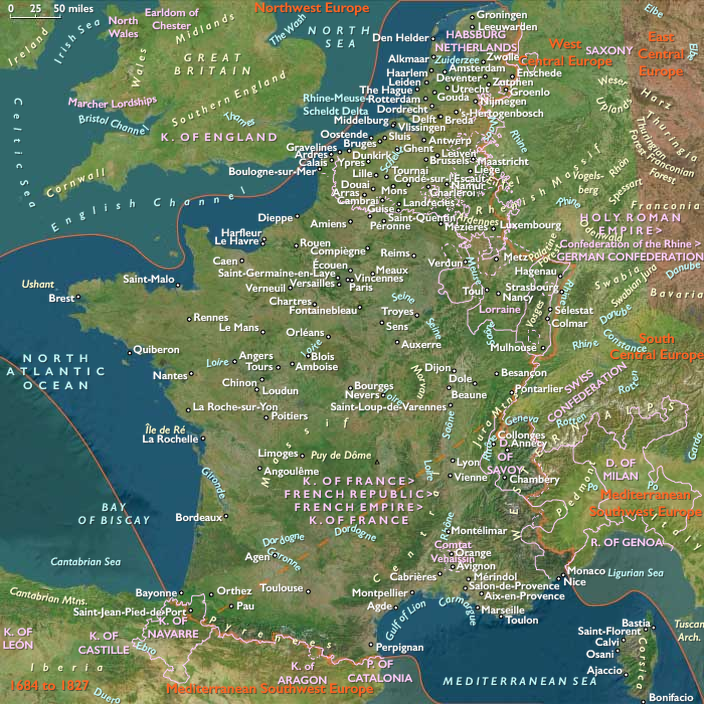
Subregions
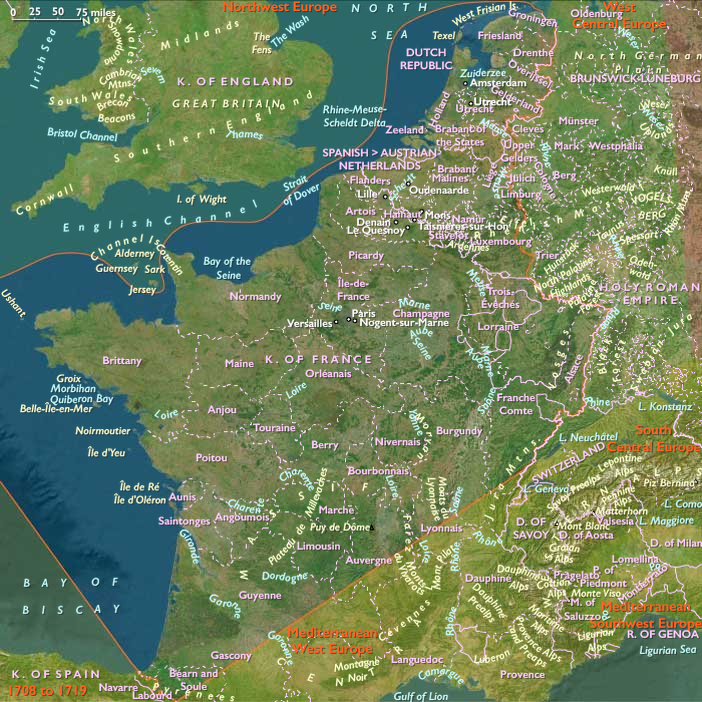
Related Events
Showing 10 events out of 28695 total
Years: 1708 - 1719
People
- Alain-René Lesage
- Bernard Le Bovier de Fontenelle
- Charles II of Spain
- François Couperin
- Jean Baptiste Loeillet
- Jean Racine
- Jean-François Regnard
- John Churchill, 1st Duke of Marlborough
- Louis XIV of France
- Marc-Antoine Charpentier
- Philippe II d'Orléans
- Pierre Bayle
Groups
- Jews
- Flanders, County of
- Normandy, Duchy of
- Liège, Prince-Bishopric of
- Namur, County of
- Christians, Roman Catholic
- Limburg, Duchy of
- Austria, Archduchy of
- Lorraine, (second) Duchy of
- Luxemburg, Duchy of
- Holy Roman Empire
- Lutheranism
- Protestantism
- Huguenots (the “Reformed”)
- Spain, Habsburg Kingdom of
- Netherlands, Southern (Spanish)
- Netherlands, United Provinces of the (Dutch Republic)
- France, (Bourbon) Kingdom of
- Dutch East India Company (Vereenigde Oostindische Compagnie or VOC in Dutch, literally "United East Indies Company")
- Dutch West India Company
- Grand Alliance
- Prussia, Kingdom of
- England, (Stuart) Kingdom of
- Britain, Kingdom of Great
- South Sea Company, the
Topics
- Colonization of the Americas, French
- Enlightenment, Age of
- Spanish Succession, War of the
- Oudenarde, Battle of
- Malplaquet, Battle of
Commodoties
Subjects
- Writing
- Watercraft
- Painting and Drawing
- Labor and Service
- Conflict
- Scholarship
- Custom and Law
- Finance
- Human Migration
- religious movement
Regions
Subregions