
Atlantic West Europe (1672–1683): Conflict, Expansion, and …
Years: 1672 - 1683
Atlantic West Europe (1672–1683): Conflict, Expansion, and Cultural Vitality
Between 1672 and 1683, Atlantic West Europe—including northern France, the Low Countries (modern-day Netherlands, Belgium, Luxembourg), and regions along the Atlantic and English Channel coasts—experienced a turbulent yet transformative period marked by intense warfare, renewed territorial expansion, economic resilience, and sustained cultural and intellectual creativity. Despite challenges, this era solidified the foundations for the region’s future global prominence.
Political and Military Developments
The Franco-Dutch War (1672–1678)
-
Known as the "Disaster Year" (Rampjaar) of 1672 in Dutch history, Louis XIV of France invaded the Dutch Republic, allying with England under Charles II. Initial French advances were dramatic, capturing Utrecht and threatening Amsterdam.
-
The invasion caused internal political upheaval, resulting in the downfall and assassination of Grand Pensionary Johan de Witt (1672). William III of Orange emerged as Stadtholder, rallying Dutch resistance.
-
The Dutch Republic, supported by Spain, the Holy Roman Empire, and Brandenburg-Prussia, successfully repelled French forces, leading to the Peace of Nijmegen (1678–1679). France acquired important territories, including parts of the Spanish Netherlands and the Franche-Comté, solidifying its northeastern borders.
Strengthening of Absolutism in France
-
Louis XIV reinforced absolute monarchy following military gains. Internal administration tightened under Jean-Baptiste Colbert and Louvois, who enhanced military reforms, infrastructure, and centralized governance.
-
French territorial expansion along the eastern frontier (Alsace, Franche-Comté) bolstered France’s geopolitical position, setting the stage for ongoing European conflicts.
Stability and Recovery in the Dutch Republic
-
Following the Franco-Dutch War, the Dutch Republic recovered politically and economically under William III’s leadership, though increasingly burdened by military and financial pressures, particularly maintaining large armies against potential future conflicts.
Economic Developments: Resilience and Expansion
French Economic Strength and Colonial Growth
-
French maritime commerce expanded dramatically. Atlantic ports like Bordeaux, Nantes, and La Rochelle prospered, driven by trade in wine, sugar, slaves, and colonial commodities from the Caribbean (Saint-Domingue, Martinique) and Canada (New France).
-
Colbert’s mercantilist policies supported industrial growth, maritime trade, and colonial settlements, significantly enhancing France’s Atlantic commercial interests.
Dutch Economic Resilience
-
Despite initial setbacks in 1672, the Dutch Republic rapidly recovered its position as a maritime and commercial powerhouse, with Amsterdam maintaining dominance in banking, shipping, and global trade.
-
The Dutch East India Company (VOC) continued its expansive presence in Asia, while the Dutch West India Company (WIC) engaged heavily in the Atlantic slave trade and plantation economies, notably in Suriname and the Caribbean.
Decline of the Spanish Netherlands' Economy
-
The Spanish Netherlands faced prolonged economic stagnation due to warfare, fiscal pressures, and diminished commercial competitiveness. Antwerp and Brussels increasingly fell behind Amsterdam and French Atlantic ports economically, prompting migration of skilled workers and merchants to the Dutch Republic and France.
Religious and Intellectual Developments
Continued Catholic Orthodoxy in France and Spanish Netherlands
-
France intensified Catholic orthodoxy, reflected in Louis XIV’s ongoing suppression of Protestant communities, notably the Huguenots. Although formal revocation of the Edict of Nantes occurred later (1685), repression was already intensifying, leading to Huguenot emigration, particularly toward the Dutch Republic and England.
-
The Spanish Netherlands remained staunchly Catholic, reinforcing ecclesiastical control and limiting Protestant influences.
Dutch Intellectual and Scientific Flourishing
-
The Dutch Republic sustained its intellectual prominence, becoming a hub of scientific inquiry and innovation. Christiaan Huygens, Antoni van Leeuwenhoek, and others made groundbreaking scientific discoveries in optics, biology, and astronomy.
-
Religious tolerance, though challenged, persisted, facilitating intellectual freedom, attracting persecuted intellectuals, and enriching Dutch scholarly traditions.
Cultural and Artistic Developments
French Cultural Patronage: Baroque and Classicism
-
Under Louis XIV, French culture flourished in grand Baroque and Classical forms. Versailles continued to symbolize royal absolutism, magnificently expanded and embellished by architects Jules Hardouin-Mansart and landscape designer André Le Nôtre.
-
Artists, playwrights, and musicians—such as Molière, Jean Racine, Jean-Baptiste Lully—thrived, supported by royal patronage, firmly establishing French cultural dominance across Europe.
Dutch Artistic Vitality and Genre Painting
-
Despite war and financial burdens, the Dutch Golden Age artistic tradition endured, with artists producing richly detailed domestic scenes, landscapes, still lifes, and portraits. Though Rembrandt had died in 1669, his artistic legacy profoundly influenced contemporaries.
-
Painters like Jan Steen and Jacob van Ruisdael contributed significantly during this era, capturing scenes of daily life and natural landscapes, representing a distinctly Dutch cultural identity.
Social and Urban Developments
Urban Growth and Economic Dynamism
-
Major Atlantic urban centers—Amsterdam, Rotterdam, Nantes, Bordeaux—continued growing, driven by maritime trade, commercial activity, and industrial expansion. Merchant classes gained greater social prominence and political influence, underpinning urban prosperity.
-
Bordeaux's wine industry, exporting significant quantities of wine to England and the Netherlands, became an economic cornerstone, bolstering the city’s prosperity and international recognition.
Social Tensions and Rural Challenges
-
Although urban prosperity was notable, rural areas across northern France and parts of the Low Countries faced ongoing economic strain due to warfare, fiscal burdens, and agricultural difficulties. Rural poverty and periodic unrest remained common, contrasting sharply with urban affluence.
Legacy and Historical Significance
The period 1672–1683 was critical in shaping Atlantic West Europe’s historical trajectory, deeply influenced by conflict, economic recovery, cultural vitality, and social transformations:
-
Politically, French territorial expansion significantly reshaped Europe’s geopolitical landscape, while the Dutch Republic preserved its independence and commercial prominence despite military threats.
-
Economically, the era witnessed sustained maritime commerce and colonial expansion, particularly benefiting France’s Atlantic ports and the resilient Dutch trading empire.
-
Culturally and intellectually, French absolutism promoted extraordinary cultural patronage, reinforcing European classical norms, while Dutch scientific inquiry and artistic production continued flourishing, exemplifying a dynamic intellectual climate.
-
Religiously, intensified religious tensions and increasing persecution of Protestant minorities foreshadowed major demographic and cultural shifts in subsequent decades.
By 1683, Atlantic West Europe had firmly established its position as a pivotal center of European power, commerce, and culture, laying foundations for its influential role in global affairs throughout subsequent centuries.
People
- André Le Nôtre
- Antonie van Leeuwenhoek
- Baruch de Spinoza
- Charles II
- Christiaan Huygens
- François Michel Le Tellier, Marquis de Louvois
- Jacob van Ruisdael
- Jan Steen
- Jean Racine
- Jean-Baptiste Colbert
- Jean-Baptiste Lully
- Johan de Witt
- Johannes Vermeer
- Jules Mansart
- Jules Mazarin
- Louis XIV of France
- Molière (Jean-Baptiste Poquelin)
- William III, Prince of Orange
Groups
- Jews
- Flanders, County of
- Normandy, Duchy of
- Brittanny, Duchy of
- Liège, Prince-Bishopric of
- Namur, County of
- Christians, Roman Catholic
- Limburg, Duchy of
- Hainaut, County of
- Holland, County of
- Austria, Archduchy of
- Moravian Margravate
- Brabant, Duchy of
- Lorraine, (second) Duchy of
- Bohemia, Kingdom of
- Artois, County of
- Luxemburg, Duchy of
- Holy Roman Empire
- Lutheranism
- Protestantism
- Anabaptists
- Calvinists
- Huguenots (the “Reformed”)
- Mennonites
- Franche-Comté (province of the Spanish Empire)
- Netherlands, Southern (Spanish)
- Netherlands, United Provinces of the (Dutch Republic)
- France, (Bourbon) Kingdom of
- Dutch East India Company (Vereenigde Oostindische Compagnie or VOC in Dutch, literally "United East Indies Company")
- Dutch West India Company
Topics
- Protestant Reformation
- Colonization of the Americas, French
- Western Architecture: 1540 to 1684
- Counter-Reformation (also Catholic Reformation or Catholic Revival)
- Dutch Golden Age
- Western Art: 1672 to 1684
- Franco-Dutch War
Commodoties
Subjects
- Writing
- Watercraft
- Painting and Drawing
- Labor and Service
- Conflict
- Scholarship
- Custom and Law
- Finance
- Optics
- religious movement
- Astronomy
- Biology
Regions
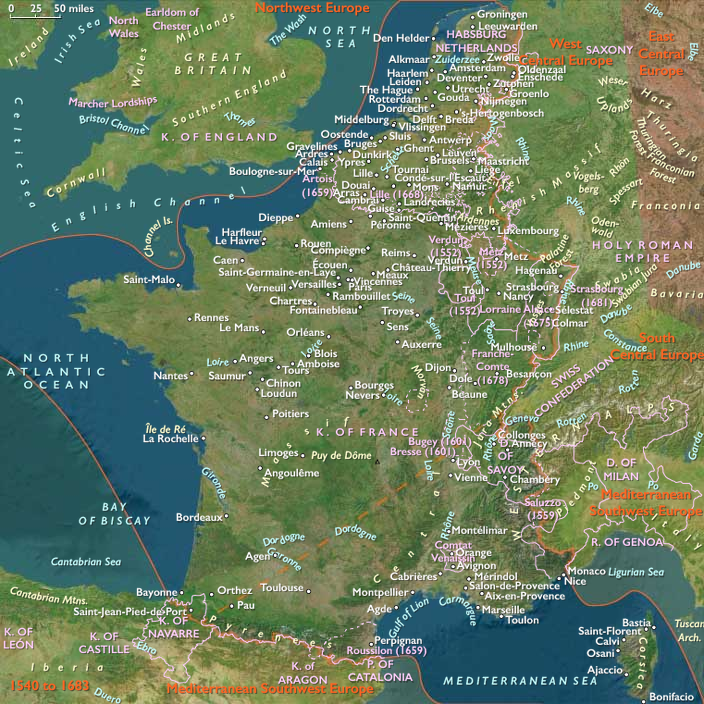
Subregions
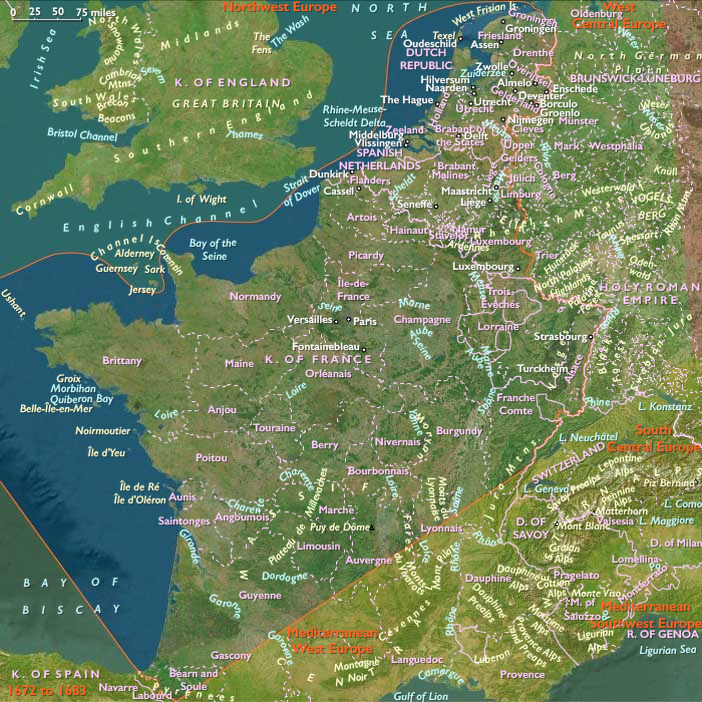
Years: 1672 - 1683
People
- André Le Nôtre
- Antonie van Leeuwenhoek
- Baruch de Spinoza
- Charles II
- Christiaan Huygens
- François Michel Le Tellier, Marquis de Louvois
- Jacob van Ruisdael
- Jan Steen
- Jean Racine
- Jean-Baptiste Colbert
- Jean-Baptiste Lully
- Johan de Witt
- Johannes Vermeer
- Jules Mansart
- Jules Mazarin
- Louis XIV of France
- Molière (Jean-Baptiste Poquelin)
- William III, Prince of Orange
Groups
- Jews
- Flanders, County of
- Normandy, Duchy of
- Brittanny, Duchy of
- Liège, Prince-Bishopric of
- Namur, County of
- Christians, Roman Catholic
- Limburg, Duchy of
- Hainaut, County of
- Holland, County of
- Austria, Archduchy of
- Moravian Margravate
- Brabant, Duchy of
- Lorraine, (second) Duchy of
- Bohemia, Kingdom of
- Artois, County of
- Luxemburg, Duchy of
- Holy Roman Empire
- Lutheranism
- Protestantism
- Anabaptists
- Calvinists
- Huguenots (the “Reformed”)
- Mennonites
- Franche-Comté (province of the Spanish Empire)
- Netherlands, Southern (Spanish)
- Netherlands, United Provinces of the (Dutch Republic)
- France, (Bourbon) Kingdom of
- Dutch East India Company (Vereenigde Oostindische Compagnie or VOC in Dutch, literally "United East Indies Company")
- Dutch West India Company
Topics
- Protestant Reformation
- Colonization of the Americas, French
- Western Architecture: 1540 to 1684
- Counter-Reformation (also Catholic Reformation or Catholic Revival)
- Dutch Golden Age
- Western Art: 1672 to 1684
- Franco-Dutch War
Commodoties
Subjects
- Writing
- Watercraft
- Painting and Drawing
- Labor and Service
- Conflict
- Scholarship
- Custom and Law
- Finance
- Optics
- religious movement
- Astronomy
- Biology
Regions
Subregions