
Atlantic West Europe (1648–1659): The Peace of …
Years: 1648 - 1659
Atlantic West Europe (1648–1659): The Peace of Westphalia, Economic Recovery, and Cultural Renewal
From 1648 to 1659, Atlantic West Europe—comprising northern France, the Low Countries (modern-day Netherlands, Belgium, Luxembourg), and the Atlantic and Channel-facing regions—entered a critical era of political stabilization, economic recovery, and renewed cultural dynamism following the conclusion of the devastating Thirty Years' War (1618–1648). The Peace of Westphalia (1648) reshaped Europe's political landscape, securing Dutch independence, significantly altering Franco-Spanish relations, and influencing regional economic and cultural trajectories.
Political and Military Developments
The Peace of Westphalia (1648): New Political Order
-
The treaties signed at Münster and Osnabrück in 1648 ended the Thirty Years' War, dramatically reshaping Europe's political order:
-
The Dutch Republic gained full international recognition of its independence from Habsburg Spain, solidifying the northern provinces’ sovereignty and ending eight decades of conflict (Dutch Revolt, 1568–1648).
-
The Spanish Netherlands (modern Belgium and Luxembourg) remained under Habsburg control, but the war left these territories politically weakened, vulnerable, and economically diminished.
-
France: Consolidation under Cardinal Mazarin and Louis XIV
-
Under Cardinal Mazarin's regency for the young Louis XIV (1643–1715), France emerged as a dominant European power, successfully securing territorial gains along its eastern borders through the Peace of Westphalia.
-
The Fronde rebellion (1648–1653), a series of civil conflicts in France driven by noble opposition to Mazarin’s centralized policies and fiscal pressures, posed temporary challenges to royal authority. The ultimate suppression of the Fronde reinforced royal absolutism, paving the way for Louis XIV’s centralized monarchy.
Continued Franco-Spanish Conflict: Treaty of the Pyrenees (1659)
-
Despite Westphalia, France and Spain continued warfare until the Treaty of the Pyrenees (1659) definitively ended hostilities:
-
France obtained significant territorial gains, including Roussillon and Artois, strengthening its geopolitical position.
-
The treaty, cemented by Louis XIV’s marriage to Maria Theresa of Spain, signaled Spain’s diminished European influence and French ascendancy.
-
Economic Developments: Stabilization and Maritime Revival
Dutch Economic Prosperity and Maritime Dominance
-
With independence secure, the Dutch Republic entered its commercial Golden Age, with Amsterdam cementing its status as Europe’s premier financial, trade, and shipping center.
-
The Dutch East India Company (VOC) and West India Company (WIC) expanded global trade networks, enhancing economic prosperity and reinforcing the Netherlands' maritime hegemony.
Northern France: Post-war Economic Recovery
-
Northern French ports—Bordeaux, Nantes, Rouen—rapidly recovered and expanded maritime trade, notably wine exports from Bordeaux, textiles from Rouen, and colonial products from Nantes, enhancing economic prosperity after decades of warfare.
-
Agricultural productivity gradually rebounded, though rural regions experienced slower recovery due to persistent demographic and infrastructural damage from warfare and taxation.
Spanish Netherlands: Economic Struggles and Limited Recovery
-
The southern Low Countries (modern Belgium and Luxembourg) experienced more significant economic hardship post-war due to sustained military occupations, disrupted trade routes, and continued vulnerability to conflict between France and Spain.
-
Cities like Antwerp saw diminished trade prominence compared to Amsterdam, marking an economic shift toward the northern provinces.
Religious and Intellectual Developments
Religious Stability and Consolidation
-
The Peace of Westphalia solidified the principle of territorial religious sovereignty, stabilizing religious divisions but leaving profound Protestant–Catholic divides intact, especially visible between the Calvinist Dutch Republic and Catholic Spanish Netherlands.
-
France continued promoting Catholic orthodoxy while cautiously maintaining internal peace through limited religious tolerance for Huguenots.
Intellectual Flourishing and Scientific Advancement
-
Intellectual activity thrived, particularly in the Dutch Republic and France. René Descartes’ philosophical and scientific ideas continued influencing intellectual circles significantly.
-
Scientific communities in Amsterdam, Leiden, and Paris flourished, fostering early Enlightenment thinking and advancing research in medicine, astronomy, mathematics, and natural philosophy.
Cultural and Artistic Developments
Dutch Golden Age of Painting
-
The post-war Dutch Republic experienced unmatched artistic prosperity, led by artists such as Rembrandt van Rijn, whose mature masterpieces reflected deep psychological insight and remarkable realism, alongside figures like Johannes Vermeer, who began his career in this period.
-
Genre painting, landscapes, still lifes, and portraits became emblematic of Dutch cultural identity, reflecting urban prosperity, mercantile values, and Protestant cultural norms.
French Baroque and Courtly Culture
-
French artistic patronage flourished under Louis XIV’s court, initiating grand architectural projects and gardens at Versailles (begun 1660s), foreshadowing Louis XIV’s later cultural grandeur.
-
Literature and drama thrived, exemplified by playwrights like Pierre Corneille and Jean Racine, whose works established classical standards defining French literary excellence.
Social and Urban Developments
Urban Expansion and Commercial Growth
-
Amsterdam, Rotterdam, Antwerp, Brussels, and northern French port cities experienced significant urban expansion and infrastructural improvements, reflecting increased commercial prosperity.
-
Growing merchant classes wielded substantial influence, fostering social mobility and economic innovation, notably in the Dutch Republic and prosperous French cities.
Rural Recovery and Persistent Social Strains
-
Rural northern France and the southern Netherlands struggled with slower economic recovery, demographic stagnation, and persistent poverty due to long-term wartime devastation, taxation, and agricultural difficulties.
-
Regional disparities intensified, accentuating economic contrasts between prosperous coastal urban centers and struggling rural hinterlands.
Legacy and Historical Significance
The years 1648–1659 marked a decisive transitional era in Atlantic West Europe:
-
Politically, the Peace of Westphalia and Treaty of the Pyrenees reshaped territorial boundaries, cemented Dutch independence, and solidified France’s ascendancy, profoundly influencing European power dynamics.
-
Economically, maritime revival, especially Dutch global trade and French port prosperity, established enduring economic trajectories that shaped early modern European economic leadership.
-
Culturally and intellectually, artistic and scientific achievements during this period left lasting cultural legacies, contributing significantly to European intellectual heritage and Baroque artistic expressions.
By 1659, Atlantic West Europe had substantially overcome wartime challenges, achieving political stabilization, economic revival, and cultural flourishing that established essential foundations for future growth, cultural influence, and geopolitical prominence in European and global contexts.
People
- Anne of Austria, Queen consort of France
- Frans Hals
- Frederick Henry of Nassau
- Hendrik Goltzius
- Isabella Clara Eugenia
- Jan van Goyen
- Jan Lievens
- Johannes Vermeer
- Jules Mazarin
- Louis XIV of France
- Marie de Medicis
- Maurice of Nassau
- Peter Paul Rubens
- Philip IV of Spain
- Pierre Corneille
- Rembrandt van Rijn
- René Descartes
Groups
- Jews
- Flanders, County of
- Normandy, Duchy of
- Brittanny, Duchy of
- Liège, Prince-Bishopric of
- Namur, County of
- Christians, Roman Catholic
- Limburg, Duchy of
- Hainaut, County of
- Holland, County of
- Austria, Archduchy of
- Moravian Margravate
- Brabant, Duchy of
- Lorraine, (second) Duchy of
- Bohemia, Kingdom of
- Artois, County of
- Luxemburg, Duchy of
- Holy Roman Empire
- Lutheranism
- Protestantism
- Anabaptists
- Calvinists
- Huguenots (the “Reformed”)
- Mennonites
- Franche-Comté (province of the Spanish Empire)
- Netherlands, Southern (Spanish)
- Netherlands, United Provinces of the (Dutch Republic)
- France, (Bourbon) Kingdom of
- Dutch East India Company (Vereenigde Oostindische Compagnie or VOC in Dutch, literally "United East Indies Company")
- Dutch West India Company
Topics
- Protestant Reformation
- Colonization of the Americas, French
- Counter-Reformation (also Catholic Reformation or Catholic Revival)
- Western Architecture: 1540 to 1684
- Eighty Years War (Netherlands, or Dutch, War of Independence)
- Dutch Golden Age
- Thirty Years' War
- Western Art: 1648 to 1660
Commodoties
Subjects
- Writing
- Watercraft
- Painting and Drawing
- Conflict
- Scholarship
- Custom and Law
- Finance
- religious movement
Regions
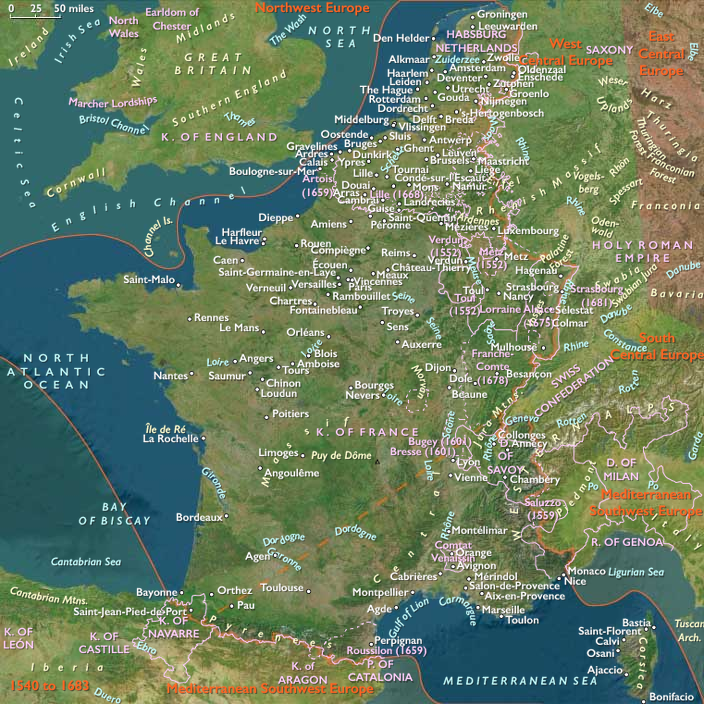
Subregions
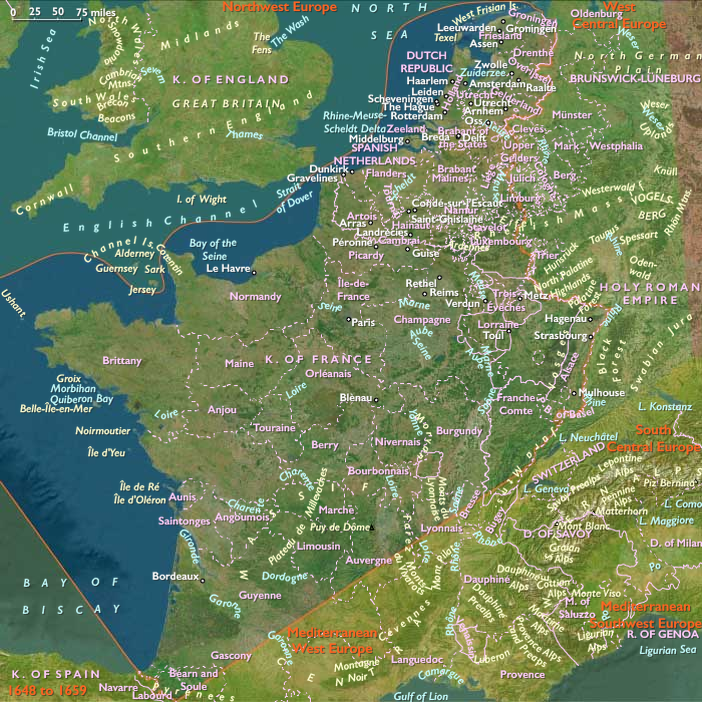
Related Events
Showing 10 events out of 31953 total
Years: 1648 - 1659
People
- Anne of Austria, Queen consort of France
- Frans Hals
- Frederick Henry of Nassau
- Hendrik Goltzius
- Isabella Clara Eugenia
- Jan van Goyen
- Jan Lievens
- Johannes Vermeer
- Jules Mazarin
- Louis XIV of France
- Marie de Medicis
- Maurice of Nassau
- Peter Paul Rubens
- Philip IV of Spain
- Pierre Corneille
- Rembrandt van Rijn
- René Descartes
Groups
- Jews
- Flanders, County of
- Normandy, Duchy of
- Brittanny, Duchy of
- Liège, Prince-Bishopric of
- Namur, County of
- Christians, Roman Catholic
- Limburg, Duchy of
- Hainaut, County of
- Holland, County of
- Austria, Archduchy of
- Moravian Margravate
- Brabant, Duchy of
- Lorraine, (second) Duchy of
- Bohemia, Kingdom of
- Artois, County of
- Luxemburg, Duchy of
- Holy Roman Empire
- Lutheranism
- Protestantism
- Anabaptists
- Calvinists
- Huguenots (the “Reformed”)
- Mennonites
- Franche-Comté (province of the Spanish Empire)
- Netherlands, Southern (Spanish)
- Netherlands, United Provinces of the (Dutch Republic)
- France, (Bourbon) Kingdom of
- Dutch East India Company (Vereenigde Oostindische Compagnie or VOC in Dutch, literally "United East Indies Company")
- Dutch West India Company
Topics
- Protestant Reformation
- Colonization of the Americas, French
- Counter-Reformation (also Catholic Reformation or Catholic Revival)
- Western Architecture: 1540 to 1684
- Eighty Years War (Netherlands, or Dutch, War of Independence)
- Dutch Golden Age
- Thirty Years' War
- Western Art: 1648 to 1660
Commodoties
Subjects
- Writing
- Watercraft
- Painting and Drawing
- Conflict
- Scholarship
- Custom and Law
- Finance
- religious movement
Regions
Subregions