
Atlantic West Europe (1624–1635): Renewed Conflict, Centralization, …
Years: 1624 - 1635
Atlantic West Europe (1624–1635): Renewed Conflict, Centralization, and Baroque Cultural Ascendancy
The period 1624–1635 in Atlantic West Europe—comprising northern France, the Low Countries (the Netherlands, Belgium, Luxembourg), and Atlantic-facing regions—was dominated by renewed military conflict, political centralization, economic prosperity coupled with financial stress, and a vivid flourishing of Baroque art and culture. Intensified involvement in the Thirty Years' War significantly impacted political alliances, while culturally, the region embraced vibrant artistic creativity and scientific inquiry.
Political and Military Developments
France: Richelieu and Centralized Authority
-
Cardinal Richelieu rose to prominence as Louis XIII's chief minister (1624), initiating far-reaching reforms aimed at consolidating royal power and diminishing noble influence.
-
Richelieu’s anti-Habsburg policies increasingly drew France into the Thirty Years’ War (1618–1648), supporting Protestant states and weakening Spain and the Austrian Habsburgs. His decisive intervention (1635) openly committed France to war, reshaping European political dynamics.
Dutch Republic: Resumption of Conflict with Spain
-
With the expiration of the Twelve Years' Truce in 1621, hostilities resumed between the Dutch Republic and Spain. During 1624–1635, the Republic reinforced military capabilities, especially naval power, intensifying the war against Spanish forces.
-
Frederick Henry of Orange, Stadtholder (r. 1625–1647), led successful military campaigns, capturing strategic cities such as 's-Hertogenbosch (1629) and Maastricht (1632), significantly consolidating Dutch territorial security.
Spanish Netherlands: Ongoing Military and Religious Pressures
-
The Spanish Netherlands continued as a critical theater in the wider European conflict. Spanish forces under Governor-General Infanta Isabella Clara Eugenia (d.1633) struggled to defend southern provinces from Dutch incursions, maintaining firm Catholic rule through military strength and religious uniformity.
-
Following Isabella’s death (1633), direct rule by the Spanish Crown resumed, intensifying local discontent amid heavy taxation, military demands, and ongoing conflicts.
Economic Developments: Prosperity, Strains, and Maritime Dominance
Dutch Golden Age and Financial Pressures
-
The Dutch Republic maintained economic dynamism, particularly in Amsterdam, Europe's financial and commercial capital, facilitated by the Dutch East India Company (VOC) and the rapidly expanding Dutch West India Company (WIC), established in 1621.
-
However, sustained military campaigns strained Dutch financial resources. Rising public debt became an issue, even amid continued trade prosperity and industrial productivity, highlighting the economic tensions of war financing.
French Economic Expansion and Maritime Trade
-
France, under Richelieu’s guidance, promoted economic growth and maritime expansion. The port cities of Bordeaux, Nantes, Le Havre, and La Rochelle prospered, driven by increased trade in wine, salt, textiles, and colonial products from newly established French overseas territories.
-
Richelieu significantly strengthened naval power, promoting overseas commerce and colonial expansion, particularly in North America and the Caribbean.
Religious and Intellectual Developments
Intensification of Counter-Reformation and Protestant Conflict
-
The renewed war heightened religious tensions. In northern France and the Spanish Netherlands, Counter-Reformation Catholicism intensified through Jesuit-led education and missionary efforts, reinforcing orthodoxy and suppressing Protestantism.
-
In the Dutch Republic, the decisive Calvinist orthodoxy following the Synod of Dort (1619) dominated, marginalizing other Protestant groups but fostering religious cohesion amid external threats.
Growth of Intellectual Inquiry and Scientific Thought
-
Notable advancements occurred in scientific thought and philosophical inquiry. In France, René Descartes pursued groundbreaking philosophical work in the Netherlands, publishing influential works such as Discourse on Method (1637) (just after this era), fostering rationalist philosophy and scientific method development.
-
Dutch and Flemish scholars continued important work in mathematics, optics, navigation, and early experimental science, reflecting broader European scientific advancements.
Cultural and Artistic Developments
Baroque Cultural Flourishing
-
Baroque art and architecture flourished spectacularly. In the Spanish Netherlands, Peter Paul Rubens achieved international prominence, executing large-scale commissions for courts across Europe, significantly influencing Baroque artistic expression.
-
The Dutch Golden Age of painting continued to blossom, with emerging masters like Rembrandt, whose early works in this period solidified his reputation as one of Europe's foremost artists. Other notable figures included Frans Hals, known for vivid, lifelike portraiture, and landscape specialists such as Jan van Goyen.
French Cultural Patronage
-
In France, Richelieu’s patronage bolstered literature, theater, and architecture. Playwrights such as Pierre Corneille began their careers, shaping French drama profoundly. Paris emerged as a vibrant cultural center, increasingly influencing European tastes and artistic standards.
Social and Urban Developments
Urban Growth Amid Economic Prosperity
-
Amsterdam, Antwerp, and Rotterdam continued to expand, driven by maritime trade and economic prosperity. Urban growth facilitated significant demographic changes, increased social mobility, and the emergence of influential urban merchant classes.
-
In France, coastal cities such as Bordeaux and Nantes flourished, while Paris grew significantly as administrative centralization under Richelieu attracted nobles, officials, intellectuals, and artists.
Continued Rural Struggles and Migration
-
Rural areas across northern France and southern Low Countries faced ongoing hardships from warfare, taxation, and poor harvests, prompting widespread migration into expanding urban areas or overseas colonies.
Legacy and Historical Significance
The era 1624–1635 was crucial in shaping Atlantic West Europe’s long-term political, economic, cultural, and social trajectory:
-
Politically, Richelieu’s centralizing reforms fundamentally transformed French governance, positioning France as a dominant European power. The Dutch Republic secured territorial gains but faced increasing economic pressure from sustained warfare.
-
Economically, Amsterdam’s financial dominance and maritime trade success contrasted with increasing fiscal strains, foreshadowing future economic challenges.
-
Religiously, the intensification of Counter-Reformation efforts and entrenched Calvinist orthodoxy further entrenched regional religious identities and divisions.
-
Culturally, the extraordinary artistic productivity of the early Baroque era established lasting legacies in European cultural history, influencing artistic standards for centuries.
Thus, by 1635, Atlantic West Europe had navigated renewed conflict, economic prosperity tempered by growing strains, and remarkable cultural and intellectual innovation, setting essential foundations for the complex developments of the later seventeenth century.
People
- Armand Jean du Plessis de Richelieu
- Frans Hals
- Frederick Henry of Nassau
- Hendrik Goltzius
- Isabella Clara Eugenia
- Jan van Goyen
- Johan van Oldenbarnevelt
- Karel van Mander
- Louis XIII of France
- Marie de Medicis
- Maurice of Nassau
- Peter Paul Rubens
- Philip III of Spain
- Philip IV of Spain
- Pierre Corneille
- Rembrandt van Rijn
- René Descartes
Groups
- Jews
- Flanders, County of
- Normandy, Duchy of
- Brittanny, Duchy of
- Liège, Prince-Bishopric of
- Namur, County of
- Christians, Roman Catholic
- Limburg, Duchy of
- Hainaut, County of
- Holland, County of
- Austria, Archduchy of
- Moravian Margravate
- Brabant, Duchy of
- Lorraine, (second) Duchy of
- Bohemia, Kingdom of
- Artois, County of
- Luxemburg, Duchy of
- Holy Roman Empire
- Lutheranism
- Protestantism
- Anabaptists
- Calvinists
- Huguenots (the “Reformed”)
- Mennonites
- Franche-Comté (province of the Spanish Empire)
- Netherlands, Southern (Spanish)
- Netherlands, United Provinces of the (Dutch Republic)
- France, (Bourbon) Kingdom of
- Dutch East India Company (Vereenigde Oostindische Compagnie or VOC in Dutch, literally "United East Indies Company")
- Dutch West India Company
Topics
- Protestant Reformation
- Colonization of the Americas, French
- Counter-Reformation (also Catholic Reformation or Catholic Revival)
- Western Architecture: 1540 to 1684
- Eighty Years War (Netherlands, or Dutch, War of Independence)
- Dutch Golden Age
- Thirty Years' War
- Western Art: 1624 to 1636
Commodoties
Subjects
- Writing
- Watercraft
- Painting and Drawing
- Conflict
- Scholarship
- Custom and Law
- Finance
- religious movement
Regions
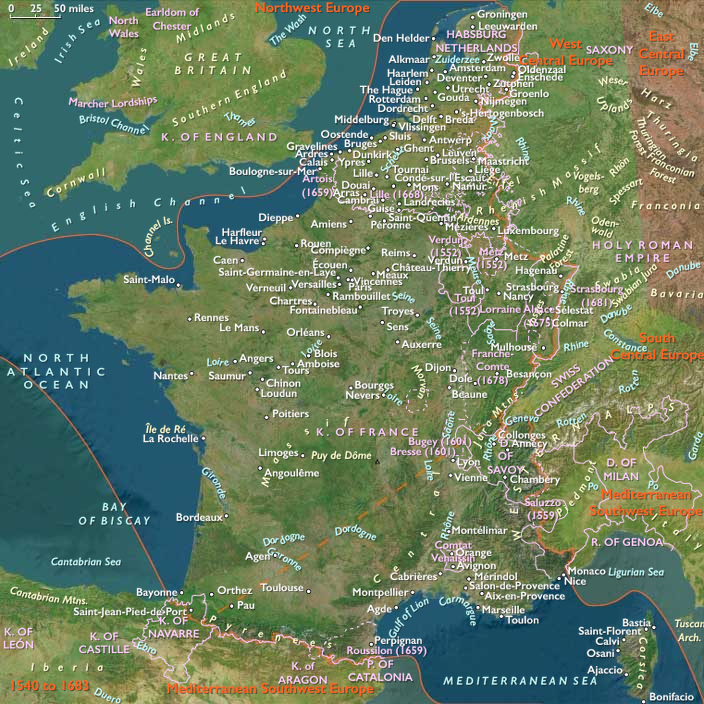
Subregions
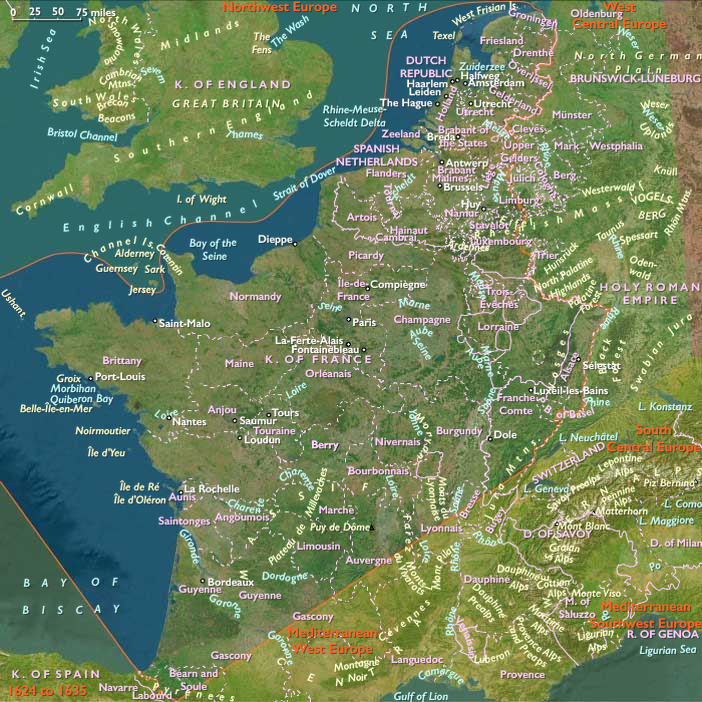
Related Events
Showing 10 events out of 32911 total
Years: 1624 - 1635
People
- Armand Jean du Plessis de Richelieu
- Frans Hals
- Frederick Henry of Nassau
- Hendrik Goltzius
- Isabella Clara Eugenia
- Jan van Goyen
- Johan van Oldenbarnevelt
- Karel van Mander
- Louis XIII of France
- Marie de Medicis
- Maurice of Nassau
- Peter Paul Rubens
- Philip III of Spain
- Philip IV of Spain
- Pierre Corneille
- Rembrandt van Rijn
- René Descartes
Groups
- Jews
- Flanders, County of
- Normandy, Duchy of
- Brittanny, Duchy of
- Liège, Prince-Bishopric of
- Namur, County of
- Christians, Roman Catholic
- Limburg, Duchy of
- Hainaut, County of
- Holland, County of
- Austria, Archduchy of
- Moravian Margravate
- Brabant, Duchy of
- Lorraine, (second) Duchy of
- Bohemia, Kingdom of
- Artois, County of
- Luxemburg, Duchy of
- Holy Roman Empire
- Lutheranism
- Protestantism
- Anabaptists
- Calvinists
- Huguenots (the “Reformed”)
- Mennonites
- Franche-Comté (province of the Spanish Empire)
- Netherlands, Southern (Spanish)
- Netherlands, United Provinces of the (Dutch Republic)
- France, (Bourbon) Kingdom of
- Dutch East India Company (Vereenigde Oostindische Compagnie or VOC in Dutch, literally "United East Indies Company")
- Dutch West India Company
Topics
- Protestant Reformation
- Colonization of the Americas, French
- Counter-Reformation (also Catholic Reformation or Catholic Revival)
- Western Architecture: 1540 to 1684
- Eighty Years War (Netherlands, or Dutch, War of Independence)
- Dutch Golden Age
- Thirty Years' War
- Western Art: 1624 to 1636
Commodoties
Subjects
- Writing
- Watercraft
- Painting and Drawing
- Conflict
- Scholarship
- Custom and Law
- Finance
- religious movement
Regions
Subregions