
Atlantic West Europe (1612–1623): Religious Conflict, Economic …
Years: 1612 - 1623
Atlantic West Europe (1612–1623): Religious Conflict, Economic Growth, and Early Baroque Flourishing
The period 1612–1623 in Atlantic West Europe—including northern France, the Low Countries (the Netherlands, Belgium, Luxembourg), and the Atlantic and Channel coastal regions—was marked by significant religious and political tensions, ongoing economic prosperity, particularly in the Dutch Republic, and notable artistic and intellectual developments. Amidst deepening divisions, the region saw sustained commercial dynamism, evolving political landscapes, and heightened cultural creativity characteristic of early Baroque Europe.
Political and Military Developments
Dutch Republic: Religious Strife and Internal Division
-
Following the Twelve Years' Truce (1609–1621), the Dutch Republic enjoyed temporary peace but faced intense internal religious conflicts, primarily between the Calvinist factions: strict orthodox Gomarists and the moderate, tolerant Arminians.
-
The political struggle climaxed in the Synod of Dort (1618–1619), resulting in the condemnation of Arminianism, and the subsequent execution of the influential statesman Johan van Oldenbarnevelt (1619), consolidating power under the orthodox Calvinists and the House of Orange.
France: Political Instability and Royal Minority
-
France faced renewed instability after the assassination of Henry IV (1610). His son, Louis XIII (r. 1610–1643), assumed the throne at nine, initiating a regency under Marie de' Medici, characterized by internal strife, noble rebellions, and court intrigue.
-
The period saw the rise of Cardinal Richelieu, who entered the royal council in 1624, beginning the consolidation of royal authority, but in these early years, political control was fragmented and uncertain, weakening France temporarily.
Spanish Netherlands: Military Pressure and Strategic Positioning
-
The Spanish Netherlands, governed from Brussels, remained militarized and strategically important. The Spanish monarchy under Philip III (r. 1598–1621) and later Philip IV (r. 1621–1665) sought to fortify the southern Low Countries against future conflicts, preparing defenses around Antwerp, Ghent, and Bruges, while maintaining firm Catholic orthodoxy against Protestant incursions from the Dutch Republic.
Economic Developments: Maritime Prosperity and Expanding Trade Networks
Continued Dutch Economic Expansion
-
Amsterdam reinforced its role as Europe's financial and commercial hub, dominated by the Dutch East India Company (VOC), whose Asian trade brought immense wealth into the Republic. The VOC’s monopoly ensured Amsterdam’s financial markets thrived, becoming Europe’s center for banking, commodity trading, and financial innovation.
-
Dutch shipbuilding and navigation advancements increased maritime trade capacity, fostering expansive commerce with Baltic, Mediterranean, Atlantic, and Asian markets.
French and Flemish Trade Recovery
-
French port cities—Bordeaux, La Rochelle, and Nantes—expanded their maritime commerce. Bordeaux's wine exports to England and Northern Europe grew significantly, establishing the city's global reputation for high-quality wines.
-
Flemish towns under Spanish governance, particularly Antwerp, partially recovered economically, albeit constrained by military and religious restrictions. Nonetheless, Antwerp continued modest financial activities, trading primarily in luxury goods and textiles.
Religious and Intellectual Developments
Dutch Religious Polarization
-
The Synod of Dort decisively shaped Dutch Calvinism, reinforcing religious orthodoxy while significantly reducing tolerance toward dissent. The Synod's rulings profoundly impacted Dutch religious, cultural, and intellectual life, with lasting repercussions on religious minorities such as the Arminians and Mennonites.
Catholic Renewal and Counter-Reformation Influence
-
The Catholic Counter-Reformation strengthened in the Spanish Netherlands and northern France, bolstered by new religious orders, notably the Jesuits, who significantly influenced education, missionary activity, and theological scholarship.
-
Catholic educational institutions flourished in France (Sorbonne, Jesuit colleges) and the Spanish Netherlands (University of Leuven), promoting Catholic theology and Baroque cultural expression.
Cultural and Artistic Developments
Early Baroque Art and Cultural Patronage
-
The Dutch Republic experienced a remarkable flowering of visual arts, with painters such as Frans Hals in Haarlem, whose dynamic portraits embodied early Baroque realism. Emerging artists like the young Rembrandt van Rijn (active from the early 1620s) began their careers, heralding a golden age of Dutch painting.
-
Flemish artist Peter Paul Rubens, based in Antwerp, gained prominence during this period. His elaborate, vibrant Baroque style gained international acclaim, influencing European art profoundly through commissions from Spanish, French, and English patrons.
French Artistic and Cultural Life
-
France’s artistic expression continued its shift towards early Baroque styles, strongly influenced by court patronage under Marie de' Medici. Parisian architecture and arts reflected royal authority and ambition, exemplified by the construction of the Luxembourg Palace (1615–1625), a central Baroque architectural project initiated by Marie de' Medici.
Social and Urban Developments
Urbanization and Social Mobility
-
Amsterdam’s population soared, driven by prosperity, religious refugees, and international merchants, resulting in significant urban expansion, improved public infrastructure, and increased social mobility.
-
French urban centers, including Bordeaux, Nantes, and Rouen, benefited economically from expanded maritime trade, fostering a dynamic urban merchant class contributing to regional growth and stability.
Rural Hardship and Migration
-
Conversely, rural regions in northern France and parts of the southern Low Countries continued to face hardships due to recurring harvest failures, heavy taxation, and ongoing warfare preparations, prompting significant rural-to-urban migration and exacerbating urban poverty in some areas.
Legacy and Historical Significance
The era 1612–1623 in Atlantic West Europe significantly shaped regional political, religious, and cultural landscapes:
-
Politically, the Dutch Republic solidified its internal structure around Calvinist orthodoxy, setting conditions for future stability yet reducing religious pluralism. France, conversely, faced short-term fragmentation and instability, awaiting Richelieu’s forthcoming political consolidation.
-
Economically, sustained commercial and maritime prosperity entrenched Amsterdam’s economic preeminence, furthering Atlantic West Europe’s global influence.
-
Religiously, the decisive internal struggles within Dutch Calvinism and intensified Counter-Reformation activity in Catholic regions laid a crucial groundwork for future religious and cultural developments.
-
Culturally, the early Baroque flourished prominently, represented by figures like Rubens and emerging Dutch masters, signaling an artistic golden age that influenced European cultural trends for centuries.
Thus, by 1623, Atlantic West Europe had navigated considerable turmoil and transformation, setting a resilient foundation for continued political, economic, religious, and cultural evolution into the heart of the seventeenth century.
People
- Armand Jean du Plessis de Richelieu
- Frans Hals
- Hendrik Goltzius
- Henry IV of France
- Johan van Oldenbarnevelt
- Karel van Mander
- Louis XIII of France
- Marie de Medicis
- Maurice of Nassau
- Peter Paul Rubens
- Philip III of Spain
- Philip IV of Spain
- Rembrandt van Rijn
Groups
- Jews
- Flanders, County of
- Normandy, Duchy of
- Brittanny, Duchy of
- Liège, Prince-Bishopric of
- Namur, County of
- Christians, Roman Catholic
- Limburg, Duchy of
- Hainaut, County of
- Holland, County of
- Austria, Archduchy of
- Moravian Margravate
- Brabant, Duchy of
- Lorraine, (second) Duchy of
- Bohemia, Kingdom of
- Artois, County of
- Luxemburg, Duchy of
- Holy Roman Empire
- Lutheranism
- Protestantism
- Anabaptists
- Huguenots (the “Reformed”)
- Calvinists
- Mennonites
- Franche-Comté (province of the Spanish Empire)
- Netherlands, United Provinces of the (Dutch Republic)
- Netherlands, Southern (Spanish)
- France, (Bourbon) Kingdom of
- Dutch East India Company (Vereenigde Oostindische Compagnie or VOC in Dutch, literally "United East Indies Company")
Topics
- Protestant Reformation
- Colonization of the Americas, French
- Counter-Reformation (also Catholic Reformation or Catholic Revival)
- Western Architecture: 1540 to 1684
- Eighty Years War (Netherlands, or Dutch, War of Independence)
- Western Art: 1612 to 1624
Commodoties
Subjects
- Writing
- Watercraft
- Painting and Drawing
- Conflict
- Scholarship
- Custom and Law
- Finance
- religious movement
Regions
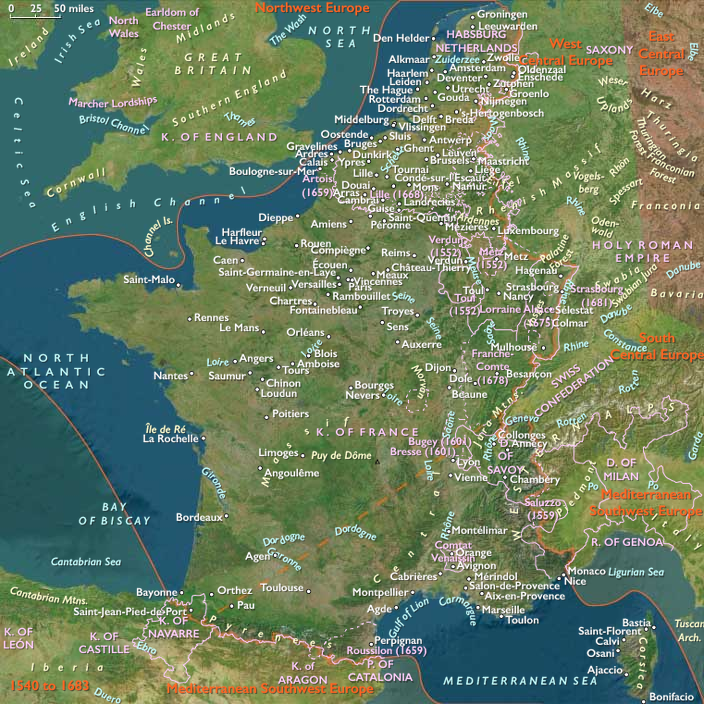
Subregions
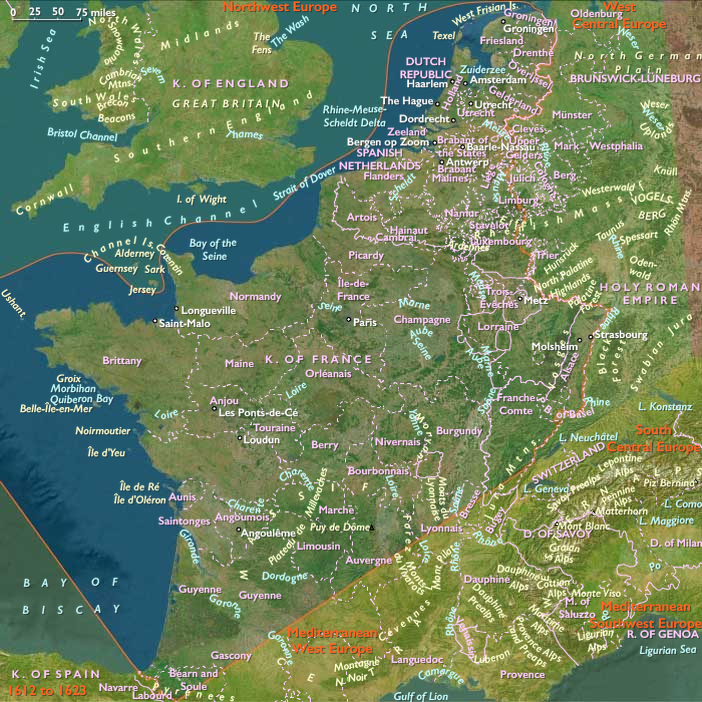
Years: 1612 - 1623
People
- Armand Jean du Plessis de Richelieu
- Frans Hals
- Hendrik Goltzius
- Henry IV of France
- Johan van Oldenbarnevelt
- Karel van Mander
- Louis XIII of France
- Marie de Medicis
- Maurice of Nassau
- Peter Paul Rubens
- Philip III of Spain
- Philip IV of Spain
- Rembrandt van Rijn
Groups
- Jews
- Flanders, County of
- Normandy, Duchy of
- Brittanny, Duchy of
- Liège, Prince-Bishopric of
- Namur, County of
- Christians, Roman Catholic
- Limburg, Duchy of
- Hainaut, County of
- Holland, County of
- Austria, Archduchy of
- Moravian Margravate
- Brabant, Duchy of
- Lorraine, (second) Duchy of
- Bohemia, Kingdom of
- Artois, County of
- Luxemburg, Duchy of
- Holy Roman Empire
- Lutheranism
- Protestantism
- Anabaptists
- Huguenots (the “Reformed”)
- Calvinists
- Mennonites
- Franche-Comté (province of the Spanish Empire)
- Netherlands, United Provinces of the (Dutch Republic)
- Netherlands, Southern (Spanish)
- France, (Bourbon) Kingdom of
- Dutch East India Company (Vereenigde Oostindische Compagnie or VOC in Dutch, literally "United East Indies Company")
Topics
- Protestant Reformation
- Colonization of the Americas, French
- Counter-Reformation (also Catholic Reformation or Catholic Revival)
- Western Architecture: 1540 to 1684
- Eighty Years War (Netherlands, or Dutch, War of Independence)
- Western Art: 1612 to 1624
Commodoties
Subjects
- Writing
- Watercraft
- Painting and Drawing
- Conflict
- Scholarship
- Custom and Law
- Finance
- religious movement
Regions
Subregions