
Atlantic West Europe (1576–1587): Deepening Conflict, Realignment, …
Years: 1576 - 1587
Atlantic West Europe (1576–1587): Deepening Conflict, Realignment, and the Birth of a Republic
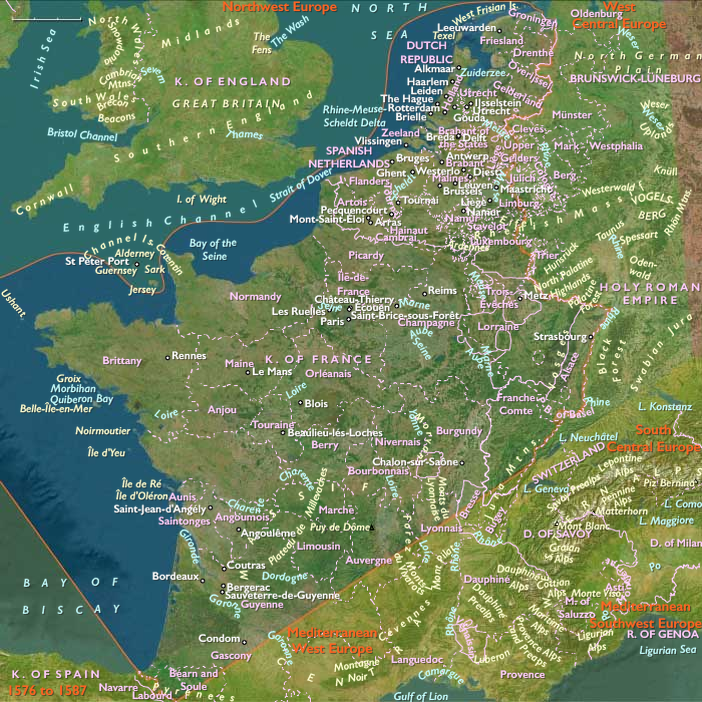
From 1576 to 1587, Atlantic West Europe—spanning northern France, the Low Countries (modern Belgium, Netherlands, Luxembourg), and the Atlantic and Channel coastal regions—witnessed escalating conflicts, shifting alliances, and critical political transformations. The intensifying Dutch Revolt reached a decisive phase, France's Wars of Religion persisted fiercely, and economic shifts solidified Amsterdam’s rise. The period's turbulence reshaped regional politics, paving the way for the Dutch Republic's establishment and continued French internal strife.
Political and Military Developments
Pacification of Ghent and Union of Arras and Utrecht (1576–1579)
-
The Pacification of Ghent (1576) briefly unified all seventeen provinces of the Low Countries—Catholic and Protestant—in opposition to Spanish oppression, particularly following a devastating mutiny and the brutal sack of Antwerp (1576) by Spanish troops.
-
However, religious divisions quickly undermined unity. Southern Catholic provinces formed the pro-Spanish Union of Arras (1579), reaffirming loyalty to Philip II, while the northern Protestant provinces countered with the Union of Utrecht (1579), laying the foundations for the future Dutch Republic.
Formal Declaration of Independence (1581)
-
In a decisive act, the northern provinces issued the Act of Abjuration (1581), formally renouncing Philip II’s sovereignty. William of Orange assumed political leadership, consolidating political structures toward a republican governance, dramatically altering European political paradigms.
Assassination of William of Orange (1584)
-
The assassination of William of Orange in Delft (1584) by a Catholic sympathizer threatened the revolt’s continuity. However, the northern provinces persevered, solidifying their political institutions under new leaders, notably Maurice of Nassau, William’s son, who modernized and strengthened Dutch military forces.
French Wars of Religion: Persistent Conflict
-
France’s internal religious wars continued unabated. King Henry III (r. 1574–1589) struggled ineffectively to mediate between radical Catholic factions (Catholic League) and Protestant Huguenots, prolonging national instability and regional violence, particularly acute in northern towns like Rouen and Amiens.
Economic Developments: Crisis and Transition
Decline of Antwerp and Rise of Amsterdam
-
The sack of Antwerp (1576) severely crippled the city's commercial dominance, as merchants increasingly fled northward to safer, Protestant-dominated Amsterdam, significantly bolstering its commercial and financial prominence.
-
By the mid-1580s, Amsterdam emerged as Europe’s rising financial capital, absorbing displaced Antwerp bankers and merchants and initiating its ascendancy as a global trading hub.
French Atlantic Commerce
-
French Atlantic ports, notably Bordeaux, Nantes, and La Rochelle, maintained vigorous maritime trade despite internal conflicts. Bordeaux’s wine industry, thriving on English and Dutch demand, provided economic resilience amid broader turmoil.
Religious and Intellectual Developments
Entrenched Religious Divisions
-
Catholic-Protestant hostilities intensified. In the Low Countries, the separation into northern Protestant provinces (Union of Utrecht) and southern Catholic provinces (Union of Arras) institutionalized religious division.
-
France’s religious wars entrenched sectarianism deeply, with northern French cities frequently shifting allegiances amid devastating violence. Royal and religious attempts at reconciliation continually failed.
Intellectual Resilience Amid Conflict
-
Despite conflict, humanist scholarship flourished in Leuven, Paris, and northern France, cautiously navigating religious censorship. Figures like Justus Lipsius in Leuven advocated neo-Stoicism, offering philosophical stability amid uncertainty.
Cultural and Artistic Developments
Cultural Flourishing Under Duress
-
Northern Renaissance art continued thriving amid conflict, exemplified by late works of Pieter Bruegel the Elder and early pieces by his son Pieter Brueghel the Younger. Their depictions vividly illustrated social divisions, war’s devastation, and common life, resonating powerfully across conflicted societies.
French Courtly Culture and Renaissance Influence
-
French court patronage sustained artistic and architectural endeavors despite instability. Paris and Loire Valley châteaux continued showcasing Mannerist and early Baroque influences, reflecting royal and aristocratic efforts to project cultural refinement amid political uncertainty.
Social Developments: Urban Stress and Rural Displacement
Urban Population Movements
-
Urban centers—particularly Antwerp, Bruges, Ghent, Lille, and Amiens—suffered significant demographic and economic disruptions due to religious violence and military conflict. Large-scale migration toward safer northern cities and abroad reshaped urban demographics and social structures profoundly.
Rural Poverty and Agrarian Crisis
-
Continued warfare exacerbated rural poverty across northern France and the Low Countries, with frequent harvest failures and heavy taxation fueling periodic peasant unrest and reinforcing migration to cities or overseas territories.
Legacy and Significance
The years 1576–1587 solidified crucial transformations across Atlantic West Europe:
-
Politically, the Dutch Revolt’s institutionalization through the Union of Utrecht and Act of Abjuration laid durable foundations for the independent Dutch Republic, significantly influencing European political theory on governance and resistance.
-
Economically, Amsterdam’s emergence, coupled with Antwerp’s decline, decisively shifted European trade and finance northward, permanently reshaping regional and global economic structures.
-
Religiously, entrenched sectarian divisions became institutionalized realities, profoundly affecting subsequent European conflicts, diplomacy, and cultural identities.
-
Culturally, remarkable artistic and intellectual resilience amid turmoil produced enduring contributions to Northern Renaissance humanism, philosophy, and artistic expression, demonstrating profound societal adaptability and creativity despite instability.
By 1587, Atlantic West Europe stood dramatically reshaped, emerging politically fractured yet culturally vibrant, economically resilient, and deeply scarred by religious conflict, setting the course decisively toward the modern European era.
People
- Henry III of France
- Justus Lipsius
- Maurice of Nassau
- Philip II of Spain
- Pieter Brueghel the Younger
- William I, “the Silent”, Prince of Orange
Groups
- Flanders, County of
- Normandy, Duchy of
- Brittanny, Duchy of
- Liège, Prince-Bishopric of
- Namur, County of
- Christians, Roman Catholic
- Limburg, Duchy of
- Hainaut, County of
- Holland, County of
- Austria, Archduchy of
- Moravian Margravate
- Brabant, Duchy of
- Lorraine, (second) Duchy of
- Bohemia, Kingdom of
- Artois, County of
- France, (Valois) Kingdom of
- Luxemburg, Duchy of
- Holy Roman Empire
- Netherlands, Habsburg
- Lutheranism
- Protestantism
- Anabaptists
- Calvinists
- Huguenots (the “Reformed”)
- Seventeen Provinces
- Franche-Comté (province of the Spanish Empire)
- Union of Arras
- Union of Utrecht
- Netherlands, United Provinces of the (Dutch Republic)
Topics
- Humanism, Renaissance
- Renaissance Architecture
- Renaissance in the Low Countries
- Renaissance, French
- Protestant Reformation
- Colonization of the Americas, French
- Western Architecture: 1540 to 1684
- Religion, Second War of
- Eighty Years War (Netherlands, or Dutch, War of Independence)
- St. Bartholomew's Day, Massacre of
- Religion, Fifth War of
- Religion, Sixth War of
- Western Art: 1576 to 1588
- Religion, Seventh War of (”Lovers' War”)
- Religion, Eighth War of (War of the Three Henrys)
Commodoties
Subjects
- Writing
- Watercraft
- Painting and Drawing
- Conflict
- Scholarship
- Custom and Law
- Finance
- religious movement
Regions

Subregions
Related Events
Showing 10 events out of 35161 total
Years: 1576 - 1587
People
- Henry III of France
- Justus Lipsius
- Maurice of Nassau
- Philip II of Spain
- Pieter Brueghel the Younger
- William I, “the Silent”, Prince of Orange
Groups
- Flanders, County of
- Normandy, Duchy of
- Brittanny, Duchy of
- Liège, Prince-Bishopric of
- Namur, County of
- Christians, Roman Catholic
- Limburg, Duchy of
- Hainaut, County of
- Holland, County of
- Austria, Archduchy of
- Moravian Margravate
- Brabant, Duchy of
- Lorraine, (second) Duchy of
- Bohemia, Kingdom of
- Artois, County of
- France, (Valois) Kingdom of
- Luxemburg, Duchy of
- Holy Roman Empire
- Netherlands, Habsburg
- Lutheranism
- Protestantism
- Anabaptists
- Calvinists
- Huguenots (the “Reformed”)
- Seventeen Provinces
- Franche-Comté (province of the Spanish Empire)
- Union of Arras
- Union of Utrecht
- Netherlands, United Provinces of the (Dutch Republic)
Topics
- Humanism, Renaissance
- Renaissance Architecture
- Renaissance in the Low Countries
- Renaissance, French
- Protestant Reformation
- Colonization of the Americas, French
- Western Architecture: 1540 to 1684
- Religion, Second War of
- Eighty Years War (Netherlands, or Dutch, War of Independence)
- St. Bartholomew's Day, Massacre of
- Religion, Fifth War of
- Religion, Sixth War of
- Western Art: 1576 to 1588
- Religion, Seventh War of (”Lovers' War”)
- Religion, Eighth War of (War of the Three Henrys)
Commodoties
Subjects
- Writing
- Watercraft
- Painting and Drawing
- Conflict
- Scholarship
- Custom and Law
- Finance
- religious movement
Regions
Subregions