
West Europe (1540–1683 CE) Principalities, Ports, …
Years: 1540 - 1683
West Europe (1540–1683 CE)
Principalities, Ports, and the Making of the Early Modern West
Geography & Environmental Context
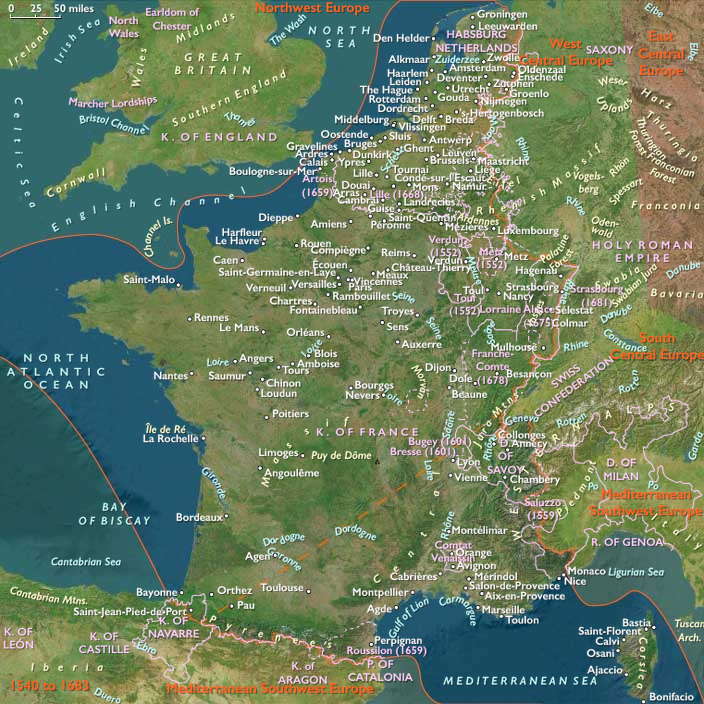
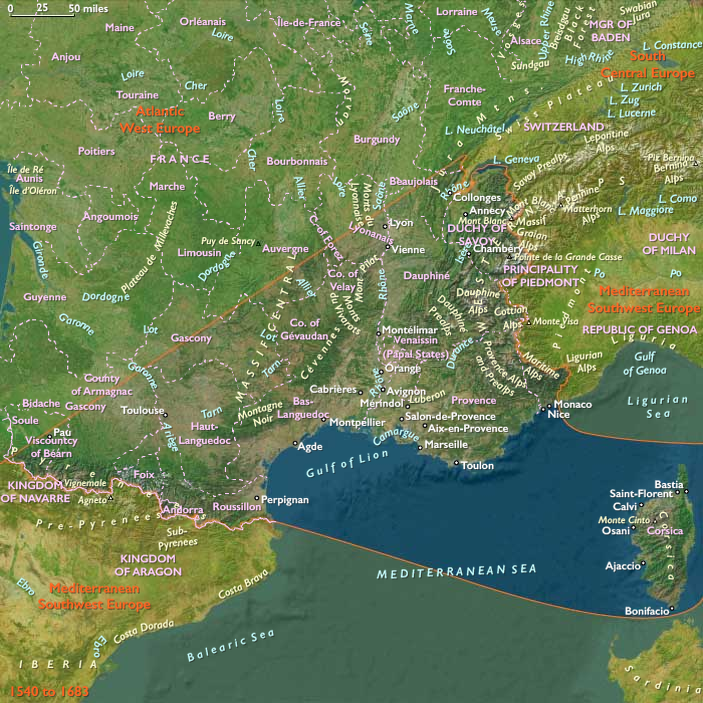
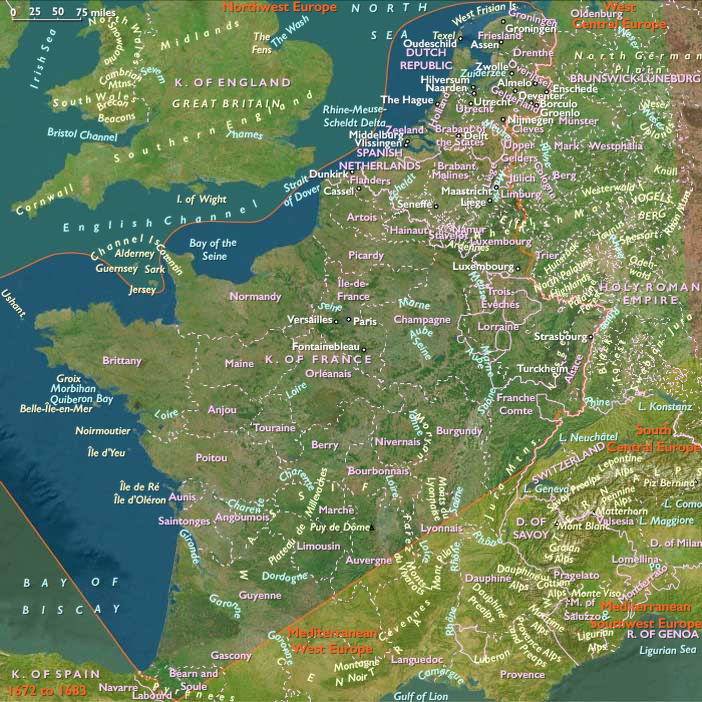
West Europe in this age cohered around two complementary maritime–Mediterranean spheres: Mediterranean West Europe—southern France, Corsica, and Monaco—and Atlantic West Europe—northern France and the Low Countries (the Dutch Republic, Spanish Netherlands, and Luxembourg) along the English Channel and Atlantic. Mountain arcs, river basins (Loire, Seine, Scheldt, Meuse, Rhine), and islanded coasts framed agrarian heartlands and sea-facing emporia. The Little Ice Age brought cooler, more volatile seasons; floods, frosts, and vintner uncertainty alternated with years of bounty, testing grain and wine economies alike.
Subsistence & Settlement
-
Mediterranean West Europe: Terraced vines, olives, figs, wheat, and pastoral uplands underpinned rural life; Corsica remained under Genoese control amid frequent revolts; Monaco, under the Grimaldi, consolidated as a small sovereign principality oriented toward France.
-
Atlantic West Europe: Grain belts and dairying in Flanders and Artois; vineyards in Loire and Burgundy; bustling ports—Amsterdam, Rotterdam, Antwerp, Bordeaux, Nantes, La Rochelle, Rouen—drove urban growth and craft specialization. Toulouse pivoted after the decline of pastel (woad) as indigo from India displaced older dye trades.
Technology & Material Culture
-
Agriculture & hydraulics: Dike and polder engineering in the Low Countries; drainage and crop rotation improved productivity; Mediterranean terraces stabilized thin soils.
-
Shipping & finance: Dutch fluyts, improved charts, and insurance markets supported long-distance trade; the Amsterdam Exchange (1602) epitomized financial innovation.
-
Architecture & arts: Renaissance and Baroque idioms reshaped towns—from Versailles’ courtly grandeur to Flemish guildhalls; coral-and-limestone citadels on Corsica testified to Genoese rule; Monaco’s palace symbolized dynastic continuity.
-
Print culture: Amsterdam, Leiden, Paris, and Antwerp were premier centers for books, newspapers, and scientific tracts.
Movement & Interaction Corridors
-
Sea lanes: Channel and Atlantic routes carried wine, grain, salt, textiles, sugar, tobacco, and enslaved labor; the Dutch and French merchant marines connected Baltic grain to Iberian salt and Caribbean staples.
-
River networks: The Seine–Loire–Rhine–Scheldt–Meuse arteries integrated inland markets with seaports.
-
Diplomatic circuits: Franco–Spanish and Habsburg–Dutch rivalries mapped corridors of war and alliance; Monaco’s 1642 French investiture bound the Rock to Bourbon protection while preserving sovereignty.
Cultural & Symbolic Expressions
-
Humanism → Baroque: French Renaissance letters (Rabelais, La Pléiade) yielded to Baroque classicism under Louis XIII/XIV; in the Low Countries, the Dutch Golden Age and Flemish Baroque flourished—Rembrandt, Vermeer, Rubens.
-
Theater & letters: Molière and Racine codified French drama; the Republic of Letters linked Amsterdam and Paris to London and Rome.
-
Urban identity: Merchant patriciates funded almshouses, canals, and guild chapels; Huguenot salons and Dutch collegia nurtured sciences (Descartes in the Netherlands; Leeuwenhoek’s microscopy).
Political & Military Shocks
Mediterranean West Europe
-
Monaco: Honoré II styled himself Prince (1612); by 1642 he became Duc et Pair Étranger under French protection—an emblem of princely consolidation amid Franco–Spanish rivalry.
-
Corsica: Genoese rule persisted through fortified ports (Calvi, Bonifacio), despite endemic clan revolts and piracy.
-
Southern France: The Wars of Religion (1562–1598) ravaged Languedoc and Provence; the Edict of Nantes (1598) stabilized coexistence until later retrenchments.
Atlantic West Europe
-
Habsburg–Valois conflicts culminated in Cateau-Cambrésis (1559); France turned inward to confront confessional war.
-
Dutch Revolt (1568–1648): The Eighty Years’ War birthed the Dutch Republic; Westphalia (1648) confirmed independence and reoriented the North Sea economy.
-
Absolutism & expansion: Louis XIV’s wars (esp. Franco–Dutch War, 1672–78) and administrative centralization projected France as Europe’s leading power by 1683.
Religious Transformations
-
Reformation & Counter-Reformation: Calvinism spread in the Low Countries and northern France; Jesuit missions, seminaries, and baroque piety spearheaded Catholic renewal.
-
Toleration settlements: The Edict of Nantes and the Dutch Republic’s pragmatic toleration offered early models of pluralism amid enduring confessional fault lines.
Economic Transitions
-
Pastel to indigo: Toulouse’s woad economy declined as Indigofera imports rose; merchants diversified into grain finance, legal professions, and textiles.
-
Dutch commercial hegemony: VOC and WIC networks, Baltic grain trade, and the Amsterdam Exchangeunderwrote a global web.
-
French Atlantic rise: Bordeaux and Nantes expanded on wine and emerging plantation commerce, laying foundations for 18th-century growth.
Environmental Adaptation & Resilience
-
Low Countries: Continuous dike raising, polder drainage, and windmill pumping defended land and stabilized yields.
-
Mediterranean slopes: Terracing, cisterns, and mixed arboriculture buffered droughts; coastal fisheries supplemented diets.
-
Urban welfare: Confraternities, hospices, and poor relief mitigated famine and plague shocks.
Transition
Between 1540 and 1683, West Europe consolidated princely sovereignties and maritime republics, rebuilt after confessional wars, and vaulted into a global commercial system.
-
In the Mediterranean, Monaco’s French alignment, Corsica’s Genoese fortresses, and southern France’s cultural refinement set the tone for principality survival amid great-power rivalry.
-
Along the Atlantic, the Dutch Republic emerged as Europe’s commercial-financial engine, while France moved toward hegemonic monarchy and colonial reach.
By the eve of 1683, West Europe’s ports, polities, and patronage had forged durable institutions and identities—foundations that would dominate the continent’s politics, culture, and oceans in the century ahead.
People
- Antonie van Leeuwenhoek
- Charles V, Holy Roman Emperor
- Francis I of France
- François Rabelais
- Henry II of France
- Henry IV of France
- Jean Calvin
- Jean Racine
- Johannes Vermeer
- Louis XIII of France
- Louis XIV of France
- Molière (Jean-Baptiste Poquelin)
- Peter Paul Rubens
- Philip II of Spain
- Rembrandt van Rijn
- René Descartes
Groups
- Flanders, County of
- Normandy, Duchy of
- Brittanny, Duchy of
- Christians, Roman Catholic
- Austria, Archduchy of
- Moravian Margravate
- Bohemia, Kingdom of
- Holy Roman Empire
- Netherlands, Habsburg
- Spain, Habsburg Kingdom of
- Lutheranism
- Protestantism
- Anabaptists
- Calvinists
- Spain, Habsburg Kingdom of
- Netherlands, Southern (Spanish)
- Netherlands, United Provinces of the (Dutch Republic)
- France, (Bourbon) Kingdom of
- Dutch East India Company (Vereenigde Oostindische Compagnie or VOC in Dutch, literally "United East Indies Company")
- Dutch East India Company (Vereenigde Oostindische Compagnie or VOC in Dutch, literally "United East Indies Company")
- Dutch West India Company
Topics
- Renaissance Architecture
- Northern Renaissance
- Renaissance, French
- Protestant Reformation
- Colonization of the Americas, French
- Baroque Literature
- Western Architecture: 1540 to 1684
- Counter-Reformation (also Catholic Reformation or Catholic Revival)
- Italian War of 1542-6, or Italian War between Charles V and Francis I, Fourth
- Italian War of 1551–1559, or Habsburg-Valois War
- Religion, First War of
- Religion, Second War of
- Eighty Years War (Netherlands, or Dutch, War of Independence)
- Religion, Third War of
- St. Bartholomew's Day, Massacre of
- Religion, Fourth War of
- Religion, Fifth War of
- Religion, Sixth War of
- Religion, Seventh War of (”Lovers' War”)
- Dutch Golden Age
- Religion, Eighth War of (War of the Three Henrys)
- Thirty Years' War
- Franco-Dutch War
Commodoties
Subjects
- Writing
- Architecture
- Painting and Drawing
- Conflict
- Scholarship
- Custom and Law
- Finance
- religious movement
Regions
Subregions
Years: 1540 - 1683
People
- Antonie van Leeuwenhoek
- Charles V, Holy Roman Emperor
- Francis I of France
- François Rabelais
- Henry II of France
- Henry IV of France
- Jean Calvin
- Jean Racine
- Johannes Vermeer
- Louis XIII of France
- Louis XIV of France
- Molière (Jean-Baptiste Poquelin)
- Peter Paul Rubens
- Philip II of Spain
- Rembrandt van Rijn
- René Descartes
Groups
- Flanders, County of
- Normandy, Duchy of
- Brittanny, Duchy of
- Christians, Roman Catholic
- Austria, Archduchy of
- Moravian Margravate
- Bohemia, Kingdom of
- Holy Roman Empire
- Netherlands, Habsburg
- Spain, Habsburg Kingdom of
- Lutheranism
- Protestantism
- Anabaptists
- Calvinists
- Spain, Habsburg Kingdom of
- Netherlands, Southern (Spanish)
- Netherlands, United Provinces of the (Dutch Republic)
- France, (Bourbon) Kingdom of
- Dutch East India Company (Vereenigde Oostindische Compagnie or VOC in Dutch, literally "United East Indies Company")
- Dutch East India Company (Vereenigde Oostindische Compagnie or VOC in Dutch, literally "United East Indies Company")
- Dutch West India Company
Topics
- Renaissance Architecture
- Northern Renaissance
- Renaissance, French
- Protestant Reformation
- Colonization of the Americas, French
- Baroque Literature
- Western Architecture: 1540 to 1684
- Counter-Reformation (also Catholic Reformation or Catholic Revival)
- Italian War of 1542-6, or Italian War between Charles V and Francis I, Fourth
- Italian War of 1551–1559, or Habsburg-Valois War
- Religion, First War of
- Religion, Second War of
- Eighty Years War (Netherlands, or Dutch, War of Independence)
- Religion, Third War of
- St. Bartholomew's Day, Massacre of
- Religion, Fourth War of
- Religion, Fifth War of
- Religion, Sixth War of
- Religion, Seventh War of (”Lovers' War”)
- Dutch Golden Age
- Religion, Eighth War of (War of the Three Henrys)
- Thirty Years' War
- Franco-Dutch War
Commodoties
Subjects
- Writing
- Architecture
- Painting and Drawing
- Conflict
- Scholarship
- Custom and Law
- Finance
- religious movement
Regions
Subregions