
Atlantic West Europe (1540–1683): Religious Turmoil, Dynastic …
Years: 1540 - 1683
Atlantic West Europe (1540–1683): Religious Turmoil, Dynastic Rivalries, and Maritime Ascendancy
The era spanning 1540 to 1683 in Atlantic West Europe—encompassing northern France, the Low Countries (modern Belgium, Netherlands, and Luxembourg), and regions along the Atlantic and English Channel coasts—witnessed profound religious transformations, intense political and dynastic conflicts, vibrant cultural achievements, and economic growth driven by maritime expansion and colonial enterprise. This period marked the region's decisive transition from medieval fragmentation to early modern states, characterized by powerful central authorities, dynamic commercial networks, and distinct national identities.
Political and Military Developments
The Habsburg-Valois Conflicts (1540–1559)
-
Early decades were dominated by wars between Francis I of France (1515–1547) and Emperor Charles V (1519–1556), particularly the Italian Wars. These conflicts drained regional economies but solidified centralized monarchical power in France.
-
The Treaty of Cateau-Cambrésis (1559) ended these conflicts, stabilizing the Franco-Habsburg borders and allowing France to refocus internally.
Religious Wars and Political Fragmentation (1562–1598)
-
France endured the brutal Wars of Religion, pitting Catholic factions against Protestant Huguenots, severely disrupting society, economy, and political stability.
-
The wars culminated in the ascension of Henry IV (r.1589–1610), who issued the Edict of Nantes (1598), granting limited religious toleration, stabilizing France, and reasserting royal authority.
Dutch Revolt and Birth of the Dutch Republic (1568–1648)
-
The Low Countries rebelled against Habsburg Spain, triggered by religious persecution, heavy taxation, and centralization attempts under Philip II. The resulting Eighty Years' War forged the Dutch Republic in the north, while the southern provinces (Spanish Netherlands) remained under Spanish rule.
-
The Peace of Westphalia (1648) confirmed the independence of the Dutch Republic, profoundly reshaping the region’s political map and enabling Dutch commercial and cultural ascendancy.
Absolutism under Louis XIV (1643–1683)
-
France reached the zenith of royal absolutism under Louis XIV (r.1643–1715), significantly expanding French territories through wars such as the Franco-Dutch War (1672–1678), solidifying France’s role as Europe's dominant continental power.
-
Centralized bureaucracy, military reforms, and lavish cultural patronage characterized Louis XIV's reign, epitomized by the expansion of Versailles as a symbol of monarchical prestige.
Economic Developments: Maritime Trade and Colonial Expansion
Growth of Atlantic Commerce
-
French Atlantic ports like Bordeaux, Nantes, La Rochelle, and Dutch hubs such as Amsterdam and Rotterdam, flourished through maritime trade, driven by sugar, tobacco, wine, textiles, and the burgeoning slave trade.
-
Bordeaux’s wine industry significantly expanded during this era, becoming a critical economic sector, exporting primarily to England and Northern Europe, reinforcing regional prosperity.
Dutch Commercial Dominance
-
The Dutch Republic emerged as a commercial powerhouse, with Amsterdam becoming Europe’s leading financial and trading center. The establishment of the Amsterdam Stock Exchange (1602) and the Dutch East India Company (VOC, 1602) epitomized the sophistication of Dutch capitalism and global trade.
-
Dutch maritime innovations in shipbuilding, navigation, and banking underpinned their economic success and influence across European markets and overseas colonies.
Agricultural and Industrial Advances
-
Advances in agricultural techniques, notably crop rotation and drainage systems, improved productivity in northern France and the Low Countries, supporting population growth and urbanization.
-
Textile production remained crucial, especially in Flanders and northern France, despite disruptions from warfare, forming a foundation for early industrialization.
Religious Developments: Reform, Conflict, and Toleration
Protestant Reformation and Catholic Response
-
The spread of Protestantism profoundly reshaped religious and political life. Calvinism gained traction, especially in northern France and the Low Countries, fueling religious dissent against Catholic authorities.
-
Catholic Counter-Reformation movements, notably led by the Jesuits, responded vigorously, reforming internal church structures, promoting religious education, and combating Protestant influence.
Religious Wars and Persecution
-
Intense religious violence erupted across France, exemplified by the St. Bartholomew’s Day Massacre (1572), resulting in thousands of Huguenot deaths and heightened religious animosities.
-
Protestant persecution under Spanish rule intensified in the Low Countries, ultimately leading to the Dutch Revolt and the establishment of religious toleration in the northern provinces, notably Holland.
Establishment of Limited Religious Toleration
-
The Edict of Nantes (1598) and the relative religious toleration of the Dutch Republic became early models of coexistence amid religious pluralism, setting critical precedents influencing later European developments.
Cultural and Intellectual Developments
Renaissance Humanism to Baroque Splendor
-
The French Renaissance, spurred by humanist scholars like François Rabelais and poets of La Pléiade, transitioned into the extravagant cultural and artistic patronage of the Baroque period under Louis XIII and Louis XIV.
-
Flemish painters such as Peter Paul Rubens and Dutch Golden Age artists including Rembrandt and Vermeer profoundly impacted European artistic traditions through innovative techniques and compelling naturalism.
Intellectual Innovations and Scientific Advances
-
This era witnessed groundbreaking advances in science, technology, and medicine. Intellectual centers such as Paris and Amsterdam became hubs for scientists and philosophers, exemplified by René Descartes’ philosophical works and Antonie van Leeuwenhoek’s microscopy.
-
The establishment of learned societies, such as the French Académie des Sciences (1666), reflected state-sponsored encouragement of scientific inquiry, significantly advancing European knowledge.
Literary and Cultural Flourishing
-
French literary culture flourished under royal patronage, with notable playwrights like Molière and Jean Racine, whose works profoundly influenced European drama.
-
In the Dutch Republic, high literacy rates and publishing freedoms fostered a vibrant literary culture, marked by prolific book publishing, newspapers, and critical philosophical discourse.
Social and Urban Transformations
Urban Expansion and Socioeconomic Mobility
-
Maritime trade significantly propelled urbanization in port cities such as Amsterdam, Antwerp, Bordeaux, and Nantes, leading to the emergence of affluent merchant classes influential in local governance and cultural patronage.
-
Economic prosperity stimulated the growth of urban infrastructure, including banking institutions, merchant guilds, public buildings, and market spaces, reshaping urban life and society.
Social Tensions and Rural Struggles
-
Despite urban wealth, significant rural poverty persisted, exacerbated by warfare, heavy taxation, agricultural disruption, and periodic famines, particularly notable in northern France and parts of the Low Countries.
-
Rural communities faced pressures from enclosures, increasing commercialization of agriculture, and demographic growth, fueling migrations toward cities and overseas colonies.
Legacy and Historical Significance
By 1683, Atlantic West Europe had undergone transformative shifts in political structure, economic power, cultural expression, and religious dynamics:
-
Politically, the period solidified powerful centralized monarchies in France and independent republican governance in the Netherlands.
-
Economically, the region became integral to global commerce, driven by maritime exploration, colonial expansion, and financial innovation, notably in the Dutch Republic.
-
Culturally and intellectually, Renaissance humanism transitioned into Baroque grandeur and scientific rationalism, profoundly shaping European thought, art, and literature.
-
Religiously, the profound tensions between Protestantism and Catholicism laid the groundwork for modern notions of religious pluralism and toleration.
Thus, this period positioned Atlantic West Europe decisively at the forefront of early modern European transformations, establishing foundational structures, cultural identities, and economic patterns that endured into subsequent centuries.
People
- Antonie van Leeuwenhoek
- Charles V, Holy Roman Emperor
- Francis I of France
- François Rabelais
- Henry II of France
- Henry IV of France
- Jean Calvin
- Jean Racine
- Johannes Vermeer
- Louis XIII of France
- Louis XIV of France
- Molière (Jean-Baptiste Poquelin)
- Peter Paul Rubens
- Philip II of Spain
- Rembrandt van Rijn
- René Descartes
Groups
- Flanders, County of
- Normandy, Duchy of
- Brittanny, Duchy of
- Christians, Roman Catholic
- Austria, Archduchy of
- Moravian Margravate
- Bohemia, Kingdom of
- Holy Roman Empire
- Netherlands, Habsburg
- Spain, Habsburg Kingdom of
- Lutheranism
- Protestantism
- Anabaptists
- Calvinists
- Spain, Habsburg Kingdom of
- Netherlands, Southern (Spanish)
- Netherlands, United Provinces of the (Dutch Republic)
- France, (Bourbon) Kingdom of
- Dutch East India Company (Vereenigde Oostindische Compagnie or VOC in Dutch, literally "United East Indies Company")
- Dutch East India Company (Vereenigde Oostindische Compagnie or VOC in Dutch, literally "United East Indies Company")
- Dutch West India Company
Topics
- Renaissance Architecture
- Northern Renaissance
- Renaissance, French
- Protestant Reformation
- Colonization of the Americas, French
- Baroque Literature
- Western Architecture: 1540 to 1684
- Counter-Reformation (also Catholic Reformation or Catholic Revival)
- Italian War of 1542-6, or Italian War between Charles V and Francis I, Fourth
- Italian War of 1551–1559, or Habsburg-Valois War
- Religion, First War of
- Religion, Second War of
- Eighty Years War (Netherlands, or Dutch, War of Independence)
- Religion, Third War of
- St. Bartholomew's Day, Massacre of
- Religion, Fourth War of
- Religion, Fifth War of
- Religion, Sixth War of
- Religion, Seventh War of (”Lovers' War”)
- Dutch Golden Age
- Religion, Eighth War of (War of the Three Henrys)
- Thirty Years' War
- Franco-Dutch War
Commodoties
Subjects
- Writing
- Architecture
- Painting and Drawing
- Conflict
- Scholarship
- Custom and Law
- Finance
- religious movement
Regions
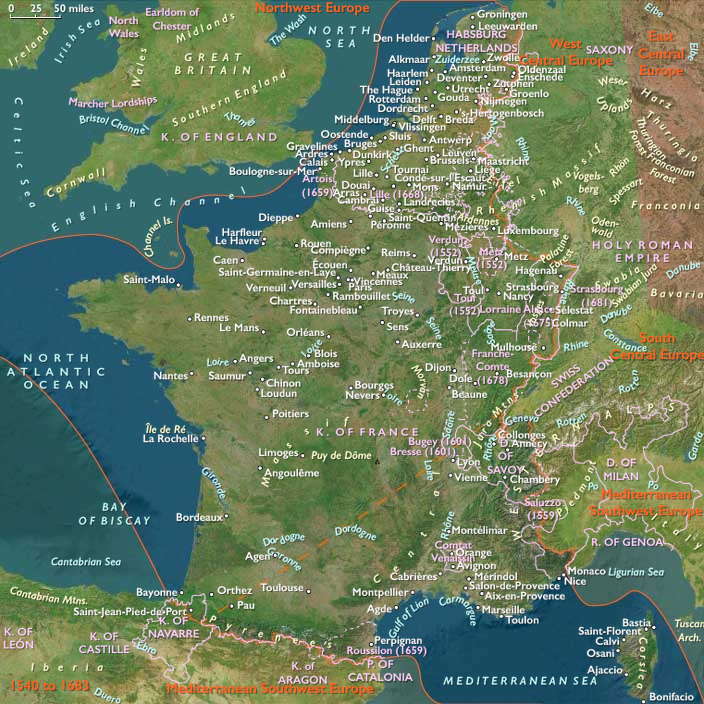
Subregions
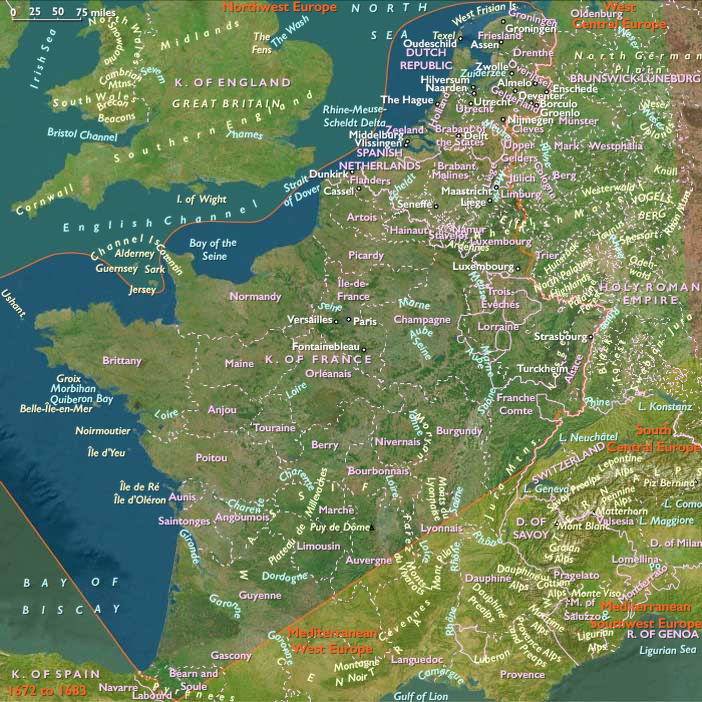
Years: 1540 - 1683
People
- Antonie van Leeuwenhoek
- Charles V, Holy Roman Emperor
- Francis I of France
- François Rabelais
- Henry II of France
- Henry IV of France
- Jean Calvin
- Jean Racine
- Johannes Vermeer
- Louis XIII of France
- Louis XIV of France
- Molière (Jean-Baptiste Poquelin)
- Peter Paul Rubens
- Philip II of Spain
- Rembrandt van Rijn
- René Descartes
Groups
- Flanders, County of
- Normandy, Duchy of
- Brittanny, Duchy of
- Christians, Roman Catholic
- Austria, Archduchy of
- Moravian Margravate
- Bohemia, Kingdom of
- Holy Roman Empire
- Netherlands, Habsburg
- Spain, Habsburg Kingdom of
- Lutheranism
- Protestantism
- Anabaptists
- Calvinists
- Spain, Habsburg Kingdom of
- Netherlands, Southern (Spanish)
- Netherlands, United Provinces of the (Dutch Republic)
- France, (Bourbon) Kingdom of
- Dutch East India Company (Vereenigde Oostindische Compagnie or VOC in Dutch, literally "United East Indies Company")
- Dutch East India Company (Vereenigde Oostindische Compagnie or VOC in Dutch, literally "United East Indies Company")
- Dutch West India Company
Topics
- Renaissance Architecture
- Northern Renaissance
- Renaissance, French
- Protestant Reformation
- Colonization of the Americas, French
- Baroque Literature
- Western Architecture: 1540 to 1684
- Counter-Reformation (also Catholic Reformation or Catholic Revival)
- Italian War of 1542-6, or Italian War between Charles V and Francis I, Fourth
- Italian War of 1551–1559, or Habsburg-Valois War
- Religion, First War of
- Religion, Second War of
- Eighty Years War (Netherlands, or Dutch, War of Independence)
- Religion, Third War of
- St. Bartholomew's Day, Massacre of
- Religion, Fourth War of
- Religion, Fifth War of
- Religion, Sixth War of
- Religion, Seventh War of (”Lovers' War”)
- Dutch Golden Age
- Religion, Eighth War of (War of the Three Henrys)
- Thirty Years' War
- Franco-Dutch War
Commodoties
Subjects
- Writing
- Architecture
- Painting and Drawing
- Conflict
- Scholarship
- Custom and Law
- Finance
- religious movement
Regions
Subregions