
Atlantic West Europe (1552–1563): Intensifying Conflicts, Religious …
Years: 1552 - 1563
Atlantic West Europe (1552–1563): Intensifying Conflicts, Religious Division, and Economic Dynamism
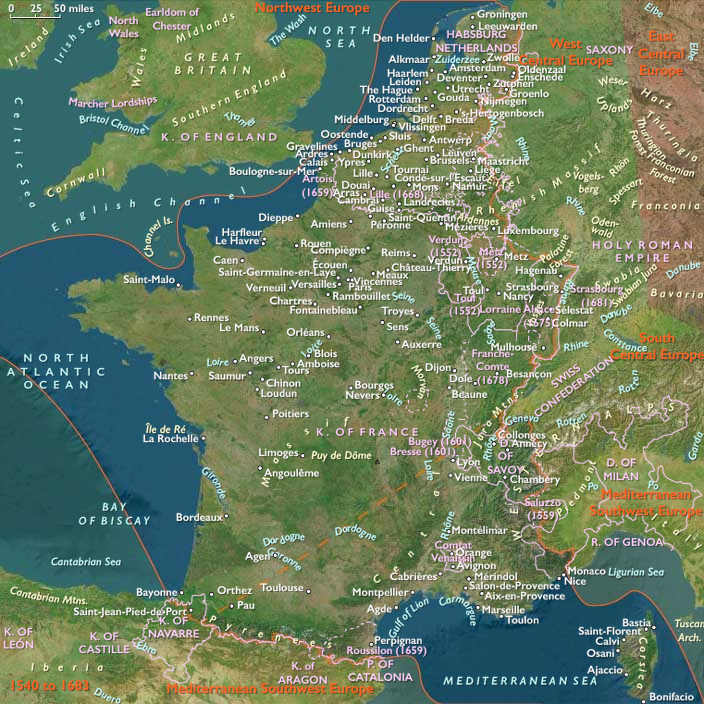
Between 1552 and 1563, Atlantic West Europe—encompassing northern France, the Low Countries (modern Belgium, Netherlands, Luxembourg), and coastal regions along the Atlantic and English Channel—experienced heightened religious conflicts, dynastic rivalries, and dynamic economic growth. This era saw escalating tensions between Catholic monarchies and Protestant movements, deepening political divisions, significant urban and maritime commercial expansion, and a vibrant cultural milieu shaped by the lingering Renaissance and the dawning of Counter-Reformation.
Political and Military Developments
Renewed Franco-Habsburg Warfare
-
The intense rivalry between France under Henry II (r. 1547–1559) and the Habsburg emperor Charles V resumed fiercely. The continuation of the Italian Wars (1551–1559) spilled over into northern France and the Low Countries, dramatically reshaping political boundaries.
-
French forces successfully captured the strategic bishoprics of Metz, Toul, and Verdun (1552), significantly strengthening France’s eastern frontier against Habsburg power and solidifying Henry II’s military prestige.
-
In 1557, a devastating French defeat at Saint-Quentin (in modern northern France) briefly exposed Paris and spurred urgent military reforms. Nonetheless, the subsequent French victory at Calais (1558), reclaiming the vital port from English control after two centuries, was celebrated as a national triumph, consolidating French territorial sovereignty.
Peace of Cateau-Cambrésis (1559)
-
After prolonged warfare and economic strain, the treaty Peace of Cateau-Cambrésis (1559) ended the Italian Wars, solidifying a tenuous peace between France and Spain (now led by Philip II after Charles V’s abdication in 1556).
-
The treaty reshaped Europe's political order, affirming Spanish Habsburg control over the Low Countries, while France secured important territorial gains, stabilizing its northern and eastern borders.
Economic and Maritime Expansion
Antwerp: Financial and Commercial Apex
-
Antwerp reached the height of its economic prominence, dominating European trade, finance, and commodities markets. Its dynamic bourse attracted merchants, bankers, and speculators from across Europe, facilitating international finance and trade innovations.
-
Merchants and financiers from Antwerp increasingly invested in global maritime enterprises, including Spanish and Portuguese voyages, establishing extensive trade networks linking the Low Countries with Asia, Africa, and the Americas.
Growth of Atlantic Trade and Industry
-
Maritime commerce along the Atlantic coast flourished. French ports, notably Bordeaux, La Rochelle, and Rouen, significantly expanded their overseas trade, exporting wines, textiles, salt, and luxury goods, reinforcing their regional and international economic influence.
-
Bordeaux’s wine industry continued its ascendancy, bolstered by growing demand from English and Dutch markets. The city’s merchants prospered, fueling local urban development and infrastructure investments.
-
Shipbuilding industries along the Norman, Breton, and Flemish coasts thrived, responding to increasing maritime commerce and naval demands, thereby stimulating urban economies in cities such as Saint-Malo, Dunkirk, and Ostend.
Religious and Intellectual Developments
Rise of Calvinism and Religious Tensions
-
Calvinist Protestantism rapidly spread throughout the Low Countries and northern France, gaining support particularly among urban middle classes, artisans, merchants, and local nobility. The Netherlands, especially Antwerp, Ghent, and Brussels, saw increasing Calvinist congregations openly challenging Catholic orthodoxy.
-
Intensified repression followed under Philip II, whose stringent anti-heresy edicts (1550–1560) aimed at suppressing Protestantism provoked widespread resentment, laying seeds for future open rebellion.
-
In France, Calvinist Huguenots gained significant followers, especially among nobility and urban bourgeoisie, setting the stage for the devastating French Wars of Religion (beginning officially in 1562).
Council of Trent and Catholic Counter-Reformation
-
The Catholic Church, alarmed by Protestant gains, responded vigorously through the Council of Trent (1545–1563). The Council reaffirmed Catholic doctrines, implemented ecclesiastical reforms, and intensified efforts against Protestant "heresy."
-
Northern French and Flemish clergy adopted Tridentine reforms, initiating revitalized religious instruction, tightened ecclesiastical discipline, and increased censorship to halt Protestant dissemination.
Cultural and Artistic Flourishing
Mannerism and Artistic Innovation
-
Artistic production flourished despite turbulent political and religious contexts. French court patronage, notably under Henry II and his queen, Catherine de' Medici, supported refined artistic developments at the Château de Fontainebleau, where the elaborate School of Fontainebleau evolved a distinct French Mannerist style blending Italian sophistication with northern aesthetics.
-
In the Low Countries, painters such as Pieter Bruegel the Elder emerged prominently during this era, introducing vivid depictions of everyday life, landscapes, and allegories, subtly reflecting social and religious tensions within northern society.
Humanist Scholarship and Print Culture
-
The humanist tradition continued robustly, supported by active printing centers in Antwerp, Paris, and Leuven, disseminating influential theological, literary, and philosophical works widely across Europe.
-
Influential humanist scholars, notably in Leuven and Paris, navigated increasing religious restrictions, maintaining intellectual exchange while carefully avoiding direct confrontation with ecclesiastical authorities.
Social Developments and Urban Dynamics
Urban Prosperity and Merchant Influence
-
Urban centers across Atlantic West Europe experienced remarkable growth. Antwerp’s commercial dominance attracted European merchants, bankers, and artisans, making it one of the continent's most cosmopolitan cities.
-
Increased urban wealth allowed merchant elites in cities like Antwerp, Bruges, Bordeaux, and Rouen to exert greater influence over municipal governments, shaping economic policies and regional politics.
Social Tensions and Rural Poverty
-
Prosperity remained unevenly distributed, deepening rural poverty and social disparities. Heightened taxation from prolonged warfare, rising food prices, and religious tensions fueled periodic unrest among peasants and urban poor, occasionally erupting into localized revolts.
Legacy and Significance
The era from 1552 to 1563 proved pivotal for Atlantic West Europe, profoundly shaping the region’s political, religious, and economic trajectories. Dynastic warfare solidified territorial boundaries that endured into modernity. Religious divisions intensified, foreshadowing prolonged conflicts of the later 16th century. Meanwhile, economic growth and maritime trade expanded rapidly, reinforcing the region’s role as a dynamic center of commercial capitalism and global connectivity. Cultural vibrancy persisted despite adversity, marking the continued flourishing of Renaissance humanism and artistic creativity, even amidst intensifying religious and social tensions.
People
- Catherine de' Medici
- Charles V, Holy Roman Emperor
- Henry II of France
- Jean Calvin
- Pieter Bruegel the Elder
Groups
- Flanders, County of
- Normandy, Duchy of
- Brittanny, Duchy of
- Liège, Prince-Bishopric of
- Christians, Roman Catholic
- Hainaut, County of
- Holland, County of
- Austria, Archduchy of
- Moravian Margravate
- Brabant, Duchy of
- Lorraine, (second) Duchy of
- Bohemia, Kingdom of
- Artois, County of
- France, (Valois) Kingdom of
- Luxemburg, Duchy of
- Holy Roman Empire
- Netherlands, Habsburg
- Lutheranism
- Protestantism
- Anabaptists
Topics
- Humanism, Renaissance
- Renaissance Architecture
- Renaissance in the Low Countries
- Renaissance, French
- Protestant Reformation
- Colonization of the Americas, French
- Western Art: 1540 to 1552
- Western Architecture: 1540 to 1684
- Italian War of 1542-6, or Italian War between Charles V and Francis I, Fourth
- Italian War of 1551–1559, or Habsburg-Valois War
Commodoties
Subjects
- Writing
- Watercraft
- Painting and Drawing
- Conflict
- Scholarship
- Custom and Law
- Finance
- religious movement
Regions
Subregions

Years: 1552 - 1563
People
- Catherine de' Medici
- Charles V, Holy Roman Emperor
- Henry II of France
- Jean Calvin
- Pieter Bruegel the Elder
Groups
- Flanders, County of
- Normandy, Duchy of
- Brittanny, Duchy of
- Liège, Prince-Bishopric of
- Christians, Roman Catholic
- Hainaut, County of
- Holland, County of
- Austria, Archduchy of
- Moravian Margravate
- Brabant, Duchy of
- Lorraine, (second) Duchy of
- Bohemia, Kingdom of
- Artois, County of
- France, (Valois) Kingdom of
- Luxemburg, Duchy of
- Holy Roman Empire
- Netherlands, Habsburg
- Lutheranism
- Protestantism
- Anabaptists
Topics
- Humanism, Renaissance
- Renaissance Architecture
- Renaissance in the Low Countries
- Renaissance, French
- Protestant Reformation
- Colonization of the Americas, French
- Western Art: 1540 to 1552
- Western Architecture: 1540 to 1684
- Italian War of 1542-6, or Italian War between Charles V and Francis I, Fourth
- Italian War of 1551–1559, or Habsburg-Valois War
Commodoties
Subjects
- Writing
- Watercraft
- Painting and Drawing
- Conflict
- Scholarship
- Custom and Law
- Finance
- religious movement
Regions
Subregions