
West Europe (1396–1539 CE) Dynastic Struggles, …
Years: 1396 - 1539
West Europe (1396–1539 CE)
Dynastic Struggles, Maritime Republics, and Reformation Currents
Geography & Environmental Context
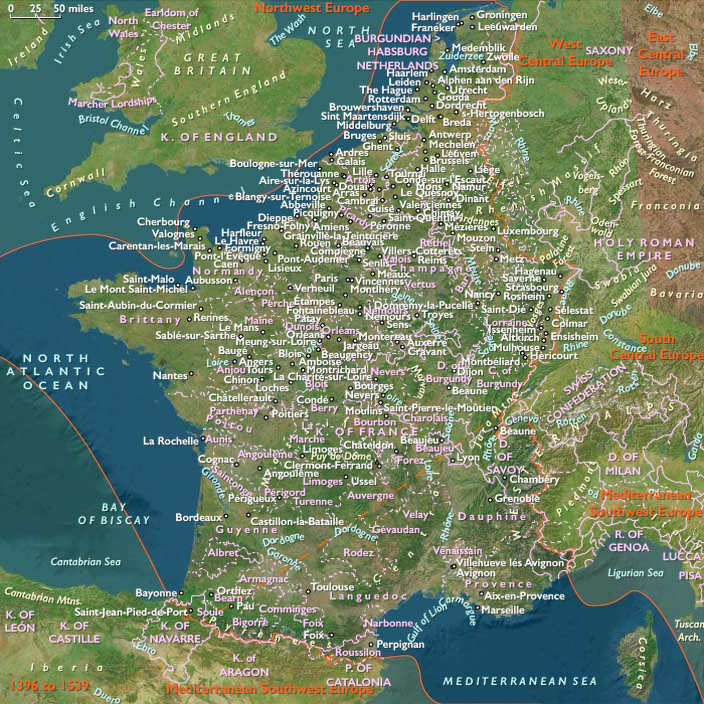
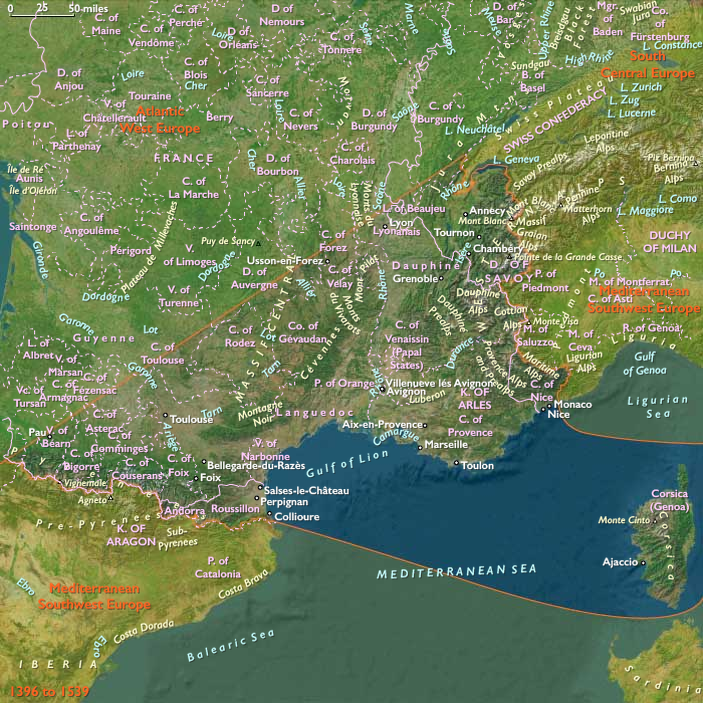
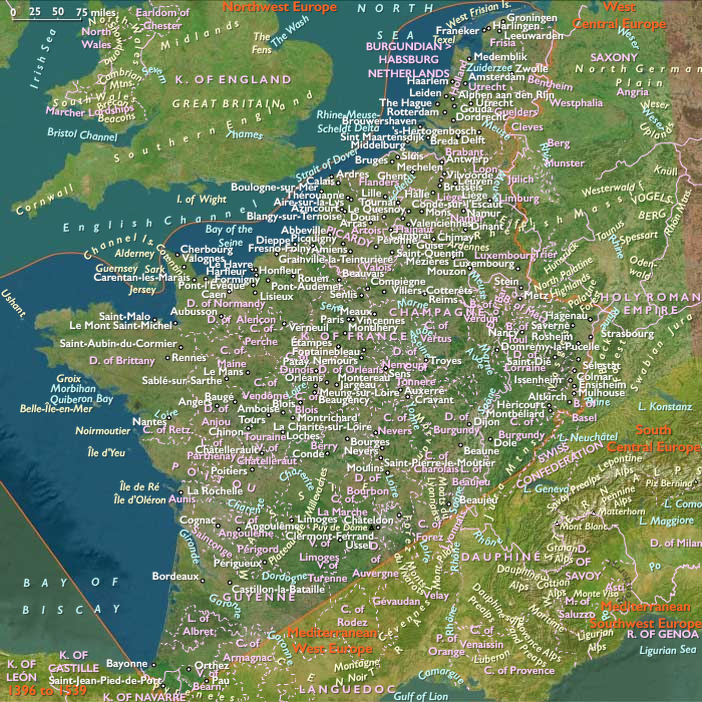
West Europe in this age bridged the Mediterranean and the Atlantic through two intertwined spheres.
Mediterranean West Europe encompassed southern France (Languedoc, Provence, the Rhône valley, the French Pyrenees), Monaco, and Corsica—a frontier of mountain uplands, terraced coasts, and river plains tied to Italian and Iberian seas.
Atlantic West Europe ran along the Atlantic and Channel coasts of France, the Loire Valley Burgundy, northern France (including Paris), and the Low Countries (Belgium, the Netherlands, Luxembourg)—fertile basins and estuaries linked to Europe’s commercial cores.
From Marseille and Nice to Antwerp, Rouen, and Bordeaux, ports, riverways, and passes bound inland grainlands to sealanes and mercantile emporia.
Climate & Environmental Shifts
The Little Ice Age brought cooler winters, late frosts, and erratic rains.
-
Languedoc–Provence & Corsica: Vine and olive belts suffered frost damage in severe winters; storms battered harbors.
-
Rhône & Loire valleys; Paris Basin; Burgundy: Alternating floods, droughts, and cold snaps reshaped grain and grape yields.
-
Low Countries & Channel coasts: North Sea surges and wetter fields demanded relentless dike upkeep; fisheries endured rougher seas yet remained staples.
Subsistence & Settlement
-
Mediterranean sphere: Mixed farming of wheat, barley, rye, and legumes in valleys; vines and olives on coastal terraces; chestnuts in Corsican uplands. Sheep–goat transhumance linked Pyrenean and island pastures to town markets. Marseille, Avignon, Montpellier, Nice, and Ajaccio thrived as fortified, trade-facing towns.
-
Atlantic sphere: Wheat, rye, oats, and barley dominated; Burgundy’s vineyards and the Loire’s orchards supported regional exchange; flax and hemp in Flanders; dairy and cattle in the Low Countries. Paris, Rouen, Dieppe, Bordeaux, Bruges, Antwerp, Ghent, and Brussels anchored urban craft and export economies. Fisheries for herring and cod—salted and barreled—fed towns and long-distance trade.
Technology & Material Culture
-
Agriculture: Three-field rotations; water- and windmills; hillside terracing across Provence and Corsica.
-
Shipbuilding & seamanship: Mediterranean galleys and Atlantic cogs evolved toward caravels and larger ocean-going hulls; coastal shipyards provisioned fleets from Marseille to Rouen and Antwerp.
-
Architecture: Flamboyant Gothic cathedrals in Narbonne and Montpellier; papal complexes at Avignon; Genoese towers on Corsica; Burgundian ducal palaces; Flemish belfries and town halls; early Renaissance idioms appeared in Loire châteaux.
-
Print & craft: Lyon, Paris, and Antwerp emerged as printing hubs; Flemish woolens and tapestries, Burgundian wines, and Parisian luxury metalwork set European tastes.
Movement & Interaction Corridors
-
Mediterranean sealanes: Marseille and Monaco linked to Genoa, Naples, and Barcelona; Corsica sat astride Italy–Iberia–Maghreb routes.
-
Rhône corridor: Carried salt, wine, and grain north to Lyon and beyond.
-
Atlantic & Channel arteries: Bruges (declining by 1500), Antwerp (rising), and Rouen tied northern Europe to Iberia and the Mediterranean; Bordeaux connected the Loire–Garonne basins to the ocean.
-
Overland networks: Burgundian roads knit Dijon and Brussels to the Empire and France; pilgrimage roads joined Roussillon, Provence, and the Loire to Santiago de Compostela and Rome.
Cultural & Symbolic Expressions
-
Catholic orthodoxy & humanism: Monastic houses and cathedrals structured devotion; Avignon’s papal legacy lingered. Lyon and Avignon sustained humanist circles; Montpellier’s medical school gained renown.
-
Burgundian court culture: Under the Valois dukes (Philip the Good, Charles the Bold), Dijon and Brussels patronized Jan van Eyck, Rogier van der Weyden, and civic pageantry.
-
French monarchy & Renaissance: Post–Hundred Years’ War recovery culminated in Francis I’s embrace of Italianate forms and royal patronage along the Loire.
-
Netherlandish art: Early Netherlandish painters pioneered oil technique; civic commissions in Ghent, Bruges, and Antwerp flourished. Troubadour legacies survived in lyric verse across Provence; confraternities staged processions and charity in town parishes.
Environmental Adaptation & Resilience
-
Diversified ecologies: Mixed cereals, vines, olives, flax, and livestock spread climatic risk.
-
Water & earth works: Terraces and dikes stabilized fragile slopes and polders; flood embankments guarded the Rhône, Loire, and Low Country coasts.
-
Storage & exchange: Communal barns, urban granaries, and salt trade mitigated shortfalls; guild aid, hospitals, and beguinages provided social buffers.
Technology & Power Shifts (Conflict Dynamics)
-
Hundred Years’ War (to 1453): Though major battles lay north, raids and instability touched Languedoc and Provence. French resurgence culminated in Joan of Arc’s campaigns (1429) and Castillon (1453).
-
Aragon–French rivalry: Roussillon oscillated between crowns; Pyrenean frontiers remained militarized.
-
Burgundian Wars (1474–1477): Charles the Bold fell at Nancy; his inheritance split—parts to France, the rest to the Habsburgs—reshaping Low Country sovereignty.
-
Italian Wars (1494–1559): Drew Provence and Corsica into Valois–Habsburg struggles; Fornovo (1495) and Pavia (1525, capture of Francis I) reverberated through Provençal ports.
-
Corsica: Fought over by Genoa and Aragon; Genoa reasserted control, fortifying coasts against Barbary corsairs.
-
Naval theaters: Mediterranean galley wars and Adriatic–Aegean rivalries impacted Marseille and Monaco; the Low Countries pivoted toward Habsburg naval finance and Atlantic networks.
Transition (to 1539 CE)
By 1539, West Europe stood as a frontier of empires and a laboratory of recovery and renaissance.
In the Mediterranean, France had consolidated Provence and Roussillon yet suffered reverses in Italy; Genoa controlled Corsica, bracing against French and Ottoman pressure; Marseille and Monaco thrived as naval–mercantile hubs under the shadow of corsair raids.
Across the Atlantic sphere, Burgundy was partitioned between Valois and Habsburg realms; the Low Countries emerged as Europe’s commercial heart, with Antwerp surpassing Bruges as entrepôt to Iberian spice and silver trades.
Humanism animated Lyon and Avignon; Gothic and early Renaissance forms stood side by side; confessional tensions gathered on the horizon.
Poised between the Mediterranean and the Atlantic, West Europe entered the mid-16th century as both battlefield and marketplace—its rivers and ports set to channel the coming storms of Reformation and Habsburg–Valois rivalry.
People
- Charles V, Holy Roman Emperor
- Charles VIII of France
- Charles the Bold
- Clément Marot
- Desiderius Erasmus of Rotterdam
- Francesco Primaticcio
- Francis I of France
- Giovanni da Verrazzano
- Hieronymus Bosch
- Ignatius of Loyola
- Jacques Cartier
- Jan van Eyck
- Joan of Arc
- Louis XI of France
- Louis XII of France
- Paracelsus
- Philip the Good
- Rogier van der Weyden
- Rosso Fiorentino
Groups
- Dutch people
- Flanders, County of
- Habsburg, House of
- Burgundy, Duchy of
- Christians, Roman Catholic
- Holland, County of
- Franche-Comté
- England, (Plantagenet, Angevin) Kingdom of
- Brabant, Duchy of
- Holy Roman Empire
- France, (Valois) Kingdom of
- Hanseatic League
- Netherlands, Burgundian
- England, (Plantagenet, Lancastrian) Kingdom of
- Holy Roman Empire
- England, (Plantagenet, Yorkist) Kingdom of
- England, (Plantagenet, Lancastrian) Kingdom of
- England, (Plantagenet, Yorkist) Kingdom of
- Franche-Comté (province of the Holy Roman Empire)
- Netherlands, Habsburg
- England, (Tudor) Kingdom of
- Protestantism
Topics
- Hundred Years' War
- Humanism, Renaissance
- Renaissance Architecture
- Age of Discovery
- Agincourt, Battle of
- Northern Renaissance
- Hundred Years' War: French Victory
- Renaissance, Northern
- Burgundian Wars
- Burgundian Wars
- Burgundian Succession, War of the
- Renaissance in the Low Countries
- Renaissance, French
- Cartier's explorations of North America
Commodoties
- Fish and game
- Domestic animals
- Grains and produce
- Textiles
- Fibers
- Strategic metals
- Beer, wine, and spirits
- Manufactured goods
Subjects
- Commerce
- Architecture
- Painting and Drawing
- Conflict
- Exploration
- Faith
- Government
- Scholarship
- Custom and Law
- Medicine
- Alchemy
Regions
Subregions
Years: 1396 - 1539
People
- Charles V, Holy Roman Emperor
- Charles VIII of France
- Charles the Bold
- Clément Marot
- Desiderius Erasmus of Rotterdam
- Francesco Primaticcio
- Francis I of France
- Giovanni da Verrazzano
- Hieronymus Bosch
- Ignatius of Loyola
- Jacques Cartier
- Jan van Eyck
- Joan of Arc
- Louis XI of France
- Louis XII of France
- Paracelsus
- Philip the Good
- Rogier van der Weyden
- Rosso Fiorentino
Groups
- Dutch people
- Flanders, County of
- Habsburg, House of
- Burgundy, Duchy of
- Christians, Roman Catholic
- Holland, County of
- Franche-Comté
- England, (Plantagenet, Angevin) Kingdom of
- Brabant, Duchy of
- Holy Roman Empire
- France, (Valois) Kingdom of
- Hanseatic League
- Netherlands, Burgundian
- England, (Plantagenet, Lancastrian) Kingdom of
- Holy Roman Empire
- England, (Plantagenet, Yorkist) Kingdom of
- England, (Plantagenet, Lancastrian) Kingdom of
- England, (Plantagenet, Yorkist) Kingdom of
- Franche-Comté (province of the Holy Roman Empire)
- Netherlands, Habsburg
- England, (Tudor) Kingdom of
- Protestantism
Topics
- Hundred Years' War
- Humanism, Renaissance
- Renaissance Architecture
- Age of Discovery
- Agincourt, Battle of
- Northern Renaissance
- Hundred Years' War: French Victory
- Renaissance, Northern
- Burgundian Wars
- Burgundian Wars
- Burgundian Succession, War of the
- Renaissance in the Low Countries
- Renaissance, French
- Cartier's explorations of North America
Commodoties
- Fish and game
- Domestic animals
- Grains and produce
- Textiles
- Fibers
- Strategic metals
- Beer, wine, and spirits
- Manufactured goods
Subjects
- Commerce
- Architecture
- Painting and Drawing
- Conflict
- Exploration
- Faith
- Government
- Scholarship
- Custom and Law
- Medicine
- Alchemy
Regions
Subregions