
Atlantic West Europe (1036–1047): Consolidation of Royal …
Years: 1036 - 1047
Atlantic West Europe (1036–1047): Consolidation of Royal Authority and Shifts in Regional Power
The era from 1036 to 1047 in Atlantic West Europe—including the Low Countries, Normandy, Brittany, Aquitaine, the Duchy of Burgundy, the Franche-Comté (County of Burgundy), Alsace, and central France—witnessed significant political consolidation, regional tensions, emerging dynastic rivalries, and notable cultural and ecclesiastical developments.
Political and Military Developments
-
France: Strengthening Capetian Rule
- King Henry I (r. 1031–1060) consolidated royal authority, overcoming earlier instability caused by feudal rebellions. He secured alliances with key magnates, notably granting considerable autonomy to his brother Robert I, Duke of Burgundy, stabilizing eastern territories.
- The arrangement with Burgundy reinforced the Capetian dynasty's regional authority while setting a pattern for future semi-independent ducal governance.
-
Normandy: Instability and Consolidation
- Duke William II of Normandy (later known as William the Conqueror) endured a turbulent minority following the death of his father, Robert I (1035). Powerful nobles contested his inheritance, creating prolonged internal strife.
- By 1047, William, with crucial aid from King Henry I of France, decisively crushed rebellious barons at the Battle of Val-ès-Dunes (1047), restoring ducal authority and laying foundations for his future dominance.
-
Brittany: Emergence of Ducal Power
- Duke Alan III of Brittany (r. 1008–1040) maintained Breton autonomy amid external pressures from Normandy and internal noble disputes. His successor, Conan II (r. 1040–1066), continued navigating regional conflicts, balancing Norman, Angevin, and French influences.
-
Aquitaine: Power and Influence Under William VII
- William VII (the Brave) (r. 1039–1058) consolidated Aquitaine and Poitou, facing challenges from ambitious nobles and reinforcing central ducal power through strategic marriages and military force.
-
Burgundy (Duchy and County): Diverging Paths
- The Duchy of Burgundy, under Robert I (r. 1032–1076), remained firmly within the French orbit, cultivating stable governance and securing dynastic longevity.
- The County of Burgundy (Franche-Comté), ruled by Renaud I (r. 1026–1057), became increasingly oriented toward the Holy Roman Empire, deepening its divergence from the French-aligned Duchy of Burgundy.
Economic and Social Developments
-
Urban Expansion and Trade Growth
- Continued commercial expansion in the Low Countries (Bruges, Ghent, Antwerp) bolstered regional economic strength, fostering trade connections across Europe and supporting urban population growth.
- Burgundy and Alsace saw economic prosperity through enhanced trade routes connecting Germany, Italy, and northern Europe.
-
Feudal Society and Noble Influence
- Increased feudal decentralization required Capetian kings and regional rulers to skillfully balance noble ambitions with the preservation of central authority.
Religious and Cultural Developments
-
Monasticism and Church Reform
- Monastic reform movements, notably the expansion of Cluny Abbey under Abbot Odilo (994–1049), significantly influenced religious and political culture, advocating stricter spiritual discipline and promoting ecclesiastical independence.
- Bishops and abbots across France increasingly served as vital intermediaries in maintaining political stability and cultural advancement.
-
Cultural and Intellectual Flourishing
- Regional scriptoria and monastic libraries, particularly in Burgundy and the Loire valley, continued copying classical texts and liturgical manuscripts, laying groundwork for later scholarly advances.
Legacy and Long-term Significance
The years 1036–1047 saw crucial political stabilization and shifts in Atlantic West Europe:
- King Henry I’s consolidation of royal power provided a foundation for future Capetian territorial expansion.
- Normandy, under William, reasserted ducal control, ultimately setting the stage for the Norman Conquest of England (1066).
- Divergence between the French-aligned Duchy of Burgundy and Empire-oriented County of Burgundy (Franche-Comté) shaped long-term regional political dynamics.
- Monastic reforms contributed to cultural and ecclesiastical renewal, influencing European religious life into the High Middle Ages.
This era established critical precedents for territorial governance, noble power dynamics, and cultural-religious developments, profoundly impacting subsequent medieval Atlantic West Europe.
People
- Alan III of Brittany
- Conan II
- Henry I of France
- Odilo of Cluny
- Reginald I
- Robert I, Duke of Normandy
- Robert II of France
- William VII, Duke of Aquitaine
- William the Conqueror
Groups
- Aquitaine, (Carolingian) Kingdom of
- Flanders, County of
- Normandy, Duchy of
- England, (Anglo-Saxon) Kingdom of
- Brittanny, Duchy of
- Burgundy, County of
- Aquitaine, (Angevin) Duchy of
- France, (Capetian) Kingdom of
- Burgundy, Duchy of
Commodoties
Subjects
Regions
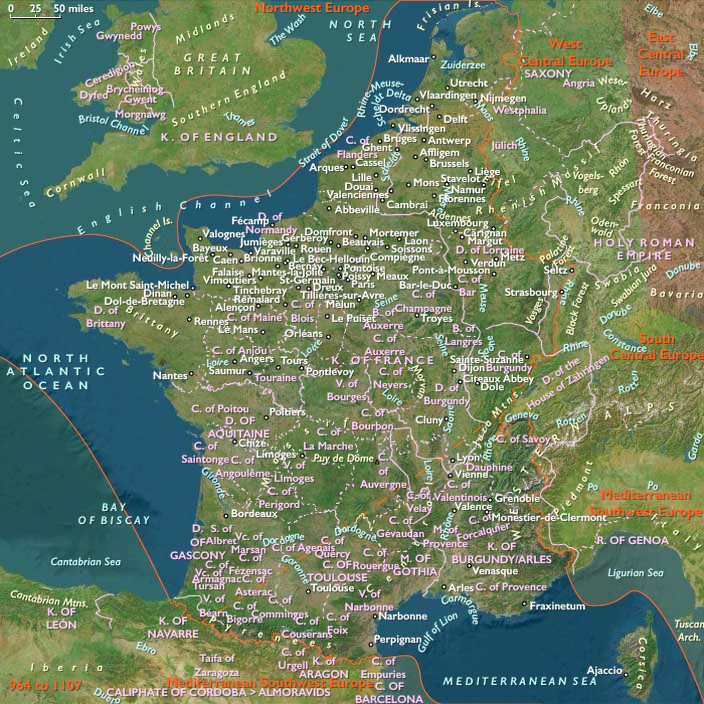
Subregions
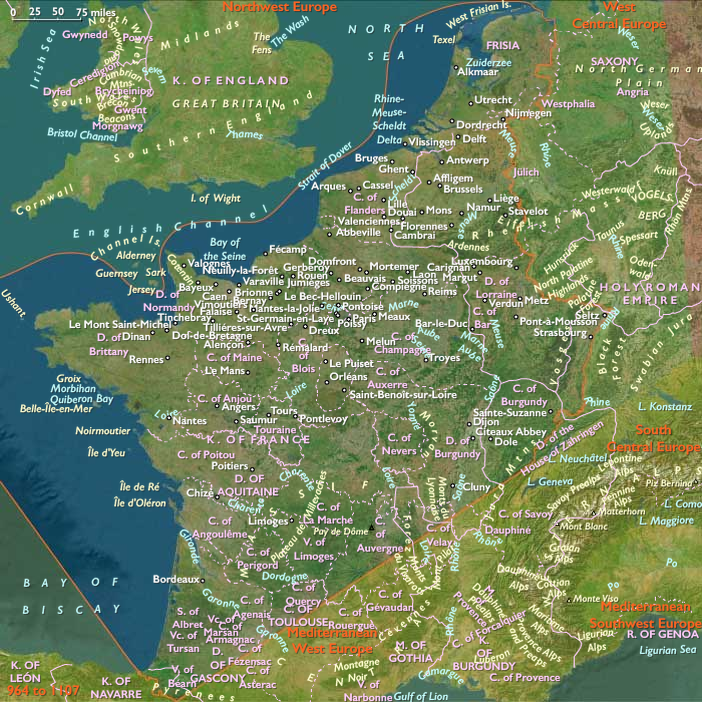
Years: 1036 - 1047
People
- Alan III of Brittany
- Conan II
- Henry I of France
- Odilo of Cluny
- Reginald I
- Robert I, Duke of Normandy
- Robert II of France
- William VII, Duke of Aquitaine
- William the Conqueror
Groups
- Aquitaine, (Carolingian) Kingdom of
- Flanders, County of
- Normandy, Duchy of
- England, (Anglo-Saxon) Kingdom of
- Brittanny, Duchy of
- Burgundy, County of
- Aquitaine, (Angevin) Duchy of
- France, (Capetian) Kingdom of
- Burgundy, Duchy of
Commodoties
Subjects
Regions
Subregions