
Atlantic West Europe (1012–1023): Burgundy's Fate and …
Years: 1012 - 1023
Atlantic West Europe (1012–1023): Burgundy's Fate and the Capetian Settlement
Between 1012 and 1023, Atlantic West Europe witnessed the resolution of the Burgundian succession crisis, consolidating French influence in the region while definitively preventing the creation of a unified Burgundian state under imperial influence.
Political and Military Developments
-
Resolution of the Burgundian Conflict (1015)
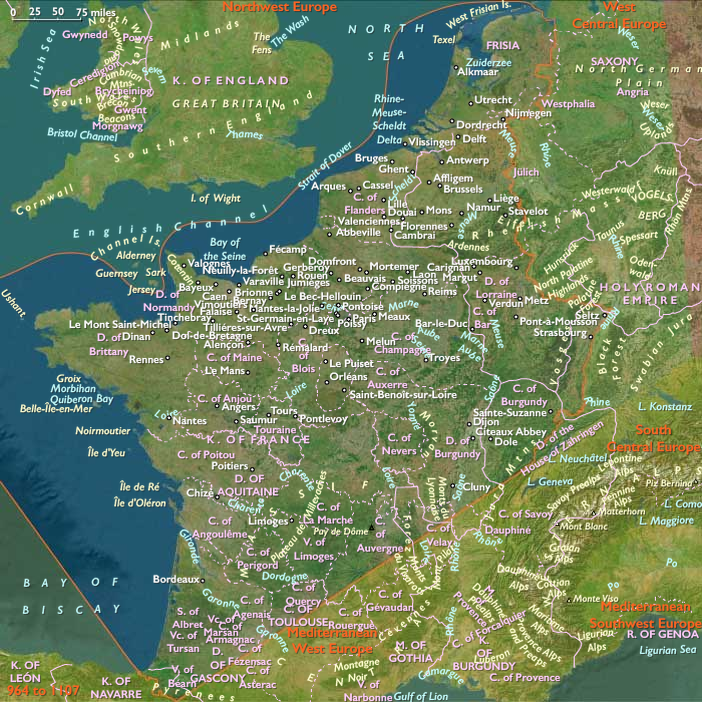
After thirteen years of protracted and destructive warfare, Robert the Pious emerged victorious, securing the Duchy of Burgundy firmly within the Kingdom of France.- The territories west of the Saône, including the strategic city of Dijon, came under definitive Capetian control.
- Otto-William, retaining only the County of Burgundy (Franche-Comté) east of the Saône, saw his ambitions to unify the two Burgundies dashed, ensuring that the duchy would remain French and the county influenced more by the Holy Roman Empire.
-
Capetian Territorial Redistribution (1016–1032)
Initially, Robert the Pious incorporated the duchy directly into the French royal domain. However, acknowledging practical administrative challenges and family politics, Robert granted the territory to his younger son and namesake, Robert, around 1016.- The arrangement became definitive in 1032 under King Henry I (r. 1031–1060), formally recognizing his brother Robert as Duke of Burgundy, allowing the duchy to be passed down within the Capetian lineage while owing feudal allegiance to the French crown.
-
Normandy and Brittany
Duke Richard II continued his stable rule in Normandy, strengthening ties with England and Scandinavia. Brittany maintained internal stability under Geoffrey I (r. 992–1008) and Alan III (r. 1008–1040), emphasizing regional autonomy amid surrounding tensions.
Economic and Social Developments
- Trade and Urban Development
Despite regional conflict, urban economies—especially Dijon, Auxerre, Tours, and Orléans—continued to grow as agricultural surpluses expanded markets.
Religious and Cultural Developments
- Growth of Cluniac Influence
The Cluniac movement continued its spiritual and cultural expansion, profoundly influencing monastic life, church reform, and European spirituality from its Burgundian heartland.
People
- Alan III of Brittany
- Henry I of France
- Otto-William
- Richard II, Duke of Normandy
- Robert I of Burgundy
Groups
- Flanders, County of
- Normandy, Duchy of
- England, (Anglo-Saxon) Kingdom of
- Brittanny, Duchy of
- Burgundy, County of
- Aquitaine, (Angevin) Duchy of
- France, (Capetian) Kingdom of
Topics
Commodoties
Subjects
Regions

Subregions
Years: 1012 - 1023
People
- Alan III of Brittany
- Henry I of France
- Otto-William
- Richard II, Duke of Normandy
- Robert I of Burgundy
Groups
- Flanders, County of
- Normandy, Duchy of
- England, (Anglo-Saxon) Kingdom of
- Brittanny, Duchy of
- Burgundy, County of
- Aquitaine, (Angevin) Duchy of
- France, (Capetian) Kingdom of
Topics
Commodoties
Subjects
Regions
Subregions