
Atlantic Southwest Europe (844–855 CE): Ramiro I's …
Years: 844 - 855
Atlantic Southwest Europe (844–855 CE): Ramiro I's Stabilization, Viking Raids, and Emergence of the Basques
Between 844 and 855 CE, Atlantic Southwest Europe—encompassing Galicia, northern and central Portugal, Asturias, Cantabria, and northern Spain south of the Franco-Spanish border (43.05548° N, 1.22924° W)—underwent significant challenges and transitions. The Asturian kingdom, under King Ramiro I (842–850 CE) and his successor Ordoño I (850–866 CE), solidified its political and territorial foundations despite external pressures from Viking raiders and Islamic incursions. This era also marks the clearer emergence of the Basques, evolving from the earlier Roman-era Vascones, who began consolidating a distinctly medieval Basque identity around the nascent Kingdom of Pamplona.
Political and Military Developments
Stabilization under Ramiro I and Succession of Ordoño I
King Ramiro I effectively solidified internal unity and reinforced royal authority, successfully suppressing internal aristocratic revolts and maintaining stable regional alliances. His reign marked increased centralization and effective border defenses, particularly against raids from Islamic al-Andalus.
Upon Ramiro’s death in 850 CE, his son Ordoño I smoothly assumed power, swiftly consolidating authority, expanding Asturian influence into the frontier buffer region along the Duero, and further strengthening defenses against external threats.
Viking Incursions and Regional Defense (844 CE)
This period witnessed the unprecedented threat of Viking raids. In 844 CE, a Viking fleet attacked coastal settlements, notably sacking and briefly occupying coastal towns such as Bracara Augusta (Braga) and areas along northern Portugal and Galicia. These raids tested regional resilience, prompting Asturian rulers to improve coastal and river defenses and fortify inland settlements.
Emergence of the Basque Identity and Kingdom of Pamplona
During this era, the historical Vascones, traditionally independent and politically neutral, clearly transitioned toward a recognizable medieval Basque identity. Around 824 CE, the establishment of the Kingdom of Pamplona began, but it was in the mid-9th century—particularly between 844 and 855 CE—that Basque political identity fully solidified. The Basques now actively participated as independent political actors in broader Iberian dynamics, decisively shaping their historical trajectory.
Economic Developments
Resilient Regional Economies Amid External Threats
Despite Viking disruptions, regional economies remained resilient, with villa-based agricultural production (grain, olives, vineyards), livestock husbandry, artisanal manufacturing, and mining (particularly silver and gold extraction in Galicia and Asturias) continuing robustly. Economic activity rebounded quickly after disruptions, demonstrating the region’s underlying stability.
Continued Maritime and Regional Trade Recovery
Although maritime commerce temporarily suffered due to Viking incursions, towns like Braga and smaller ports along Galicia and northern Portugal swiftly resumed trade activities. These commercial networks proved resilient, maintaining critical economic links to broader Atlantic and Mediterranean markets.
Cultural and Religious Developments
Sustained Growth of Santiago de Compostela
Despite regional disruptions, Santiago de Compostela maintained its significance as a major pilgrimage center, drawing increasing numbers of pilgrims. The town’s growing religious prestige continued to profoundly shape regional identity, cultural unity, and economic prosperity, further embedding Santiago’s pilgrimage into the medieval fabric of northern Iberia.
Enhanced Ecclesiastical Authority and Social Cohesion
Bishoprics—especially Braga, Lugo, Asturica Augusta, and Santiago de Compostela—remained pivotal institutions, effectively responding to regional crises by providing moral authority, community organization, and welfare services. Their active role bolstered community cohesion, strengthened regional stability, and deepened orthodox Christianity’s social influence.
Monastic Vitality and Cultural Preservation
Monasteries continued to thrive despite external pressures, serving as centers of learning, manuscript preservation, education, agricultural innovation, and social welfare. Their resilience significantly contributed to maintaining cultural continuity and regional identity amid external threats.
Enduring Cultural Syncretism
The integration of orthodox Christianity with indigenous Celtic and Iberian traditions persisted robustly, especially in rural Galicia, Asturias, and northern Portugal. These traditions continued to reinforce regional identity and unity, providing resilience against disruptions.
Civic Identity and Governance
Consolidated Royal and Ecclesiastical Structures
Under Ramiro I and Ordoño I, Asturian governance solidified further, clearly integrating royal and ecclesiastical authority. Civic identity remained centered on the Asturian monarchy, regional bishoprics, and pilgrimage traditions of Santiago de Compostela, reinforcing Asturias as the symbolic heartland of Christian resistance in Iberia.
Basque Identity Formation
Simultaneously, the Basques emerged decisively as a distinct people, transitioning from the earlier Vascones and actively forming their own governance structures under the early Kingdom of Pamplona. Their clearer political identity significantly influenced broader regional dynamics from this era onward.
Notable Tribal Groups and Settlements
-
Astures and Cantabri: Continued to provide political stability, military strength, and core identity to the Asturian kingdom.
-
Galicians and Lusitanians: Retained resilient local governance, economic prosperity, and cultural autonomy, pragmatically cooperating with Asturian royal authority.
-
Basques (formerly Vascones): Now emerged explicitly as the Basque people, clearly defined by a distinct cultural, linguistic (Euskara), and political identity centered around Pamplona.
Long-Term Significance and Legacy
Between 844 and 855 CE, Atlantic Southwest Europe:
-
Maintained political stability and successfully adapted to new external threats, particularly Viking incursions, reinforcing regional resilience and defensive capabilities.
-
Witnessed the emergence of the Basques as distinct political and cultural actors, significantly shaping subsequent regional history.
-
Further entrenched Santiago de Compostela’s role as a major pilgrimage destination, significantly shaping medieval Iberian cultural and religious identity.
This pivotal era reinforced the political, cultural, and economic foundations of Atlantic Southwest Europe, significantly influencing its subsequent medieval historical trajectory.
People
Groups
- Polytheism (“paganism”)
- Vascones
- Lusitanians, or Lusitani
- Gallaeci
- Astures (Celtic tribe)
- Cantabri (Celtic tribe)
- Moors
- Christianity, Chalcedonian
- Islam
- al-Andalus (Andalusia), Muslim-ruled
- Asturias, Kingdom of
- Córdoba, Umayyad Emirate of
- Navarre, Kingdom of
- Abbasid Caliphate (Samarra)
- Basque people
Topics
Commodoties
- Fish and game
- Weapons
- Oils, gums, resins, and waxes
- Grains and produce
- Fibers
- Textiles
- Ceramics
- Strategic metals
- Salt
- Beer, wine, and spirits
- Lumber
Subjects
- Commerce
- Architecture
- Engineering
- Labor and Service
- Conflict
- Mayhem
- Faith
- Government
- Scholarship
- Custom and Law
- Technology
- religious movement
Regions
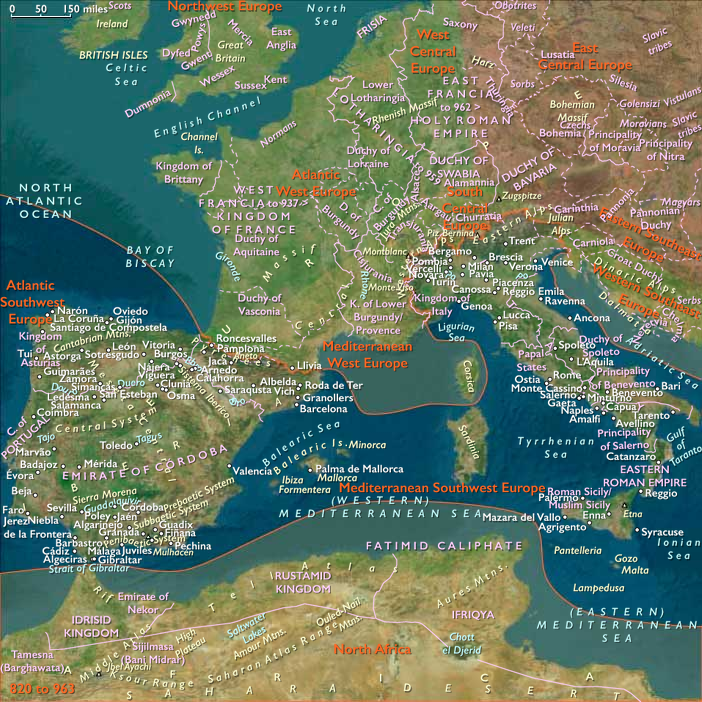
Subregions
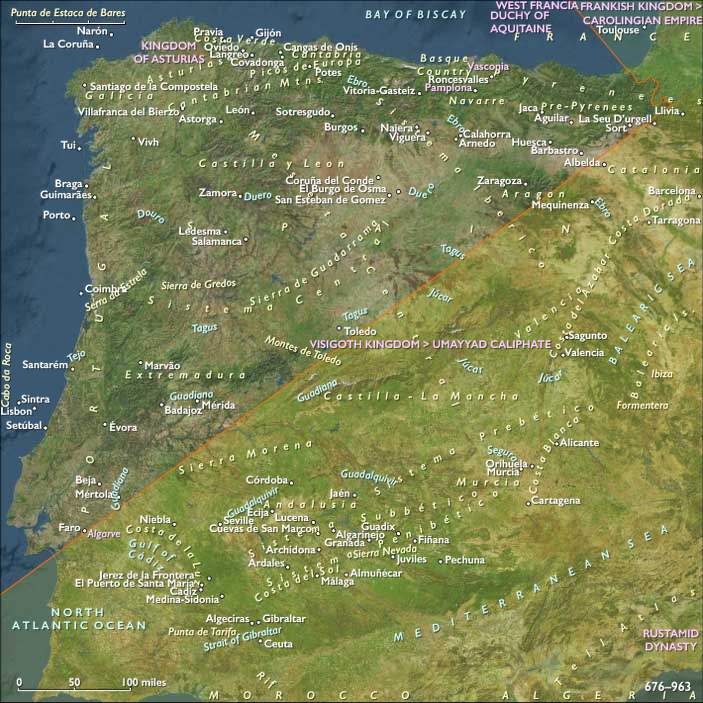
Years: 844 - 855
People
Groups
- Polytheism (“paganism”)
- Vascones
- Lusitanians, or Lusitani
- Gallaeci
- Astures (Celtic tribe)
- Cantabri (Celtic tribe)
- Moors
- Christianity, Chalcedonian
- Islam
- al-Andalus (Andalusia), Muslim-ruled
- Asturias, Kingdom of
- Córdoba, Umayyad Emirate of
- Navarre, Kingdom of
- Abbasid Caliphate (Samarra)
- Basque people
Topics
Commodoties
- Fish and game
- Weapons
- Oils, gums, resins, and waxes
- Grains and produce
- Fibers
- Textiles
- Ceramics
- Strategic metals
- Salt
- Beer, wine, and spirits
- Lumber
Subjects
- Commerce
- Architecture
- Engineering
- Labor and Service
- Conflict
- Mayhem
- Faith
- Government
- Scholarship
- Custom and Law
- Technology
- religious movement
Regions
Subregions