
Atlantic Southwest Europe (796–807 CE): Consolidation of …
Years: 796 - 807
Atlantic Southwest Europe (796–807 CE): Consolidation of Asturian Kingship and Cultural Flourishing under Alfonso II
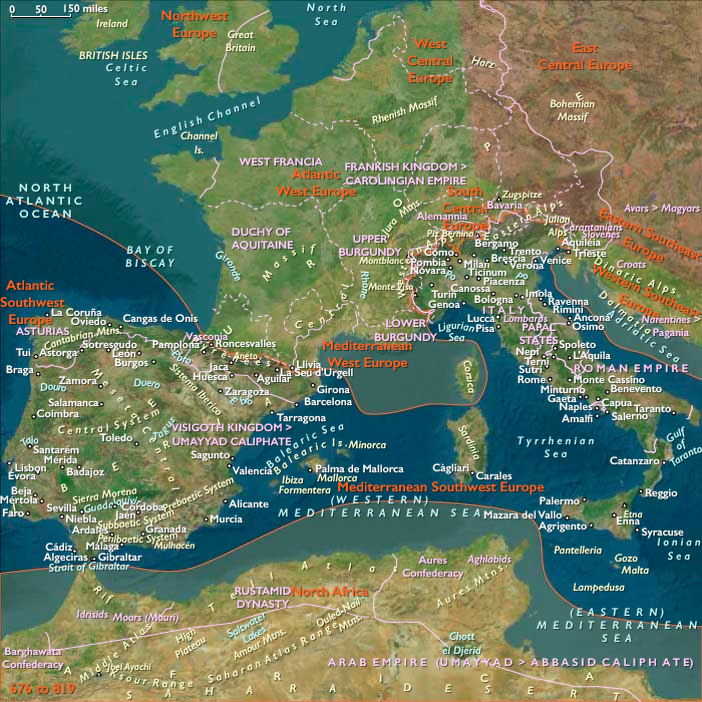
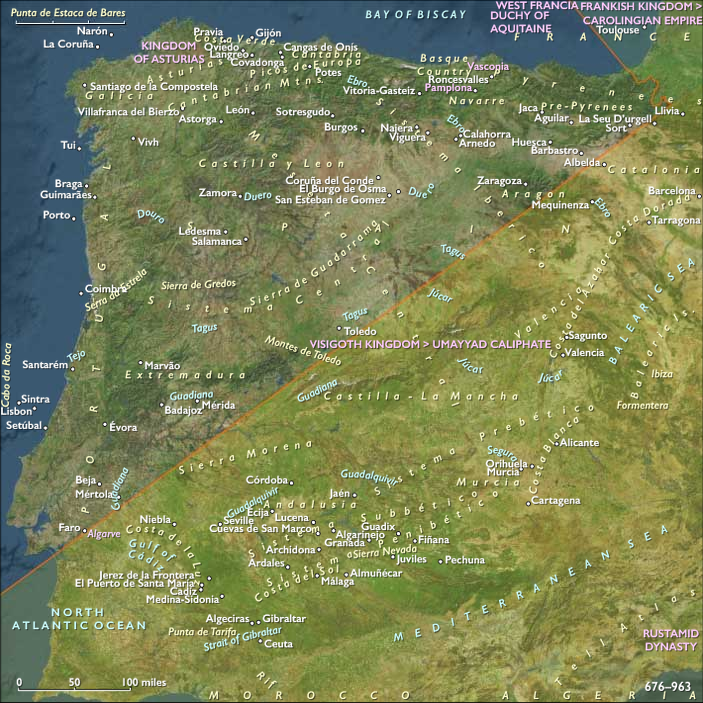
Between 796 and 807 CE, Atlantic Southwest Europe—covering Galicia, northern and central Portugal, Asturias, Cantabria, and northern Spain south of the Franco-Spanish border (43.05548° N, 1.22924° W)—experienced significant political consolidation and cultural flourishing under the reign of King Alfonso II ("the Chaste," 791–842 CE). This era marked a decisive strengthening of centralized Asturian governance, economic resilience, enhanced ecclesiastical leadership, and notable cultural developments, firmly establishing Asturias as the cornerstone of Iberian Christian identity and resistance against Islamic al-Andalus.
Political and Military Developments
Centralization under Alfonso II
King Alfonso II, after stabilizing initial dynastic tensions, embarked on a sustained campaign of territorial consolidation and political centralization. His reign emphasized strengthening royal authority, reinforcing strategic fortifications, and actively supporting regional aristocrats and ecclesiastical leaders, significantly enhancing internal unity and defensive capabilities.
Strategic Diplomacy and Military Security
Alfonso carefully balanced diplomatic engagement with the neighboring Vascones, Galician aristocrats, and local tribal leaders, securing regional alliances and effectively containing Islamic pressures from al-Andalus. By solidifying defensive boundaries and promoting frontier settlements, Alfonso’s strategies provided lasting security and territorial integrity.
Economic Developments
Economic Prosperity and Growth
Under Alfonso’s stable governance, regional economies expanded steadily. Rural estates (villae) thrived, focusing on grain cultivation, vineyards, olive groves, livestock husbandry, and artisanal production (pottery, textiles, metalwork). Mining, particularly of gold and silver in Galicia and Asturias, significantly bolstered the kingdom’s wealth and regional prosperity.
Renewed Maritime and Regional Trade
Coastal towns, including Bracara Augusta (Braga) and ports along Galicia and northern Portugal, sustained consistent maritime commerce, strengthening economic connectivity with broader Atlantic and Mediterranean networks. Although still modest, this trade provided vital economic continuity and growth.
Cultural and Religious Developments
Expansion and Influence of Ecclesiastical Institutions
Influential bishoprics—especially those of Braga, Lugo, Iria Flavia, and Asturica Augusta—expanded their civic authority, playing critical roles in governance, education, and community welfare. Bishops and clergy provided strong moral leadership and administrative guidance, embedding orthodox Christianity deeply into regional life.
Monastic Flourishing and Cultural Renaissance
Monastic communities saw a notable expansion during Alfonso II’s reign, serving as key centers of manuscript production, scholarship, education, agricultural innovation, and social welfare. These monasteries fostered a cultural renaissance, significantly enhancing regional identity and preserving historical memory.
Discovery of the Tomb of Saint James (Santiago de Compostela)
Around the early 9th century, tradition records the discovery of the reputed tomb of the Apostle Saint James in Galicia, near Iria Flavia. This discovery profoundly reshaped regional religious identity, soon transforming Santiago de Compostela into a major pilgrimage site and spiritual center, further solidifying Christian cultural unity across Atlantic Southwest Europe.
Enduring Cultural Syncretism
The longstanding synthesis of orthodox Christianity with indigenous Celtic and Iberian traditions continued robustly, especially in rural Galicia, Asturias, and northern Portugal. This cultural continuity provided significant regional cohesion and reinforced a distinctive Iberian Christian identity.
Civic Identity and Governance
Further Centralization of Asturian Governance
Under Alfonso II, governance structures became firmly centralized, emphasizing royal authority and ecclesiastical leadership, though preserving substantial regional autonomy. Civic identities were increasingly defined by allegiance to the Asturian monarchy and orthodox Christianity, solidifying Asturias as the heart of Iberian Christian resistance.
Notable Tribal Groups and Settlements
-
Astures and Cantabri: Continued providing military and political leadership, decisively shaping the kingdom’s core identity and strength.
-
Galicians and Lusitanians: Maintained effective local governance, economic prosperity, and cultural autonomy, pragmatically supporting Asturian authority.
-
Vascones: Maintained traditional neutrality, territorial independence, and cultural distinctiveness, remaining largely insulated from broader Iberian conflicts but actively engaging diplomatically with Asturias.
Long-Term Significance and Legacy
Between 796 and 807 CE, Atlantic Southwest Europe:
-
Achieved political consolidation and territorial stability under Alfonso II, reinforcing the Asturian kingdom’s central role in medieval Iberian politics.
-
Experienced economic growth, ecclesiastical expansion, and cultural flourishing, significantly shaping regional identity and historical continuity.
-
Initiated the transformative cult of Saint James in Santiago de Compostela, establishing enduring religious and cultural traditions that decisively influenced Iberian medieval history.
This era firmly established the Asturian kingdom’s political, economic, and cultural foundations, marking a critical turning point that profoundly influenced Atlantic Southwest Europe’s medieval trajectory.
People
Groups
- Polytheism (“paganism”)
- Vascones
- Lusitanians, or Lusitani
- Gallaeci
- Cantabri (Celtic tribe)
- Astures (Celtic tribe)
- Moors
- Christianity, Chalcedonian
- Islam
- al-Andalus (Andalusia), Muslim-ruled
- Asturias, Kingdom of
- Córdoba, Umayyad Emirate of
- Abbasid Caliphate (Baghdad)
Topics
Commodoties
- Fish and game
- Weapons
- Oils, gums, resins, and waxes
- Grains and produce
- Fibers
- Textiles
- Ceramics
- Strategic metals
- Salt
- Beer, wine, and spirits
- Lumber
Subjects
- Commerce
- Architecture
- Engineering
- Labor and Service
- Conflict
- Mayhem
- Faith
- Government
- Scholarship
- Custom and Law
- Technology
- religious movement
Regions
Subregions
Related Events
Showing 10 events out of 54939 total
Years: 796 - 807
People
Groups
- Polytheism (“paganism”)
- Vascones
- Lusitanians, or Lusitani
- Gallaeci
- Cantabri (Celtic tribe)
- Astures (Celtic tribe)
- Moors
- Christianity, Chalcedonian
- Islam
- al-Andalus (Andalusia), Muslim-ruled
- Asturias, Kingdom of
- Córdoba, Umayyad Emirate of
- Abbasid Caliphate (Baghdad)
Topics
Commodoties
- Fish and game
- Weapons
- Oils, gums, resins, and waxes
- Grains and produce
- Fibers
- Textiles
- Ceramics
- Strategic metals
- Salt
- Beer, wine, and spirits
- Lumber
Subjects
- Commerce
- Architecture
- Engineering
- Labor and Service
- Conflict
- Mayhem
- Faith
- Government
- Scholarship
- Custom and Law
- Technology
- religious movement
Regions
Subregions